



الصفحة 12
الصفحة 12

Handbook of the Sociology of Emotions
This book is designed to bring the reader up to date on the theory and research traditions that have proliferated in the analysis of human emotions. Key figures who have carried the sociology of emotions to its current level of prominence review their own work and the work of others who have made contributions to a particular approach to the study of emotions. The outcome is a comprehensive book that serves as a primer on the cutting edge of sociological work in what is obviously a key dynamic in human affairs.
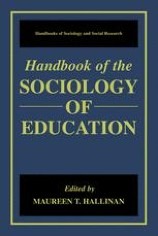
Handbook of the Sociology of Education
The Handbook of the Sociology of Education provides a comprehensive overview of the field of education from a sociological perspective. Experts in this area present theoretical and empirical research on major educational issues and analyze the social processes that govern schooling, as well as the role of schools in and their impact on contemporary society. The book is a major reference work for social scientists, graduate students, and educators who want an overview of the field.

Handbook of Technical and Vocational Education and Training Research
This handbook provides a comprehensive coverage of TVET research in an international context, and, with special focus on research and research methods, it is a cutting-edge resource and reference.Various areas of TVET research are covered, including on the vocational disciplines and on TVET systems. Case studies illustrate different approaches to TVET research, and the final section of the book presents research methods, including interview and observation methods, as well as of experimentation and development.

Handbook of Teacher Education : Globalization, Standards and Professionalism in Times of Change
This book provides an international review of the current state of teacher education, with chapters from an international group of teacher educators. It focuses on major issues that are confronting teacher educators now and in the next decade. These include the impact of globalization on the profession of teaching, and how teacher education must deal with changing accountability requirements from governments and establish a set of minimum standards acceptable to enable a person to teach.

Handbook of Spatial Logics
The aim of this handbook is to create, for the first time, a systematic account of the field of spatial logic. The book comprises a general introduction, followed by fourteen chapters by invited authors. Each chapter provides a self-contained overview of its topic, describing the principal results obtained to date, explaining the methods used to obtain them, and listing the most important open problems. Jointly, these contributions constitute a comprehensive survey of this rapidly expanding subject.

Handbook of Social Psychology
Social Psychology is an important interdisciplinary field within Sociology. Psychology, focusing on processes that occur inside the individual and Sociology, focusing on social collectives and social institutions, come together in social psychology to explore the interface between the two fields. Social Psychology is the study of how both intra-individual factors and social interaction influence and are influenced by individual behavior.

Handbook of Social Movements Across Disciplines
Researchers and students from divergent academic disciplines share an interest in the study of social movements and collective action. Through a variety of disciplinary approaches and techniques, researchers seek to understand the emergence and development of collective action. In the last few decades, the field of social-movements-studies has proliferated enormously, covering a wide array of movements, issues and places. With this growth, social movement scholars have criticized the traditional vision of collective mobilization as the results of irrational behavior and have instead developed a range of new approaches. The expansion of the field has also led to increased theoretical debates and attempts to synthesize the different perspectives. With this in mind, this seminal volume revisits the disciplinary roots of social movement studies. Each discipline raises its own questions and approaches the subject from a different perspective. This volume combines these divergent perspectives into one cohesive, comprehensive work.

Handbook of Religion and Social Institutions
The Handbook of Religion and Social Institutions presents a comprehensive, up to date overview of the intersection of religion with major social institutions. Rather than being narrowly pitched to sociologists of religion, the major audience for the book is social scientists who are interested in identifying and understanding what is known about ways in which religion relates to the specific institution which they are teaching and/or in which they are conducting research. Each chapter will review studies that explore ways in which religion intersects with one specific institution.

Handbook of quantitative science and technology research : The use of publication and patent statistics in studies of S&T systems
This handbook offers a state-of-the-art overview of quantitative science and technology research. It focuses on the development and application of indicators derived from data on scientific or scholarly publications and patents. It comprises 34 chapters written by leading specialists in the various sub-domains. These chapters deal with theoretical and methodological issues, illustrate applications, and highlight their policy context and relevance. Authors present a survey of the research topics they address, and show their most recent achievements.

Handbook of Population
The Handbook of Population is organized for classroom as well as reference use. It is divided into four sections – Population Structure, Population Processes, Population and the Social Sciences, and Applied Demography – and includes both an Introduction and an Epilogue by the editors. Part I, Population Structure, contains chapters on population size and growth, age and sex composition, marriage and family structure, and demographic analyses of gender, aging, race and ethnicity, and the labor force. Part II is focused on population processes, and includes chapters on fertility, infant and adult mortality, internal and international migration, and the demography of social stratification. Part III reflects the growing multidisciplinary nature of demography. Finally, Part IV recognizes the varied practical applications of demographic perspectives and data to national and global issues and problems.

Handbook of philosophical logic ; Vol.13 ; 2nd ed.
in this book achapter on non-monotoniclogic a chapter on combinatory logic and calculus We feltat the time(1979)that non-monotonic logic was not ready fora chapter yet and that combinatory logic and calculus was toofar re-moved.1Non-monotonic logic is now a very major area of philosophi-cal logic, alongside default logics, labelled deductive systems,fibring log-ics, multi-dimensional,multi modal and substructur allogics. Intensive re-examinations offragments of classical logic have produced fresh insights,includingat time decision procedures and equivalence with non-classical systems

Handbook of philosophical logic ; Vol. 14
I would like to take this opportunity to put forward my current views about logic in computer science, computational linguistics and arti?cial intelligence. In the early 1980s the perception of the role of logic in computer science was that of a speci?cation and reasoning tool and that of a basis for possibly neat computer languages. The computer scientist was manipulating data structures and the use of logic was one of his options.

Handbook of philosophical logic : Vol.12
The first edition of the Handbook of Philosophical Logic (four volumes) was published in the period 1983-1989 and has proven to be an invaluable reference work to both students and researchers in formal philosophy, language and logic. The second edition of the Handbook is intended to comprise some 18 volumes and will provide a very up-to-date authoritative, in-depth coverage of all major topics in philosophical logic and its applications in many cutting-edge fields relating to computer science, language, argumentation, etc. The volumes will no longer be as topic-oriented as with the first edition because of the way the subject has evolved over the last 15 years or so. However the volumes will follow some natural groupings of chapters. Audience: Students and researchers whose work or interests involve philosophical logic and its applications

Handbook of employment discrimination research : Rights and realities
This volume contains acollection of original papersbyleadinglegal scholars and social scientists that develop new perspectivesonanti-discriminationlaw, with anemphasison employment discrimination. The volume is introduced by three papers that broadly an-alyze anti-discriminationlaw andits relationshiptoexisting socialscience. we write as lawyer-sociologists attemptingto advance a socio-legalunderstanding of employment discrimination law. We examine the debate amongcom-petingconceptions of the anti-discrimination law which argue that the law has becometoo expansive, is too weak, or is too reliant on litigation. After review in gdoctrinal developments in the law and trends in claiming behavior before the EEOC and the federal courts through the 1990s to present, we apply the concept of the pyramid ofdisputes to discrimination claims to assess the ongoingdebate. Although the analysis demonstrates that there are significant gaps in our knowledge of how employment dis-crimination claims arise and are dealt with, it also suggests that the current system isdramatically under-inclusive of potentialclaimants.

Handbook of employment discrimination research : Rights and realities
this book includes original contributions from many of the legal scholars, economists, psychologists, sociologists, political scientists, and historians who are at the forefront of new research on discrimination and law. The Handbook of Employment Discrimination Research encompasses critical discussions across different social science disciplines, as well as between legal scholars and social scientists. As a collection, it suggests a broad reconsideration of employment discrimination and its treatment in law.

Handbook of Economic Sociology for the 21st Century : New Theoretical Approaches, Empirical Studies and Developments
This handbook provides an overview on major developments that occurred in the field of economic sociology after its rebirth since the 1980s in the US. It offers new insights on the uniqueness of European economic sociology compared to US economic sociology which emerged at the end of the 20th century. The handbook presents economic sociology as a developing field which started with certain foundations as new economic sociology, widening the perspective by introducing social factors thereby focusing more on general belief systems, social forms of coordination and the relationships between society and the economy. It offers an outstanding portrait of the research field helping to identify major foundations and trajectories as well as new research perspectives for a globalized economic sociology.

Handbook of Drug Abuse Prevention
This wide-ranging handbook brings together experts in the sociology of drug abuse prevention. Providing a comprehensive overview of the accumulated knowledge on prevention theory, intervention design, and development and prevention research methodology, this work also promotes prevention science as an evolving field in the practice and policy of drug abuse prevention.Included are sections on Theoretical and Empirical Foundations, Social Contexts of Prevention, Prevention as Social Control, Special Populations, Research Design and a Look at the Future.

Handbook of Disaster Research
"The Handbook of Disaster Research will generate considerable excitement amongst international disaster research and management professionals. Finally, a volume that takes on the task of articulating and unpacking the many social complexities of modern disasters and catastrophes. By taking a multi-disciplinary perspective, the Handbook addresses the very pressing need to better understand the social dimensions of disaster. ... offers a very balanced set of analyses that will undoubtedly appeal to not only the researcher, but the practitioner and the policy-maker alike."

Handbook of Digital and Mutlimedia Evidence
Handbook of Digital and Multimedia Forensic Evidence presents an overview of computer forensics perfect for beginners. This volume will serve as a foundation and guide for: (a) students considering a career in this field; (b) the law enforcement investigator assigned to work cybercrimes; (c) establishing training programs for forensic examiners; (d) the IT professional; (e) the veteran forensic examiner; (f) the prosecutor faced with litigating cybercrime cases brought before a trier of fact. A distinguished group of specialist authors have crafted chapters rich with detail yet accessible for readers who are not experts in the field. Tying together topics as diverse as applicable laws on search and seizure, investigating cybercrime, and preparation for courtroom tesitmony, Handbook of Digital and Multimedia Forensic Evidence is the ideal overall reference for this multi-faceted discipline.

Guideline for Salinity Assessment, Mitigation and Adaptation Using Nuclear and Related Techniques
Develop protocols for salinity and sodicity assessment and develop mitigation and adaptation measures to use saline and sodic soils sustainably. The focus is on important issues related to salinity and sodicity and to describe these in an easy and user friendly way. The information has been compiled from the latest published literature and from the authors’ publications specific to the subject matter.
