



الصفحة 12
الصفحة 12

Fare astronomia con piccoli telescopi = Are astronomy with small telescopes
Giant tools are not necessarily required to produce scientifically valid results in the field of astronomy. Even the amateur with a small telescope, with a diameter of only 8-9 cm, can contribute to the science of the sky by making useful observations of the Sun, the Moon, planets, comets, asteroids, double or variable stars, nebulae and star clusters. The manual of M.K. Gainer explains what the minimum equipment is (a small telescope, a computer, a simple digital camera), how to use it, and what are the appropriate techniques to be adopted in the observations. It also offers schemes for interpreting and reducing the collected data, as well as forms to be filled in and sent to international collection centers.

Factories of the Future : The Italian Flagship Initiative
This book presents results relevant in the manufacturing research field, that are mainly aimed at closing the gap between the academic investigation and the industrial application, in collaboration with manufacturing companies. Several hardware and software prototypes represent the key outcome of the scientific contributions that can be grouped into five main areas, representing different perspectives of the factory domain

Extremes in Nature : An Approach Using Copulas
The study of the statistics of extreme events is an essential first step in the mitigation of natural catastrophies, that often cause severe economic losses worldwide. This book is about the theoretical and practical aspects of the statistics of Extreme Events in Nature. Most importantly, this is the first text in which Copulas are introduced and used in Geophysics. Several topics are fully original, and show how standard models and calculations can be improved by exploiting the opportunities offered by Copulas. In addition, new quantities useful for design and risk assessment are introduced. Practicioners in all research areas of Geosciences and extreme events (including Finance and Insurance, closely related to natural disasters) will definitely benefit from the new Copula-approach outlined in the book.

Evolvable systems : From biology to hardware ; 8th International Conference, ICES 2008, Prague, Czech Republic, September 21-24, 2008. Proceedings
This book constitutes the refereed proceedings of the 8th International Conference on Evolvable Systems, ICES 2008, held in Prague, Czech Republic, in September 2008.The 28 revised full papers and 14 revised poster papers presented were carefully reviewed and selected from 52 submissions. The papers are organized in topical sections on evolution of analog circuits, evolution of digital circuits, hardware-software codesign and platforms for adaptive systems, evolutionary robotics, development, real-world applications, evolutionary networking, evolvable artificial neural networks, and transistor-level circuit evolution.

Evolvable systems : From biology to hardware ; 7th International Conference, ICES 2007, Wuhan, China, September 21-23, 2007, Proceedings
The 41 revised full papers collected in this volume are organized in topical sections on digital hardware evolution, analog hardware evolution, bio-inspired systems, mechanical hardware evolution, evolutionary design, evolutionary algorithms in hardware design, and hardware implementation of evolutionary algorithms.

Evolvable Hardware
The contributions in this book provide the basics of reconfigurable devices so that readers will be fully prepared to understand what EHW is, why it is necessary and how it is designed. The book also discusses the leading research in digital, analog and mechanical EHW. Selections from leading international researchers offer examples of cutting-edge research and applications, placing particular emphasis on their practical usefulness.

Evaluating Information Retrieval and Access Tasks : NTCIR's Legacy of Research Impact
This open access book summarizes the first two decades of the NII Testbeds and Community for Information access Research (NTCIR). NTCIR is a series of evaluation forums run by a global team of researchers and hosted by the National Institute of Informatics (NII), Japan. The book is unique in that it discusses not just what was done at NTCIR, but also how it was done and the impact it has achieved. For example, in some chapters the reader sees the early seeds of what eventually grew to be the search engines that provide access to content on the World Wide Web, today’s smartphones that can tailor what they show to the needs of their owners, and the smart speakers that enrich our lives at home and on the move. We also get glimpses into how new search engines can be built for mathematical formulae, or for the digital record of a lived human life.

European Higher Education Area : Challenges for a New Decade
This book highlights the major outcomes of the fourth edition of the Future of Higher Education – Bologna Process Researchers Conference (January 2020), which has already established itself as a landmark in the European higher education environment.

European E-Democracy in Practice
This book explores how digital tools and social media technologies can contribute to better participation and involvement of EU citizens in European politics. By analyzing selected representative e-participation projects at the local, national and European governmental levels, it identifies the preconditions, best practices and shortcomings of e-participation practices in connection with EU decision-making procedures and institutions

European capital markets law
Examines the underlying concepts from a broadly interdisciplinary perspective. The 3rd edition deals with 3 central developments: the project of the capital markets union; sustainable finance; and the further digitalisation of financial instruments and securities markets. Throughout the book emphasis is placed on legal practice, and frequent reference is made to the key decisions of supervisory authorities and courts

EU Digital Copyright Law and the End-User
This book is the first comprehensive exploration of the legal framework of EU digital copyright law from the perspective of the ‘end-user’. This multi-faceted actor of the digital environment is a consumer of copyrighted works, a file-sharer of these works on the Internet, and a possible follow-on creator, who builds upon pre-existing digitised materials. All of these activities raise significant issues for national, European and international legal systems.

Esthetic & restorative dentistry : Material selection & technique
Provides the most up-to-date information on enhanced developments, materials, and techniques that have emerged since the publication of the second edition, offering the reader a completely updated, revised, and newly illustrated overview of modern esthetic and restorative dentistry complete with tutorial videos. New topics include web-based communication with the laboratory, indirect composite chairside CAD/CAM restorations, a comparison of digital and conventional techniques, the resin composite injection technique, as well as updated information on composites and ceramic systems, including esthetic zirconia. New cases illustrate the maintenance of esthetic restorative materials, esthetic contouring, immediate dentin sealing, and novel surgical techniques such as lip repositioning, connective tissue grafting, and ridge preservation with collagen membranes.

Essentials of Computer Organization and Architecture
Addresses all necessary organization and architecture topics, but concise enough to be appropriate for a single-term course. Its focus on real-world examples and practical applications encourages students to develop a “big-picture” understanding of how essential organization and architecture concepts are applied in the computing world. In addition to direct correlation with the ACM/IEEE guidelines for computer organization and architecture, the text exposes readers to the inner workings of a modern digital computer through an integrated presentation of fundamental concepts and principles.

Essays on congruence theory in marketing : Special focus on digital products and webstores
Digital products are intangible goods, mainly presented visually and acoustically to consumers in the form of videos, images, texts, and music that can be bought, downloaded, or streamed via various web stores. Their consumption primarily fulfills hedonic needs. Before purchasing, a consumer's interaction with a digital product is always mediated by technology. Therefore, consumers cannot directly judge the quality through "touch and feel" experiences.

E-science : Open, social and virtual technology for research collaboration
This book shows the breadth and various facets of e-Science, while also illustrating their shared core. Changes in scientific work are driven by the shift to grid-based worlds, the use of information and communication systems, and the existential infrastructure, which includes global collaboration. In this context, the book addresses emerging issues such as open access, collaboration and virtual communities and highlights the diverse range of developments associated with e-Science. As such, it will be of interest to researchers and scholars in the fields of information technology and knowledge management.

Entrepreneurship : Digital transformation, education, opportunities and challenges ; Vol. 28
Digital transformation and artificial intelligence play an important role in entrepreneurship. this book adopts a multidisciplinary approach to entrepreneurship, exploring how entrepreneurial processes contribute to developing new products and services and innovative business models. recent shifts in business models focus on digital transformation and well-being. entrepreneurship is evolving with innovative approaches, and artificial intelligence is revolutionizing marketing strategies and market engagement. this volume presents a comprehensive overview of entrepreneurship, digital transformation, and entrepreneurial education.

Entertainment-Education Behind the Scenes : Case Studies for Theory and Practice
This book tracks the latest trends in the theory, research, and practice of entertainment-education, the field of communication that incorporates social change messaging into entertaining media. Sometimes called edutainment, social impact television, narrative persuasion, or cultural strategy, this approach to social and behavior change communication offers new opportunities including transmedia and digital formats
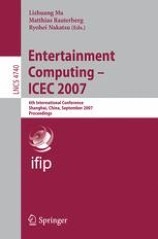
Entertainment computing – ICEC 2007 ; 6th International Conference, Shanghai, China, September 15-17, 2007, Proceedings
This book are organized in topical sections on augmented, virtual and mixed reality, computer games, image processing, mesh and modeling, digital storytelling and interactive systems, sound, music and creative environments, video processing, rendering, computer animation and networks, game based interfaces, as well as robots and cyber pets.

Entertainment computing - ICEC 2006 ; 5th International Conference, Cambridge, UK, September 20-22, 2006, Proceeding
ICEC 2006 attracted 47 full paper submissions, 48 short paper submissions in total 95 technical papers. Based on a thorough review and selection process by 85 international experts from academia and industry as members of the Program Committee, a high-quality program was compiled. The International Program Committee consisted of experts from all over the world As a result, 17 full papers and 17 short papers were accepted as submitted or with minor revisions. For the remaining submissions, 28 were recommended to change according to the reviews and were submitted as posters. This proceedings volume presents 62 technical contributions which are from many different countries.
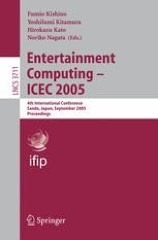
Entertainment Computing - ICEC 2005 ; 4th International Conference, Sanda, Japan, September 19-21, 2005, Proceedings
First of all, we appreciate the hard work of all the authors who contributed to ICEC 2005 by submitting their papers. ICEC 2005 attracted 95 technical paper submissions, 8 poster submissions and 7 demo submissions, in total 110. This number is nearly equal to ICEC 2004. Based on a thorough review and selection process carried out by 76 international experts from academia and industry as members of the senior and international program committees, a high-quality program was compiled. The program committee consisted of experts from all over the world: 1 from Austria, 3 from Bulgaria, 2 from Canada, 4 from China, 1 from Finland, 4 from France, 10 from Germany, 1 from Greece, 1 from Ireland, 1 from Israel, 1 from Italy, 26 from Japan, 1 from Korea, 4 from The Netherlands, 1 from New Zealand, 1 from Norway, 1 from Singapore, 1 from Thailand, 4 from the UK, and 8 from the USA. In this number, reviewers are included. The final decision was made at the senior program committee meeting based on three reviewers' feedback, available online via the conference management tool. Through earnest and fair discussion at the meeting, 25 technical papers were accepted as long papers and 32 technical papers were accepted as short papers from 95 submitted technical papers. Moreover, 3 poster papers and 5 demo papers were accepted.
