



الصفحة 112
الصفحة 112

Advances in cognitive neurodynamics ICCN 2007; Proceedings of the International conference on cognitive neurodynamics - 2007
Contains the Proceedings of the 1st International Conference on Cognitive Neurodynamics held in Shanghai, November 17-21, 2007. The participants were treated to an exciting and stimulating conference that left everyone with an enthusiastic vision for the future of the field. The latest important progress was covered by 13 mini-symposia including: Models of Mental Disorders; Cognitive Machines; Dynamics in learning and memory; Central nervous system synchronization; Neuroinformatics; Cognitive Computational Modeling of Human Language Processing; Cognitive Neurodynamics of Attention; Bottom-Up and Top-Down; Brain Networks; From Anatomy to Dynamics; Translational Cognitive Neuroimaging; K-sets; Theory and Applications; Advanced Signal Processing Techniques for Brain Data Analysis; Visual cortex: information processing and dynamics; Dynamics of Firing Patterns and Synchronization in Neuronal Systems.

Advances in civil engineering materials : Selected articles from the 6th International Conference on architecture and civil engineering (ICACE 2022), August 2022, Kuala Lumpur, Malaysia
Presents selected articles from the 6th International Conference on Architecture and Civil Engineering 2022 (ICACE 2022), held in Malaysia. Written by leading researchers and industry professionals, the papers highlight recent advances and addresses current issues in the fields of civil engineering and architecture.

Advances in Case-Based Reasoning ; 8th European Conference, ECCBR 2006, Fethiye, Turkey, September 4-7, 2006, Proceedings
This book constitutes the refereed proceedings of the 8th European Conference on Case-Based Reasoning, ECCBR 2004, held in Fethiye, Turkey in September 2006. The book presents 31 revised full papers and 5 revised application papers together with 2 invited papers and 2 abstracts of invited talks. The coverage represents snapshot of current current issues in case-based reasoning, ranging from theoretical and methodological issues to advanced applications in various fields.

Advances in Biometrics: Sensors, Algorithms and Systems
This book presents a comprehensive treatment of biometrics and offers coverage of the entire gamut of topics in the field, including data acquisition, pattern-matching algorithms, and issues that impact at the system level, such as standards, security, networks, and databases.

Advances in Biometrics ; International Conference, ICB 2007, Seoul, Korea, August 27-29, 2007, Proceedings
Biometrics technology continues to stride forward with its wider acceptance and its real need in various new security facets of modern society. From simply logging on to a laptop to crossing the border of a country, biometrics is being called upon to meet the growing challenges of identity management. This book presents a comprehensive treatment of biometrics and offers coverage of the entire gamut of topics in the field, including data acquisition, pattern-matching algorithms, and issues that impact at the system level, such as standards, security, networks, and databases. It has been organized under three sections: sensors, advances in biometric matching algorithms, and topics that deal with issues at the systems level.

Advances in artificial life ; 8th European Conference, ECAL 2005 , Canterbury, UK, September 5-9, 2005, Proceedings
The Artificial Life term appeared more than 20 years ago . Since then the area has developed dramatically, many researchersjoining enthusiastically and research groups sprouting everywhere.a conceptual track, where papers were judged on criteria like importance and/or novelty of the concepts proposed rather than the experimental / theoretical results, has been introduced this year. A conference on a theme as broad as Artificial Life is bound to be very di-verse, but a few tendencies emerged. First, fields like ‘Robotics and Autonomous Agents’ or ‘Evolutionary Computation’are still extremely active and keep onbringing a wealth of results to the A-Life community. Even there, however, new tendencies appear, like collective robotics, and more specifically self-assembling robotics, which represent now a large subsection. Second, new areas appear.‘Morphogenesis and Development’ which used to be the subject of only a fewpapers, is now one of the largest subsections, and seems to be on the brinkof becoming a field of its own. Finally, most classical themes of A-Life re-search like ‘Artificial Chemistry’, ‘Ant-Inspired Systems’, ‘Cellular Automata’,‘Self-Replication’, ‘Social Simulations’ or ‘Bio-realist Simulations’ are still goingstrong and are well represented within this volume.

Advances in artificial intelligence: models, optimization, and machine learning
Contains all the articles accepted and published in the Special Issue “Advances in Artificial Intelligence: Models, Optimization, and Machine Learning” of the MDPI Mathematics journal, which covers a wide range of topics connected to the theory and applications of artificial intelligence and its subfields. These topics include, among others, deep learning and classic machine learning algorithms, neural modelling, architectures and learning algorithms, biologically inspired optimization algorithms, algorithms for autonomous driving, probabilistic models and Bayesian reasoning, intelligent agents and multiagent systems.

Advances in Artificial Intelligence ; Vol. 4013 : 19th Conference of the Canadian Society for Computational Studies of Intelligence, Canadian AI 2006, Quebec City, Quebec, Canada, June 7-9, Proceedings
Constitutes the refereed proceedings of the 4th Hellenic Conference on Artificial Intelligence, SETN 2006, held at Heraklion, Crete, Greece in May 2006. The 43 revised full papers and extended abstracts of 34 revised short papers presented together with 2 invited contributions were carefully reviewed and selected from 125 submissions. The papers address any area of artificial intelligence; particular fields of interest include; logic programming, knowledge-based systems, intelligent information retrieval, machine learning, neural nets, genetic algorithms, data mining and knowledge discovery, hybrid intelligent systems and methods, intelligent agents, multi-agent systems, intelligent distributed systems, intelligent/natural interactivity, intelligent virtual environments, planning, scheduling, and robotics.

Advances in Artificial Intelligence ; Vol. 3955 : 4th Helenic Conference on AI, SETN 2006, Heraklion, Crete, Greece, May 18-20, 2006, Proceedings
Constitutes the refereed proceedings of the 4th Hellenic Conference on Artificial Intelligence, SETN 2006, held at Heraklion, Crete, Greece in May 2006. The 43 revised full papers and extended abstracts of 34 revised short papers presented together with 2 invited contributions were carefully reviewed and selected from 125 submissions. The papers address any area of artificial intelligence; particular fields of interest include; logic programming, knowledge-based systems, intelligent information retrieval, machine learning, neural nets, genetic algorithms, data mining and knowledge discovery, hybrid intelligent systems and methods, intelligent agents, multi-agent systems, intelligent distributed systems, intelligent/natural interactivity, intelligent virtual environments, planning, scheduling, and robotics.
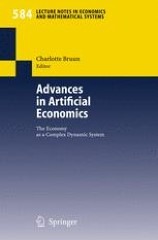
Advances in Artificial Economics : The Economy as a Complex Dynamic System
Perceiving the economy as a complex dynamic system, generates a need for new tools for its study. As a constructive simulation method, Agent-Based Computational Economics (ACE) has in recent years proven its strength and extensive applicability. Fields of study are widely spread within economics, with a cluster around financial markets. This book is based on communications given at AE’2006 (Aalborg, Denmark) – the second symposium on Artificial Economics, and covers both wellknown questions of economics, like the existence of market efficiency, as well as new questions raised by the new tools, for example questions related to networks of social interaction.

Advances in 3D Geo Information Systems
The individual papers represent a valuable collection of information on the current state-of-the-art research in the field of 3D geoinformation. It covers a range of these challenges, collected under the themes of Applications, Acquisition, Modelling, Analysis and Visualisation. The main strength of the collection concerns the data modelling and DBMS implementation issues with 3D GIS.

Advances and Technical Standards in Neurosurgery ; Vol. 33
This series has already become a classic. In general, one volume is published per year. The advances section presents fields of neurosurgery and related areas in which important recent progress has been made. The technical standards section features detailed descriptions of standard procedures to assist young neurosurgeons in their post-graduate training.

Advances and technical standards in neurosurgery ; Vol. 31
Part of the series sponsored by the European Association of Neurosurgical Societies. The Advances section presents fields of neurosurgery and related areas. The Technical Standards section features detailed descriptions of standard procedures to assist young neurosurgeons in their post-graduate training.

Advances and Technical Standards in Neurosurgery ; Vol. 30
This series, sponsored by the European Association of Neurosurgical Societies, has already become a classic. In general, one volume is published per year. The Advances section presents fields of neurosurgery and related areas in which important recent progress has been made. The Technical Standards section features detailed descriptions of standard procedures to assist young neurosurgeons in their post-graduate training. The contributions are written by experienced clinicians and are reviewed by all members of the Editorial Board.
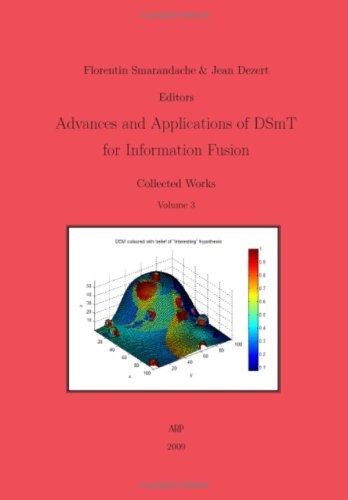
Advances and applications of DSmT for information fusion: Collected works ; Vol.3
One of the most comprehensive and flexible fusion theory based on belief functions. It can work in all fusion spaces: power set, hyper-power set, and super-power set, and has various fusion and conditioning rules that can be applied depending on each application. Some new generalized rules are introduced in this volume with codes for implementing some of them. For the qualitative fusion, the DSm Field and Linear Algebra of Refined Labels (FLARL) is proposed which can convert any numerical fusion rule to a qualitative fusion rule. When one needs to work on a refined frame of discernment, the refinement is done using Smarandache s algebraic codification. New interpretations and implementations of the fusion rules based on sampling techniques and referee functions are proposed, including the probabilistic proportional conflict redistribution rule.
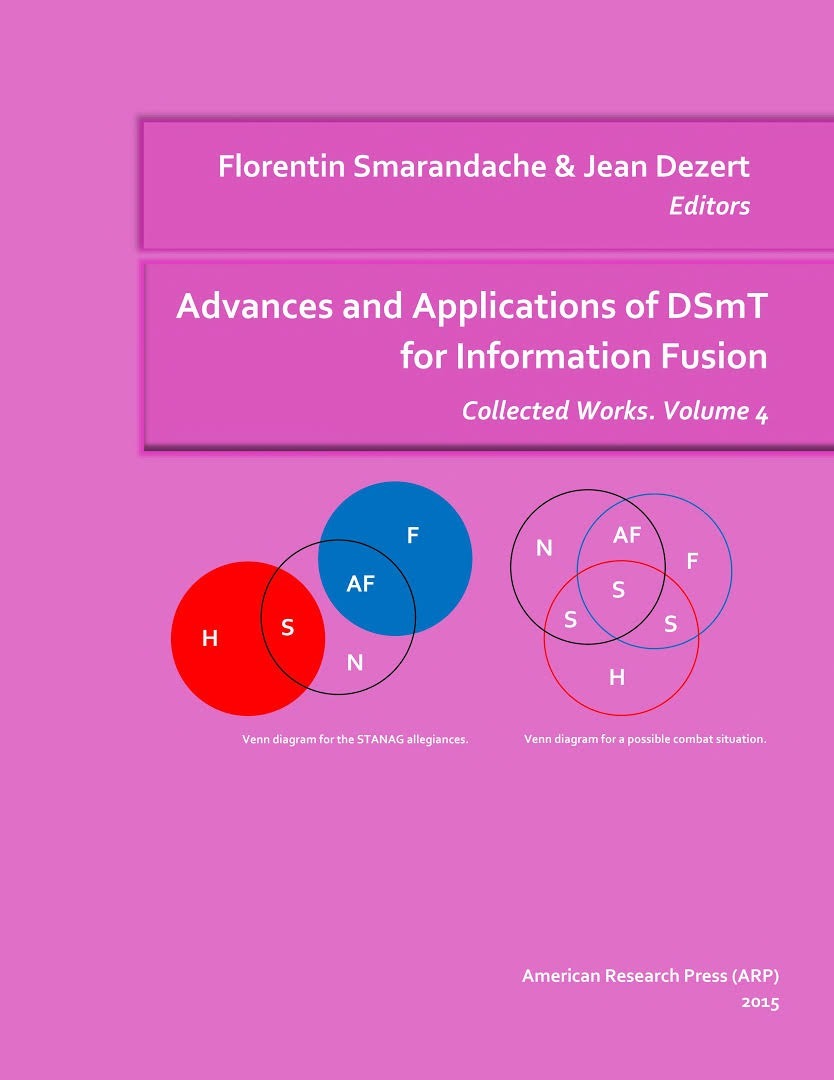
Advances and applications of DSmT for information fusion ; Vol. 4
One of the most comprehensive and flexible fusion theory based on belief functions. It can work in all fusion spaces: power set, hyper-power set, and super-power set, and has various fusion and conditioning rules that can be applied depending on each application. Some new generalized rules are introduced in this volume with codes for implementing some of them. For the qualitative fusion, the DSm Field and Linear Algebra of Refined Labels (FLARL) is proposed which can convert any numerical fusion rule to a qualitative fusion rule. When one needs to work on a refined frame of discernment, the refinement is done using Smarandache s algebraic codification. New interpretations and implementations of the fusion rules based on sampling techniques and referee functions are proposed, including the probabilistic proportional conflict redistribution rule.

Advancement of Deep Learning and its Applications in Object Detection and Recognition
In just the past five years, deep learning has taken the world by surprise, driving rapid progress in fields as diverse as computer vision, natural language processing, automatic speech recognition, etc. This book presents an introduction to deep learning and various applications of deep learning such as recommendation systems, text recognition, diabetic retinopathy prediction of breast cancer, prediction of epilepsy, sentiment, fake news detection, software defect prediction and protein function prediction.

Advanced Visual Quantum Mechanics
Investigate and to teach quantum mechanics with the aid of computer-generated animations. It is a self-contained textbook that combines selected topics from atomic physics (spherical symmetry, the hydrogen atom, and particles with spin) with an introduction to quantum information theory (qubits, EPR paradox, teleportation, quantum computers). It explores relativistic quantum mechanics and the strange behavior of Dirac equation solutions. A series of appendices covers important topics from perturbation and scattering theory. The book places an emphasis on ideas and concepts, with a fair to moderate amount of mathematical rigor. Though this book stands alone, it can also be paired with Thaller Visual Quantum Mechanics to form a comprehensive course in quantum mechanics. The software for the first book earned the European Academic Software Award 2000 for outstanding innovation in its field.

Advanced Techniques in Diagnostic Microbiology
The book is divided into two sections. The first techniques section covers the principles and characteristics of techniques ranging from rapid antigen testing, to advanced antibody detection, to in vitro nucleic acid amplification techniques, and to nucleic acid microarray and mass spectrometry. Sufficient space is assigned to cover different nucleic acid amplification formats that are currently being used widely in the diagnostic microbiology field. Within each technique, examples are given regarding its application in the diagnostic field. Commercial product information, if available, is introduced with commentary in each chapt
Advanced technique and future perspective for next generation optical fiber communications
Optical fiber communication industry has gained unprecedented opportunities and achieved rapid progress in recent years. However, with the increase of data transmission volume and the enhancement of transmission demand, the optical communication field still needs to be upgraded to better meet the challenges in the future development. Artificial intelligence technology in optical communication and optical network is still in its infancy, but the existing achievements show great application potential. In the future, with the further development of artificial intelligence technology, AI algorithms combining channel characteristics and physical properties will shine in optical communication. This reprint introduces some recent advances in optical fiber communication and optical network, and provides alternative directions for the development of the next generation optical fiber communication technology.
