



الصفحة 11
الصفحة 11

Infection control and management of hazardous materials for the dental team
Comprehensive coverage looks at infection control and prevention from the perspective of all dental team members. Easy-to-follow, step-by-step procedures are provided for skills that dental team members must master, each presented with a goal, materials, chronological steps, and rationales for the performance of each step. Review questions ensure your comprehension of the material and provide practice for classroom and board examinations. Key terms begin each chapter and are highlighted within text discussions and defined in a back-of-book glossary. Chapter learning objectives help you set goals for what you will accomplish and serve as checkpoints for comprehension and study tools in preparation for examinations.

Impossible Bodies, Impossible Selves : Exclusions and Student Subjectivities
This book looks inside the school to examine how every-day, school-level processes act to place particular students 'outside' the educational endeavour and argues for new strategies for thinking critically about and interrupting educational exclusions and inequalities.The book uses tools offered by post-structural theory to read ethnographic data and show how the discourses that circulate inside schools at once mobilize and elide gender, sexuality, social class, ability, disability, race, ethnicity, religious and cultural belongings at the same time as they open up and close down 'who' students can be as learners.

Implementing semantic web services : The SESA framework
Service-oriented computing has become one of the predominant factors in IT research and development efforts over the last few years. In spite of several standardization efforts that advanced from research labs into industrial-strength technologies and tools, there is still much human effort required in the process of finding and executing Web services.

Implementing Industry 4.0 in SMEs : Concepts, Examples and Applications
This book addresses the practical challenges that Industry 4.0 presents for SMEs. While large companies are already responding to the changes resulting from the fourth industrial revolution , small businesses are in danger of falling behind due to the lack of examples, best practices and established methods and tools.

Implants and Oral Rehabilitation of the Atrophic Maxilla : Advanced Techniques and Technologies
Covers the most suitable techniques for the rehabilitation of patients experiencing tooth loss, trauma or other situations resulting in bone atrophy. The book discusses current technologies, from diagnosis to treatment and surgery, applied to atrophic jaws using innovative tools and new PSI (patient specific implant) approaches.

Immunogenetics of Autoimmune Disease
Utoimmunity is the downstream outcome of a rather extensive and coordinated series of events that include loss of self-tolerance, peripheral lymphocyte Aactivation, disruption of the blood-systems barriers, cellular infiltration into the target organs and local inflammation. Cytokines, adhesion molecules, growth factors, antibodies, and other molecules induce and regulate critical cell functions that perpetuate inflammation, leading to tissue injury and clinical phenotype. The nature and intensity of this response as well as the physiological ability to restore homeostasis are to a large extent conditioned by the unique amino acid sequences that define allelic variants on each of the numerous participating mol ecules. Therefore, the coding genes in their germline configuration play a primary role in determining who is at risk for developing such disorders, how the disease progresses, and how someone responds to therapy. Although genetic components in these diseases are clearly present, the lack of obvious and homogeneous modes of transmission has slowed progress by prevent ing the full exploitation of classical genetic epidemiologic techniques. Furthermore, autoimmune diseases are characterized by modest disease risk heritability and m- tifaceted interactions with environmental influences. Yet, several recent discoveries have dramatically changed our ability to examine genetic variation as it relates to human disease. In addition to the development of large-scale laboratory methods and tools to efficiently recognize and catalog DNA diversity, over the past few years there has been real progress in the application of new analytical and data-manage ment approaches

Immobilisation of DNA on Chips II
DNA chips are gaining increasing importance in different fields ranging from medicine to analytical chemistry with applications in the latter in food safety and food quality issues as well as in environmental protection. In the medical field, DNA chips are frequently used in arrays for gene expression studies to identify diseased cells due to over- or under-expression of certain genes, to follow the response of drug treatments, or to grade cancers), for genotyping of individuals, for the detection of single nucleotide polymorphisms, point mutations, and short tandem reports, or moreover for genome and transcriptome analyses in the quasi post-genomic sequencing era. Furthermore, due to some unique properties of DNA molecules, self-assembled layers of DNA are promising candidates in the field of molecular electronics.the main focus of these two volumes is on the immobilization chemistry, considering the various aspects of the immobilization process itself, since different types of nucleic acids, support materials, surface activation chemistries and patterning tools are of key concern.

Immobilisation of DNA on Chips I
the main focus of these two volumes is on the immobilization chemistry, considering the various aspects of the immobilization process itself, since different types of nucleic acids, support materials, surface activation chemistries and patterning tools are of key concern.the focus of the major part of the chapters lies on the coupling chemistry used for DNA immobilization. Successful immobilization techniques for DNA appear to either involve a multi-site attachment of DNA (preferentially by electrochemical and/or physical adsorption) or a single-point attachment of DNA (mainly by surface activation and covalent immobilization or (strept)avidin-biotin linkage).

Imaging in Drug Discovery and Early Clinical Trials
Efficient tools for the selection and validation of drug targets both at the preclinical and clinical level are required. Non-invasive imaging and in particular molecular imaging methods are becoming essential technologies to support drug discovery and dvelopment. Imaging provides structural, functional, metabolic and molecular readouts that are being applied to characterize a disease phenotype (diagnosis), to elucidate molecular mechanisms involved, to evaluate drug efficacy and safety, and to identify potential biomarkers of the drug's mechanism-of-action, efficacy and safety. Non-invasive imaging techniques constitute a bridge between preclinical and clinical drug evaluation. In this monograph the contribution of imaging modalities to the various stages of drug discovery and development, from early target validation to their use in clinical development programs, is described. Chapters are devoted to the description of the drug discovery process as such, to the various imaging modalities being used both preclinically and clinically, to applications of imaging during the optimization of a lead compound (addressing issues such as bioavailability and efficacy) and during the drug safety evaluation.

Image Processing Using Pulse-Coupled Neural Networks
This is the first book to explain and demonstrate the tremendous ability of Pulse-Coupled Neural Networks (PCNNs) when applied to the field of image processing. PCNNs and their derivatives are biologically inspired models that are powerful tools for extracting texture, segments, and edges from images.

Image Processing in Radiology : Current Applications
Few fields have witnessed such impressive advances as image processing in radiology. The progress achieved has revolutionized diagnosis and greatly facilitated treatment selection and accurate planning of procedures. This book provides a comprehensive and up-to-date description of how to use 2D and 3D processing tools in clinical radiology.

Identification of Continuous-time Models from Sampled Data
Identification of Continuous-time Models from Sampled Data brings together contributions from well-known experts who present an up-to-date view of this active area of research and describe recent methods and software tools developed in this field.

Ideals and Reality : Projective Modules and Number of Generators of Ideals
The book gives a comprehensive introduction to basic commutative algebra, together with the related methods from homological algebra, which will enable students who know only the fundamentals of algebra to enjoy the power of using these tools. At the same time, it also serves as a valuable reference for the research specialist and as potential course material, because the authors present, for the first time in book form, an approach here that is an intermix of classical algebraic K-theory and complete intersection techniques, making connections with the famous results of Forster-Swan and Eisenbud-Evans. A study of projective modules and their connections with topological vector bundles in a form due to Vaserstein is included. Important subsidiary results appear in the copious exercises.

Hydra = هايدرا
Forgery involves the use of advanced algorithms to replicate and distribute deceptive products across various categories, casting shadows of doubt on the authenticity of goods. Although counterfeit detection can be useful in identifying and mitigating fraudulent activities, the widespread presence of counterfeit goods poses significant dangers, undermining consumer confidence and brand reputation. To underscore the severity of this issue, consider instances such as fake luxury items flooding the market, counterfeit electronics compromising safety, or bogus pharmaceuticals endangering health. Addressing this issue is critical in maintaining the integrity of brands, safeguarding consumer well-being, and preserving trust in the marketplace. The ability to distinguish between authentic and counterfeit products is paramount in ensuring accurate decision-making and preventing the harmful consequences of fraudulent goods. This technological context underscores the urgency of developing and deploying cutting-edge solutions to combat the evolving landscape of product forgery. Hydra emerges as a robust solution, utilizing a comprehensive approach that includes extracting posts and images from search engine tools, and is integrated with AI models to detect forgery. The Hydra platform not only provides users with a powerful tool for detecting counterfeit products but also offers tangible benefits such as enhanced brand security, increased awareness about the prevalence of forgeries, and the opportunity to actively participate in a real-time community.

Hybrid Systems: Computation and Control ; 10th International Workshop, HSCC 2007, Pisa, Italy, April 3-5, 2007, Proceedings
Constitutes the refereed proceedings of the 10th International Conference on Hybrid Systems: Computation and Control, HSCC 2007, held in Pisa, Italy in April 2007.

Hybrid Systems : Computation and Control ; Vol.3927 ; 9th International Workshop, HSCC 2006, Santa Barbara, CA, USA, March 29-31, 2006, Proceedings
The focus is on modeling, analysis, and implementation of dynamic and reactive systems involving both discrete and continuous behaviors. Topics addressed include tools for analysis and verification, control and optimization, modeling, engineering applications, and new directions in language support and implementation.

Hybrid Systems : Computation and Control ; Vol. # 3414 ; 8th International Workshop, HSCC 2005, Zurich, Switzerland, March 9-11, 2005, Proceedings
Contains the proceedings of the 8th Workshop on Hybrid S- tems: Computation and Control(HSCC2005)heldinZurich, Switzerlandduring March 9-11, 2005. The annual workshop on hybrid systems attracts researchers from academia and industry interested in modeling, analysis, and implemen- tion of dynamic and reactive systems involving both discrete and continuous - haviors. This year's HSCC was technically co-sponsored by the IEEE Control Systems Society. The program consisted of 3 invited talks and 40 regular papers selected from 91 regular submissions. The program covered topics such as tools for analysis and verification, control and optimization, modeling, engineering applications, and emerging directions in programming language support and implementation. We would like to thank the Program Committee members and reviewers for an excellent job of evaluating the submissions and participating in the online Program Committee discussions.
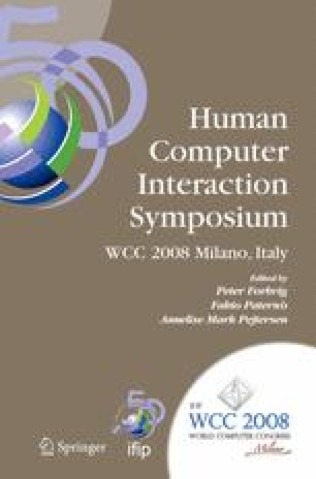
Human-computer interaction Symposium ; IFIP 20th World Computer Congress, Proceedings of the 1st TC 13 Human-Computer Interaction Symposium (HCIS 2008), September 7-10, 2008, Milano, Italy
The IFIP series publishes state-of-the-art results in the sciences and technologies of information and communication. The scope of the series includes: foundations of computer science; software theory and practice; education; computer applications in technology; communication systems; systems modeling and optimization; information systems; computers and society; computer systems technology; security and protection in information processing systems; artificial intelligence; and human-computer interaction. Proceedings and post-proceedings of refereed international conferences in computer science and interdisciplinary fields are featured.

Human-Computer Interaction : Interaction design and usability ; 12th International Conference, HCI International 2007, Beijing, China, July 22-27, 2007, Proceedings, Part I
The 12th International Conference on Human-Computer Interaction, HCI Inter- tional 2007, was held in Beijing, P.R. This volume, edited by Julie A. Jacko, contains papers in the thematic area of Human-Computer Interaction, addressing the following major topics: • Interaction Design: Theoretical Issues, Methods, Techniques and Practice • Usability and Evaluation Methods and Tools • Understanding Users and Contexts of Use • Models and Patterns in HCI

Human-computer interaction – INTERACT 2005 ; IFIP TC 13 International Conference, Rome, Italy, September 12-16, 2005, Proceedings
We will be, sooner or later, not only handling personal computers but also mul- purpose cellular phones, complex personal digital assistants, devices that will be context-aware, and even wearable computers stitched to our clothes…we would like these personal systems to become transparent to the tasks they will be performing. In fact the best interface is an invisible one, one giving the user natural and fast access to the application he (or she) intends to be executed. The working group that organized this conference (the last of a long row!) tried to combine a powerful scientific program (with drastic refereeing) with an entertaining cultural program, so as to make your stay in Rome the most pleasant one all round: I do hope that this expectation becomes true. July 2005 Stefano Levialdi, IEEE Life Fellow INTERACT 2005 General Chairman [1] Peter J. Denning, ACM Communications, April 2005, vol. 48, N° 4, pp. 27-31. Editors’ Preface INTERACT is one of the most important conferences in the area of Human-Computer Interaction at the world-wide level. We believe that this edition, which for the first time takes place in a Southern European country, will strengthen this role, and that Rome, with its history and beautiful setting provides a very congenial atmosphere for this conference. The theme of INTERACT 2005 is Communicating Naturally with Computers.
