



الصفحة 11
الصفحة 11

Freehand figure drawing for illustrators
In Freehand Figure Drawing for Illustrators, artist and instructor David H. Ross provides an alternative solution, showing you how to master freehand figure drawing without visual reference by using a modern twist on the classic technique of blocking out the human figure in mannequin form. Step-by-step lessons guide illustrators from basic poses (standing, running, jumping) to extreme motions (throwing punches, high kicking). For on-the-go artists, Freehand Figure Drawing for Illustrators allows you complete freedom to bring your figures to life at any time

Free Energy Calculations : Theory and Applications in Chemistry and Biology
This volume sets out to present a coherent and comprehensive account of the concepts that underlie different approaches devised for the determination of free energies. The reader will gain the necessary insight into the theoretical and computational foundations of the subject and will be presented with relevant applications from molecular-level modelling and simulations of chemical and biological systems. Both formally accurate and approximate methods are covered using both classical and quantum mechanical descriptions. A central theme of the book is that the wide variety of free energy calculation techniques available today can be understood as different implementations of a few basic principles.

Framing in Sustainability Science : Theoretical and Practical Approaches
This book offers both conceptual and empirical descriptions of how to “frame” sustainability challenges. It defines “framing” in the context of sustainability science as the process of identifying subjects, setting boundaries, and defining problems. The chapters are grouped into two sections: a conceptual section and a case section.

Framing global mathematics : The international mathematical union between theorems and politics
This book is about the shaping of international relations in mathematics over the last two hundred years. It focusses on institutions and organizations that were created to frame the international dimension of mathematical research. Today, striking evidence of globalized mathematics is provided by countless international meetings and the worldwide repository ArXiv. The text follows the sinuous path that was taken to reach this state, from the long nineteenth century, through the two wars, to the present day. International cooperation in mathematics was well established by 1900, centered in Europe. The first International Mathematical Union, IMU, founded in 1920 and disbanded in 1932, reflected above all the trauma of WW I. Since 1950 the current IMU has played an increasing role in defining mathematical excellence, as is shown both in the historical narrative and by analyzing data about the International Congresses of Mathematicians. For each of the three periods discussed, interactions are explored between world politics, the advancement of scientific infrastructures, and the inner evolution of mathematics. Readers will thus take a new look at the place of mathematics in world culture, and how international organizations can make a difference. Aimed at mathematicians, historians of science, scientists, and the scientifically inclined general public.

Fragmentation of Rings and Shells : The Legacy of N.F. Mott
The present book surveys the theoretical analysis put forth by Mott with particular focus on his efforts to characterize the size and distribution of fragments resulting from a dynamic fragmentation event. Copies of the original internal reports of Mott and his co-workers are included. The book also pursues additional theoretical analysis with the intent of delving further into the physical ideas and unfinished analysis implicit in Mott`s original studies. This book will be of interest to all scientists and engineers concerned with the dynamic fracture and fragmentation of solid bodies subject to intense transient loads imparted by explosive detonation and high-velocity impact from both the historical and modern perspective.

Fractures du genou = Knee fractures
Provides a comprehensive yet practical overview of the management of knee fractures and their complications. The editorial team comprises specialists from France, Switzerland, Belgium, the United States, and Ireland, many of whom are members of the AO group. Imaging strategies, assessment, classification, and anatomical variations are reviewed for each anatomical location. All therapeutic approaches are discussed without exception: conventional implants, intramedullary nailing, minimally invasive techniques, including the role of external fixation, and newer technologies such as the LISS. These approaches are subjected to critical analysis to identify the best options based on the indications and individual circumstances. The patellar apparatus is addressed in its functional unity. Postoperative management, influenced by functional prognosis, is also covered, as is the management of malunion, stiffness, and other complications. Finally, very specific problems are discussed, such as pediatric injuries, patellectomies, periprosthetic fractures, often complex projectile injuries, the role of immediate arthroplasty and massive grafts, but also associated injuries which sometimes have a heavy impact on the final prognosis.

Fracture Mechanics : With an Introduction to Micromechanics
Concerned with the fundamental concepts and methods of fracture mechanics and micromechanics, Fracture Mechanics primarily focuses on the mechanical description of fracture processes; however, material specific aspects are also discussed. The presentation of continuum mechanical and phenomenological foundations is followed by an introduction into classical failure hypotheses. A major part of the book is devoted to linear elastic and elastic-plastic fracture mechanics. Further subjects are creep fracture, dynamic fracture mechanics, damage mechanics, probabilistic fracture mechanics, failure of thin films and fracture of piezoelectric materials. The book also contains an extensive introduction into micromechanics.

Fracture and Failure of Natural Building Stones : Applications in the Restoration of Ancient Monuments
The book consists of invited papers written by leading experts in the field. It contains original contributions concerning the latest developments in the fracture and failure of the natural building stones and their application in the restoration of ancient monuments. It covers a wide range of subjects - cluding purely mechanical aspects, physico-chemical approaches, appli- tions and case studies. The papers are arranged in two parts with a total of nine chapters. Part I is devoted to purely mechanical and structural aspects and applications, while Part II is devoted to the physico-chemical and environmental aspects including thermal effects.

Fractals in Biology and Medicine : Beyond Planting Trees
This volume it highlights the potential that fractal geometry offers for elucidating and explaining the complex make-up of cells, tissues and biological organisms either in normal or in pathological conditions, including the structural changes that occur in tumours. It helps develop the concepts, questions and methods required in research on fractal biology and natural phenomena and to evidence the pitfalls of a too simplistic application of these principles in investigating topical subjects of biology and medicine. It discusses present and future applications of fractal geometry, bringing together cellular and molecular biology, engineering, mathematics, physics, medicine and other disciplines and allowing an interdisciplinary vision.

Foundation Mathematics for Computer Science : A Visual Approach
In this second edition of Foundation Mathematics for Computer Science, John Vince has reviewed and edited the original book and written new chapters on combinatorics, probability, modular arithmetic and complex numbers. These subjects complement the existing chapters on number systems, algebra, logic, trigonometry, coordinate systems, determinants, vectors, matrices, geometric matrix transforms, differential and integral calculus. During this journey, the author touches upon more esoteric topics such as quaternions, octonions, Grassmann algebra, Barrycentric coordinates, transfinite sets and prime numbers.

Formal Methods and Testing : An Outcome of the FORTEST Network, Revised Selected Papers
This book constitutes the thoroughly refereed and peer-reviewed outcome of the Formal Methods and Testing (FORTEST) network - formed as a network established under UK EPSRC funding that investigated the relationships between formal (and semi-formal) methods and software testing - now being a subject group of two BCS Special Interest Groups: Formal Aspects of Computing Science (BCS FACS) and Special Interest Group in Software Testing (BCS SIGIST).

Forest Restoration in Landscapes
This book integrates the restoration of forest functions into landscape conservation plans. and this book represents the collective body of knowledge and experience of WWF and its many partners--which is collected here for the first time and which will be invaluable to all of those working in the field. This guide will serve as a first stop for practitioners and researchers in any organization or region and as a key reference on the subject. Along with concise, practical information for a variety of specific systems and issues, it gives many suggestions for further research.

Forest Entomology in East Africa : Forest Insects of Tanzania
East African forests, among the world’s most biologically rich and diverse, are subject to multiple pressures, including insects. As the first work to focus exclusively on East African forest insects, this monograph distils 135 years of scientific and historical literature extending from before the colonial era to the present into an authoritative survey of this region’s major pests of trees and wood, as well as their antagonists. This comprehensive treatise also addresses insects of social and economic importance, such as endemics, edible and collectible insects, wild bees and silk producers. It should be of great value to foresters, entomologists, conservation biologists, resource managers, safari outfitters and anyone else interested in the natural history of this fascinating region.
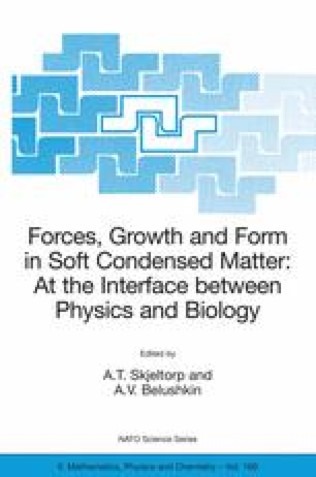
Forces, Growth and Form in Soft Condensed Matter : At the Interface between Physics and Biology
This volume comprises the proceedings of a NATO Advanced Study Institute held at Geilo, Norway, 24 March - 3 April 2003, the seventeenth ASI in a series held every two years since 1971. The objective of this ASI was to identify and discuss areas where synergism between modern physics, soft condensed matter and biology might be most fruitful. The main pedagogical approach was to have lecturers focussing on basic understanding of important aspects of the relative role of the various interaction- electrostatic, hydrophobic, steric, conformational, van der Waals etc. Soft condensed matter and the connection between physics and biology have been the themes of several earlier Geilo Schools. A return to these subjects thus allowed a fresh look and a possibility for defining new directions for research. Examples of soft materials, which were discussed at this ASI, included colloidal dispersions, gels, biopolymers and charged polymer solutions, polyelectrolytes, protein/membrane complexes, nucleic acids and their complexes. Indeed, most forms of condensed matter are soft and these substances are composed of aggregates and macromolecules, with interactions that are too weak and complex to form crystals spontaneously. A characteristic feature is that small external forces, slight perturbations in temperature, pressure or concentration, can all be enough to induce significant structural changes. Thermal fluctuations are almost by definition strong in soft materials and entropy is a predominant determinant of structure, so that disorder, slow dynamics and plastic deformation are the rule. Hence the phrase ‘soft condensed matter’ has been coined.

Foot and ankle in rheumatoid arthritis
This book broaches the theme of the most recent medicinal treatments, that of orthoses, made-to-measure shoes (the prescription of which practitioners and the rheumatologists often hand over to the orthopaedic surgeons), and finally that of local injections. These elements constitute the main treatment of the rheumatoid foot. Taking care of the ill subject does not necessarily stop there and a surgeon may need to operate on the forefoot, which is more common, or on the mid-foot or the ankle.

Food Engineering : Integrated Approaches
Food Engineering: Integrated Approaches presents an up-to-date review of important food engineering concepts, issues and recent advances in the field. Distinguished food engineers and food scientists from key institutions worldwide have contributed chapters that provide a deep analysis of their particular subjects. At the same time, each topic is framed within the context of a broader more integrated approach, demonstrating its relationship and interconnectedness to other areas. The premise of this work, therefore, is to offer both a comprehensive understanding of food engineering as a whole and a thorough knowledge of individual subjects. This approach appropriately conveys the basic fundamentals, state-of-the-art technology, and applications of the involved disciplines.

Food Emulsifiers and Their Applications
Thoroughly revised and updated, the second edition of Food Emulsifiers and their Applications integrates theoretical background with practical orientation and serves as the definitive reference on subject. It offers practitioners an overview of the manufacture, analysis, physical properties, interactions and applications of emulsifiers used in processed food. Written for food technologists as well as R & D and product development personnel, begins with the design and preparation of emulsifiers (including interactions with other food ingredients), which leads in to product categories, including dairy, infant nutrition, bakery, confectionery, and margarine, followed by nutrition improvement and processing techniques.

Folk Psychology Re-Assessed
FOLK PSYCHOLOGY, THEORY OF MIND AND SIMULATION The tasks we face in our day to day social lives are quite heterogeneous but many of them make a common demand upon us. They require us to understand and interact with other people and, in most social encounters, we exhibit a special sensitivity to our fellow human beings that is quite different from the way we respond to inanimate objects and most other species of organism. Social life is dependent, to a considerable degree, on our ability to understand what is distinctive about human behaviour and to successfully apply that understanding in all manner of situations.

Fluid Mechanics : An Introduction to the Theory of Fluid Flows
Advancements of fluid flow measuring techniques and of computational methods have led to new ways to treat laminar and turbulent flows. These methods are extensively used these days in research and engineering practise. This also requires new ways to teach the subject to students at higher educational institutions in an introductory manner. The book provides the knowledge to students in engineering and natural science needed to enter fluid mechanics applications in various fields. Analytical treatments are provided, based on the Navier-Stokes equations. Introductions are also given into numerical and experimental methods applied to flows. The main benefit the reader will derive from the book is a sound introduction into all aspects of fluid mechanics covering all relevant subfields.

Flowing Matter
This book presents an introduction to selected research topics in the broad field of flowing matter, including the dynamics of fluids with a complex internal structure -from nematic fluids to soft glasses- as well as active matter and turbulent phenomena. Flowing matter is a subject at the crossroads between physics, mathematics, chemistry, engineering, biology and earth sciences, and relies on a multidisciplinary approach to describe the emergence of the macroscopic behaviours in a system from the coordinated dynamics of its microscopic constituents. Depending on the microscopic interactions, an assembly of molecules or of mesoscopic particles can flow like a simple Newtonian fluid, deform elastically like a solid or behave in a complex manner. When the internal constituents are active, as for biological entities, one generally observes complex large-scale collective motions. Phenomenology is further complicated by the invariable tendency of fluids to display chaos at the large scales or when stirred strongly enough. This volume presents several research topics that address these phenomena encompassing the traditional micro-, meso-, and macro-scales descriptions, and contributes to our understanding of the fundamentals of flowing matter.
