



الصفحة 11
الصفحة 11
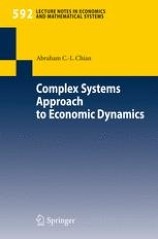
Complex systems approach to economic dynamics
This monograph introduces new concepts of unstable periodic orbits and chaotic saddles which are unstable structures embedded in a chaotic attractor, responsible for economic intermittency.
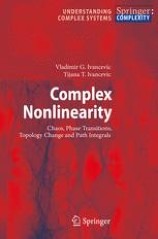
Complex Nonlinearity : Chaos, Phase Transitions, Topology Change and Path Integrals
The book starts with a textbook-like expose on nonlinear dynamics, attractors and chaos, both temporal and spatio-temporal, including modern techniques of chaos–control. Chapter 2 turns to the edge of chaos, in the form of phase transitions (equilibrium and non-equilibrium, oscillatory, fractal and noise-induced), as well as the related field of synergetics. While the natural stage for linear dynamics comprises of flat, Euclidean geometry (with the corresponding calculation tools from linear algebra and analysis), the natural stage for nonlinear dynamics is curved, Riemannian geometry (with the corresponding tools from nonlinear, tensor algebra and analysis). The extreme nonlinearity – chaos – corresponds to the topology change of this curved geometrical stage, usually called configuration manifold. Chapter 3 elaborates on geometry and topology change in relation with complex nonlinearity and chaos. Chapter 4 develops general nonlinear dynamics, continuous and discrete, deterministic and stochastic, in the unique form of path integrals and their action-amplitude formalism.
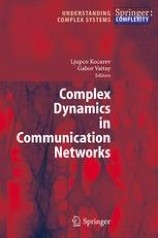
Complex Dynamics in Communication Networks
Computer and communication networks are among society's most important infrastructures. The internet, in particular, is a giant global network of networks without central control or administration. It is a paradigm of a complex system, where complexity may arise from different sources: topological structure, network evolution, connection and node diversity, or dynamical evolution. The present volume is the first book entirely devoted to the new and emerging field of nonlinear dynamics of TCP/IP networks. It addresses both scientists and engineers working in the general field of communication networks.
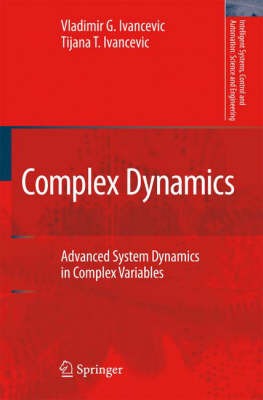
Complex dynamics : Advanced system dynamics in complex variables
Complex Dynamics: Advanced System Dynamics in Complex Variables is a graduate-level monographic textbook. It is designed as a comprehensive introduction into methods and techniques of modern complex-valued nonlinear dynamics with its various physical and non-physical applications.
Complex decision making : Theory and practice
The increasingly complex environment of today's world, characterized by technological innovation and global communication, generates myriads of possible and actual interactions while limited physical and intellectual resources severely impinge on decision makers, be it in the public or private domains. At the core of the decision-making process is the need for quality information that allows the decision maker to better assess the impact of decisions in terms of outcomes, nonlinear feedback processes and time delays on the performance of the complex system invoked.
Classification and Modeling with Linguistic Information Granules : Advanced Approaches to Linguistic Data Mining
Many approaches have already been proposed for classification and modeling in the literature. These approaches are usually based on mathematical mod els. Computer systems can easily handle mathematical models even when they are complicated and nonlinear (e.g., neural networks). On the other hand, it is not always easy for human users to intuitively understand mathe matical models even when they are simple and linear. This is because human information processing is based mainly on linguistic knowledge while com puter systems are designed to handle symbolic and numerical information. A large part of our daily communication is based on words. We learn from various media such as books, newspapers, magazines, TV, and the Inter net through words. We also communicate with others through words. While words play a central role in human information processing, linguistic models are not often used in the fields of classification and modeling. If there is no goal other than the maximization of accuracy in classification and modeling, mathematical models may always be preferred to linguistic models. On the other hand, linguistic models may be chosen if emphasis is placed on interpretability.
Circuits and Systems Based on Delta Modulation : Linear, Nonlinear and Mixed Mode Processing
This book is intended for students and professionals who are interested in the field of digital signal processing of delta-sigma modulated sequences. The overall focus is on the development of algorithms and circuits for linear, non-linear, and mixed mode processing of delta-sigma modulated pulse streams. The material presented here is directly relevant to applications in digital communication, DSP, instrumentation, and control.
Chaos, Nonlinearity, Complexity : The Dynamical Paradigm of Nature
This carefully edited book presents a focused debate on the mathematics and physics of chaos, nonlinearity and complexity in nature. It explores the role of non-extensive statistical mechanics in non-equilibrium thermodynamics, and presents an overview of the strong nonlinearity of chaos and complexity in natural systems that draws on the relevant mathematics from topology, measure-theory, inverse and ill-posed problems, set-valued analysis, and nonlinear functional analysis. It presents a self-contained scientific theory of complexity and complex systems as the steady state of non-equilibrium systems, denoting a homeostatic dynamic equilibrium between stabilizing order and destabilizing disorder.

Chaos in Structural Mechanics
This volume introduces and reviews novel theoretical approaches to modeling strongly nonlinear behaviour of either individual or interacting structural mechanical units such as beams, plates and shells or composite systems thereof.

Chaos : A Program Collection for the PC
This new edition strives yet again to provide readers with a working knowledge of chaos theory and dynamical systems through parallel introductory explanations in the book and interaction with carefully-selected programs supplied on the accompanying diskette. The programs enable readers, especially advanced-undergraduate students in physics, engineering, and math, to tackle relevant physical systems quickly on their PCs, without distraction from algorithmic details. For the third edition of Chaos: A Program Collection for the PC, each of the previous twelve programs is polished and rewritten in C++ (both Windows and Linux versions are included). A new program treats kicked systems, an important class of two-dimensional problems, which is introduced in Chapter 13. Each chapter follows the structure: theoretical background; numerical techniques; interaction with the program; computer experiments; real experiments and empirical evidence; reference.

Canonical Perturbation Theories, Degenerate Systems, and Resonance
Canonical Perturbation Theories, Degenerate Systems and Resonance presents the foundations of Hamiltonian Perturbation Theories used in Celestial Mechanics, emphasizing the Lie Series Theory and its application to degenerate systems and resonance. This book is the complete text on the subject including advanced topics in Hamiltonian Mechanics, Hori’s Theory, and the classical theories of Poincaré, von Zeipel-Brouwer, and Delaunay.

Calculus of variations and nonlinear partial differential equations : With a historical overview by Elvira Mascolo : Lectures given at the C.I.M.E. Summer School held in Cetraro, Italy, June 27 - July 2, 2005
This volume provides the texts of lectures given by L. Ambrosio, L. Caffarelli, M. Crandall, L.C. Evans, N. Fusco at the Summer course held in Cetraro (Italy) in 2005. These are introductory reports on current research by world leaders in the fields of calculus of variations and partial differential equations. The topics discussed are transport equations for nonsmooth vector fields, homogenization, viscosity methods for the infinite Laplacian, weak KAM theory and geometrical aspects of symmetrization. A historical overview of all CIME courses on the calculus of variations and partial differential equations is contributed by Elvira Mascolo.
Business cycle dynamics : Models and tools
Business cycle theory has been one of the fastest growing fields in modern nonlinear economic dynamics. The book is centered around models of multiplier-accelerator type, emerging from Samuelson's seminal work, later developed into nonlinear formats by Hicks and Goodwin. These models left open ends, as the tools then available did not permit more systematic analysis.

Beyond partial differential equations : On linear and Quasi-Linear abstract hyperbolic evolution equations
The present volume is self-contained and introduces to the treatment of linear and nonlinear (quasi-linear) abstract evolution equations by methods from the theory of strongly continuous semigroups.

Bayesian Methods in the Search for MH370
This book demonstrates how nonlinear/non-Gaussian Bayesian time series estimation methods were used to produce a probability distribution of potential MH370 flight paths. It provides details of how the probabilistic models of aircraft flight dynamics, satellite communication system measurements, environmental effects and radar data were constructed and calibrated. The probability distribution was used to define the search zone in the southern Indian Ocean. The book describes particle-filter based numerical calculation of the aircraft flight-path probability distribution and validates the method using data from several of the involved aircraft’s previous flights. Finally it is shown how the Reunion Island flaperon debris find affects the search probability distribution.

Averaging Methods in Nonlinear Dynamical Systems
The authors have presented an extensive revision of the first edition of the Averaging Methods in Nonlinear Dynamical Systems book. There are many changes, corrections and updates in chapters on Basic Material and Asymptotics, Averaging, and Attraction.

Asymptotics for Dissipative Nonlinear Equations
Many of problems of the natural sciences lead to nonlinear partial differential equations. However, only a few of them have succeeded in being solved explicitly. Therefore different methods of qualitative analysis such as the asymptotic methods play a very important role. This is the first book in the world literature giving a systematic development of a general asymptotic theory for nonlinear partial differential equations with dissipation. Many typical well-known equations are considered as examples, such as: nonlinear heat equation, KdVB equation, nonlinear damped wave equation, Landau-Ginzburg equation, Sobolev type equations, systems of equations of Boussinesq, Navier-Stokes and others.

Astrophysical disks : Collective and stochastic phenomena
The book deals with collective and stochastic processes in astrophysical discs involving theory, observations, and the results of modelling. Among others, it examines the spiral-vortex structure in galactic and accretion disks , stochastic and ordered structures in the developed turbulence. It also describes sources of turbulence in the accretion disks, internal structure of disk in the vicinity of a black hole, numerical modelling of Be envelopes in binaries, gaseous disks in spiral galaxies with shock waves formation, observation of accretion disks in a binary system and mass distribution of luminous matter in disk galaxies.

Assessment and future directions of nonlinear model predictive control
Thepastthree decadeshaveseenrapiddevelopmentin the areaofmodelpred- tive control with respect to both theoretical and application aspects. Over these 30 years, model predictive control for linear systems has been widely applied, especially in the area of process control. However, today’s applications often require driving the process over a wide region and close to the boundaries of - erability, while satisfying constraints and achieving near-optimal performance. Consequently, the application of linear control methods does not always lead to satisfactory performance, and here nonlinear methods must be employed. This is one of the reasons why nonlinear model predictive control (NMPC) has - joyed signi?cant attention over the past years,with a number of recent advances on both the theoretical and application frontier. Additionally, the widespread availability and steadily increasing power of today’s computers, as well as the development of specially tailored numerical solution methods for NMPC, bring thepracticalapplicabilityofNMPCwithinreachevenforveryfastsystems.This has led to a series of new, exciting developments, along with new challenges in the area of NMPC.

Artificial neural networks – ICANN 2007 ; 17th International Conference, Porto, Portugal, September 9-13, 2007, Proceedings, Part I
This book contains learning theory, advances in neural network learning methods, ensemble learning, spiking neural networks, advances in neural network architectures neural network technologies, neural dynamics and complex systems, data analysis, estimation, spatial and spatio-temporal learning, evolutionary computing, meta learning, agents learning, complex-valued neural networks, as well as temporal synchronization and nonlinear dynamics in neural networks.
