



الصفحة 11
الصفحة 11
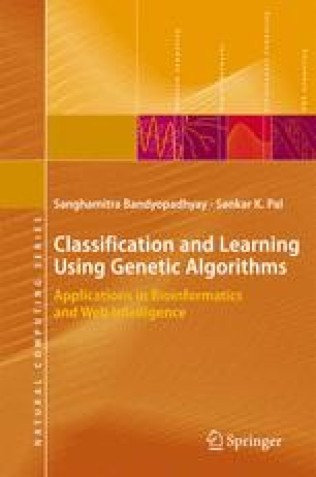
Classification and Learning Using Genetic Algorithms : Applications in Bioinformatics and Web Intelligence
This book provides a unified framework that describes how genetic learning can be used to design pattern recognition and learning systems. The book is unique in the sense of describing how a search technique, the genetic algorithm, can be used for pattern classification mainly through approximating decision boundaries, and it demonstrates the effectiveness of the genetic classifiers vis-à-vis several widely used classifiers, including neural networks. It provides a balanced mixture of theories, algorithms and applications, and in particular results from the bioinformatics and Web intelligence domains.
Classification and Clustering for Knowledge Discovery
This book covers recent advances in unsupervised and supervised data analysis methods in Computational Intelligence for knowledge discovery. In its first part the book provides a collection of recent research on distributed clustering, self organizing maps and their recent extensions. If labeled data or data with known associations are available, we may be able to use supervised data analysis methods, such as classifying neural networks, fuzzy rule-based classifiers, and decision trees. Therefore this book presents a collection of important methods of supervised data analysis. "Classification and Clustering for Knowledge Discovery" also includes variety of applications of knowledge discovery in health, safety, commerce, mechatronics, sensor networks, and telecommunications.

Chance Discoveries in Real World Decision Making : Data-based Interaction of Human intelligence and Artificial Intelligence
For this book, the editors invited and called for contributions from indispensable research areas relevant to "chance discovery," which has been defined as the discovery of events significant for making a decision, and studied since 2000. From respective research areas as artificial intelligence, mathematics, cognitive science, medical science, risk management, methodologies for design and communication, the invited and selected authors in this book present their particular approaches to chance discovery. The chapters here show contributions to identifying rare or hidden events and explaining their significance, predicting future trends, communications for scenario development in marketing and design, identification effects and side-effects of medicines, etc.
Challenges for Computational Intelligence
Computational Intelligence (CI) is used as a name to cover many existing branches of science, with artificial neural networks, fuzzy systems and evolutionary computation forming its core. In recent years CI has been extended by adding many other subdisciplines and it became quite obvious that this new field also requires a series of challenging problems that will give it a sense of direction. Without setting up clear goals and yardsticks to measure progress on the way many research efforts are wasted.The book written by top experts in CI provides such clear directions and the much-needed focus on the most important and challenging research issues, showing a roadmap how to achieve ambitious goals.
Brainlesion: Glioma, Multiple Sclerosis, Stroke and Traumatic Brain Injuries ; 7th International Workshop, BrainLes 2021, Held in Conjunction with MICCAI 2021, Virtual Event, September 27, 2021, Revised Selected Papers, Part I
The content of thebook covers the current state-of-the-art literature on federated learning applications for cancer research and Vclinical oncology analysis, as well as an overview of the deep learning approaches improving the current standard of care for brain lesions and current neuroimaging challenges. It is also focusing on the accepted BrainLes workshop submissions, is to provide an overview of new advances of medical image analysis in all the aforementioned brain pathologies. It brings together researchers from the medical image analysis domain, neurologists, and radiologists working on at least one of these diseases. The aim is to consider neuroimaging biomarkers used for one disease applied to the other diseases.
Brain-inspired computing ; 4th International Workshop, BrainComp 2019, Cetraro, Italy, July 15–19, 2019, Revised Selected Papers
The 11 papers presented in this volume were carefully reviewed and selected for inclusion in this book. They deal with research on brain atlasing, multi-scale models and simulation, HPC and data infra-structures for neuroscience as well as artificial and natural neural architectures.
Brain, vision, and artificial intelligence ; 1st International Symposium, BVAI 2005, Naples, Italy, October 19-21, 2005, Proceedings
This book constitutes the refereed proceedings of the First International Symposium on Brain, Vision and Artificial Intelligence, BVAI 2005, held in Naples, Italy in October 2005. The 48 revised papers presented together with 6 invited lectures were carefully reviewed and selected from more than 80 submissions for inclusion in the book. The papers are addressed to the following main topics and sub-topics: brain basics - neuroanatomy and physiology, development, plasticity and learning, synaptic, neuronic and neural network modelling; natural vision - visual neurosciences, mechanisms and model systems, visual perception, visual cognition; artificial vision - shape perception, shape analysis and recognition, shape understanding; artificial inteligence - hybrid intelligent systems, agents, and cognitive models.
Brain Repair
Brain Repair, addresses all relevant issues underlying the mechanisms of brain damage, brain plasticity and post-traumatic reorganisation after CNS lesions. This book is divided the three major sections that follow; cellular and molecular basis of brain repair, plasticity and reorganisation of neural networks, and experimental therapy strategies. Brain Repair is written by high profile, international experts who describe in detail the newest results from basic research and highlight new model systems, techniques and therapy approaches. Based on a careful analysis of the cellular and molecular reaction patterns of the CNS to lesions, the contributions cover possibilities for endogenous reorganisation and repair as well as exciting new therapies emerging from basic research, some of which have already been introduced into the clinics.
Brain dynamics : An introduction to models and simualtions
Brain Dynamics serves to introduce graduate students and nonspecialists from various backgrounds to the field of mathematical and computational neurosciences. Some of the advanced chapters will also be of interest to the specialists. The book approaches the subject through pulse-coupled neural networks, with at their core the lighthouse and integrate-and-fire models, which allow for the highly flexible modelling of realistic synaptic activity, synchronization and spatio-temporal pattern formation. Topics also include pulse-averaged equations and their application to movement coordination. The book closes with a short analysis of models versus the real neurophysiological system.
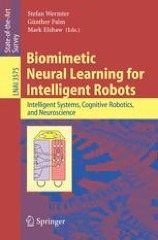
Biomimetic neural learning for intelligent robots : Intelligent systems, cognitive robotics, and neuroscience
This book presents research performed as part of the EU project on biomimeticmultimodal learning in a mirror neuron-based robot (MirrorBot) and contribu-tions presented at the International AI-Workshop on NeuroBotics. The over-all aim of the book is to present a broad spectrum of current research intobiomimetic neural learning for intelligent autonomous robots. In this book we show the development of newtechniques using cell assemblies, associative neural networks, and Hebbian-typelearning in order to associate vision, language and motor concepts. We havedeveloped biomimetic multimodal learning and language instruction in a robotto investigate the task of searching for objects. As well as the research performedin this area for the MirrorBot project, the second part of this book incorporatessignificant contributions from other research in the field of biomimetic robotics.This second part of the book concentrates on the progress made in neuroscienceinspired robotic learning approaches (in short: NeuroBotics). We hope that this book stimulates and encourages new research in this in-teresting and dynamic area.
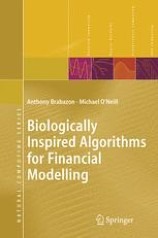
Biologically Inspired Algorithms for Financial Modelling
Then Part I provides a thorough guide to the various bioinspired methodologies – neural networks, evolutionary computing (particularly genetic algorithms and grammatical evolution), particle swarm and ant colony optimization, and immune systems. Part II brings the reader through the development of market trading systems. Finally, Part III examines real-world case studies where BIA methodologies are employed to construct trading systems in equity and foreign exchange markets, and for the prediction of corporate bond ratings and corporate failures.
Biological and artificial intelligence environments
The book reports the proceedings of the 15th Italian workshop on neural networks issued by the Italian Society on Neural Networks SIREN. The longevity recipe of this conference stands in three main points that normally renders the reading of these proceedings so interesting as appealing. 1. The topics of the neural networks is considered an attraction pole for a set of researches centered on the inherent paradigm of the neural networks, rather than on a specific tool exclusively. Thus, the subsymbolic management of the data information content constitutes the key feature of papers in various fields such as Pattern Recognition, Stochastic Optimization, Learning, Granular Computing, and so on, with a special bias toward bioinformatics operational applications. An excerpt of all these matters may be found in the book. 2. Though managed at domestic level, the conference attracts contributions from foreign researchers as well, so that in the book the reader may capture the flavor of the state of the art in the international community. 3. The conference is a meeting of friends as well. Thus the papers generally reflect a relaxed atmosphere where researchers meet to generously exchange their thought and explain their actual results in view of a common cultural growing of the community.

Bio-inspired modeling of cognitive tasks ; 2nd International Work-conference on the interplay between natural and artificial computation, IWINAC 2007, La Manga del Mar Menor, Spain, June 18-21, 2007, Proceedings, Part I
This volume includes all the contributions mainly related with theoretical, conceptual and methodological aspects linking AI and knowledge engineering with neurophysiology, clinics and cognition.

Bio-inspired computational intelligence and applications ; International conference on life system modeling, and simulation, LSMS 2007, Shanghai, China, September 14-17, 2007. Proceedings
It covers both micro and macro c- ponents ranging from cells, tissues and organs across to organisms and ecologic niches. These interact and evolve to produce an overall complex system whose beh- ior is difficult to comprehend and predict.The arrival of the 21st century has been marked by a resurgence of research interest both in arriving at a systems-level und- standing of biology and in applying such knowledge in complex real-world appli- tions. Consequently, computational methods and intelligence in systems, biology, as well as bio-inspired computational intelligence, have emerged as key drivers for new computational methods. For this reason papers dealing with theory, techniques and real-world applications relating to these two themes were especially solicited.
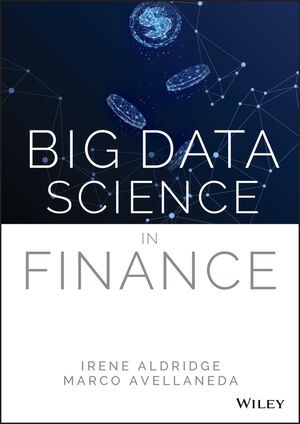
Big Data Science in Finance
Explains the mathematics, theory, and methods of Big Data as applied to finance and investing Examines the mathematics, theory, and practical use of the revolutionary techniques that are transforming the industry. Designed for mathematically-advanced students and discerning financial practitioners alike, this energizing book presents new, cutting-edge content based on world-class research taught in the leading Financial Mathematics and Engineering programs in the world. Marco Avellaneda, a leader in quantitative finance, and quantitative methodology author Irene Aldridge help readers harness the power of Big Data. Provides a complete account of Big Data that includes proofs, step-by-step applications, and code samples Explains the difference between Principal Component Analysis (PCA) and Singular Value Decomposition (SVD) Covers vital topics in the field in a clear, straightforward manner Compares, contrasts, and discusses Big Data and Small Data Includes Cornell University-tested educational materials such as lesson plans, end-of-chapter questions, and downloadable lecture slides
Big Data : Conceptual Analysis and Applications
The book is devoted to the analysis of big data in order to extract from these data hidden patterns necessary for making decisions about the rational behavior of complex systems with the different nature that generate this data. To solve these problems, a group of new methods and tools is used, based on the self-organization of computational processes, the use of crisp and fuzzy cluster analysis methods, hybrid neural-fuzzy networks, and others. The book solves various practical problems. In particular, for the tasks of 3D image recognition and automatic speech recognition large-scale neural networks with applications for Deep Learning systems were used.

Beyond the Worst-Case Analysis of Algorithms
There are no silver bullets in algorithm design, and no single algorithmic idea is powerful and flexible enough to solve every computational problem. Nor are there silver bullets in algorithm analysis, as the most enlightening method for analyzing an algorithm often depends on the problem and the application. However, typical algorithms courses rely almost entirely on a single analysis framework, that of worst-case analysis, wherein an algorithm is assessed by its worst performance on any input of a given size. The purpose of this book is to popularize several alternatives to worst-case analysis and their most notable algorithmic applications, from clustering to linear programming to neural network training. Forty leading researchers have contributed introductions to different facets of this field, emphasizing the most important models and results, many of which can be taught in lectures to beginning graduate students in theoretical computer science and machine learning.

Beginning deep learning with TensorFlow : Work with Keras, MNIST data sets, and advanced neural networks
Stats with an introduction to AI, where you’ll learn the history of neural networks and what sets deep learning apart from other varieties of machine learning. Discovery the variety of deep learning frameworks and set-up a deep learning development environment. Next, you’ll jump into simple classification programs for hand-writing analysis. Once you’ve tackled the basics of deep learning, you move on to TensorFlow 2 specifically. Find out what exactly a Tensor is and how to work with MNIST datasets. Finally, you’ll get into the heavy lifting of programming neural networks and working with a wide variety of neural network types such as GANs and RNNs. Deep Learning is a new area of Machine Learning research widely used in popular applications, such as voice assistant and self-driving cars. Work through the hands-on material in this book and become a TensorFlow programmer! You will: Develop using deep learning algorithms Build deep learning models using TensorFlow 2 Create classification systems and other, practical deep learning applications
Aspects of mathematical modelling : Applications in science, medicine, economics and management
The construction of mathematical models is an essential scientific activity. Mathematics has long been associated with developments in the exact sciences and engineering, but more recently mathematical modelling has been used to investigate complex systems that arise in many other fields. The contributors to this book demonstrate the application of mathematics to modern research topics in ecology and environmental science, health and medicine, phylogenetics and neural networks, theoretical chemistry, economics and management. The reader will find some review papers outlining current research directions in hot topics such as pattern formation and applications to medicine, and more targeted research papers on current developments in the various disciplines included.
Aspects of Automatic Text Analysis
This book It collects contributions of authors from a multidisciplinary area who focus on the topic of automatic text analysis from several (i.e. linguistic, mathematical, and information theoretical) perspectives. It describes methodological as well as methodical foundations and collects approaches in the field of text and corpus linguistics. In this sense, it contributes to the computational linguistic and information theoretical grounding of automatic text analysis.
