



الصفحة 11
الصفحة 11
Modeling and Retrieval of Context ; 2nd International Workshop, MRC 2005, Edinburgh, UK, July 31-August 1, 2005, Revised Selected Papers
Computing in context has become a necessity in modern and intelligent IT - plications. With the use of mobile devices and current research on ubiquitous computing, context-awareness has become a major issue. However, context and context-awareness are crucial not only for mobile and ubiquitous computing. They are also vital for spanning various application areas, such as collaborative softwareand Web engineering,personaldigital assistantsand peer-to-peer inf- mation sharing, health care work?ow and patient control, and adaptive games and e-learning solutions. In these areas, context serves as a major source for reasoning, decision making, and adaptation, as it covers not only application knowledge but also environmental knowledge.Likewise, modeling and retrieving context is an important part of modern knowledge management processes.
Modeling and Management of Fuzzy Semantic RDF Data
Presents the latest research findings in fuzzy RDF data modeling and management. Fuzziness widely exist in many data and knowledge intensive applications. With the increasing amount of metadata available, efficient and scalable management of massive semantic data with uncertainty is of crucial importance. This book goes to great depth concerning the fast-growing topic of technologies and approaches of modeling and managing fuzzy metadata with Resource Description Framework (RDF) format. Its major topics include representation of fuzzy RDF data, fuzzy RDF graph matching, query of fuzzy RDF data, and persistence of fuzzy RDF data in diverse databases. The objective of the book is to provide the state-of-the-art information to researchers, practitioners, and postgraduates students who work on the area of big data intelligence and at the same time serve as the uncertain data and knowledge engineering professional as a valuable real-world reference.

Modeling and Control of Discrete-event Dynamic Systems : with Petri Nets and Other Tools
Discrete-event dynamic systems (DEDs) permeate our world, being of great importance in modern manufacturing processes, transportation and various forms of computer and communications networking. Modeling and Control of Discrete-event Dynamic Systems begins with the mathematical basics required for the study of DEDs and moves on to present various tools used in their modeling and control. Among the instruments explained are many forms of Petri net, Grafcet (the sequential function chart), state charts, formal languages and max-plus algebra; all essential for control students to become proficient with DEDs and to make use of them in practical applications.

Modeling and Control of Antennas and Telescopes
Modeling and Control of Antennas and Telescopes presents the author’s research and field experience in the area of antenna modeling, dynamics, and control. The required spacecraft tracking accuracy of 1 mdeg was the impetus for the new approaches to the antenna controls that use model based controllers (LQG and H¥ ). Consequently, modeling also required a new approach using system identification techniques. Most of the material presented is new in the telescope industry. The methods have been not only analyzed and tested, but actually implemented, giving confidence in the final result, which is significantly increased antenna pointing accuracy.

Modeling and computations in electromagnetics ; A volume dedicated to Jean-Claude Nédélec
Modeling and computations in electromagnetics is a quite novel and growing discipline, expanding as a result of the steadily increasing demand for designing electrical devices, modeling electromagnetic materials, and simulating electromagnetic fields in nanoscale structures. The aim of this volume is to bring together prominent worldwide experts to review state-of-the-art developments and future trends of modeling and computations in electromagnetics. This volume is devoted to merging the expertise of scientists working in this dynamic discipline, and to raising interest for challenging issues. The most significant advances in computational techniques have been made only in the last few years, and several challenging technological applications are presented in this volume.

Modeling and computation of boundary-layer flows : Laminar, turbulent and transitional boundary layers in incompressible and compressible flows
This second edition of our book extends the modeling and calculation of boundary-layer flows to include compressible flows. The subjects cover laminar, transitional and turbulent boundary layers for two- and three-dimensional incompressible and compressible flows. The viscous-inviscid coupling between the boundary layer and the inviscid flow is also addressed. The book has a large number of homework problems.

Modeling and Analysis of Transient Processes in Open Resonant Structures : New Methods and Techniques
The principal goal of the book is to describe new accurate and robust algorithms for open resonant structures with substantially increased efficiency. The book presents a systematic approach to the study of electromagnetic waves scattering which can be introduced in undergraduate/postgraduate education in theoretical and applied radiophysics and different advanced engineering courses on antenna and wave-guide technology.
Model-Driven Testing : Using the UML Testing Profile
Written by the original members of this standardization group, this book shows you how to use UML to test complex software systems. The authors introduce UTP step-by-step, using a case study that illustrates how UTP can be used for test modeling and test specification. You’ll learn how UTP concepts can be used for functional and non-functional testing, with example applications and best practices for user-interfaces and service oriented architectures. In addition, the authors demonstrate how to apply UTP using frameworks like TTCN-3 and the JUnit test framework for Java.
Model-Driven Software Development
Abstraction is the most basic principle of software engineering. Abstractions are provided by models. Modeling and model transformation constitute the core of model-driven development. Models can be refined and finally be transformed into a technical implementation, i.e., a software system. The aim of this book is to give an overview of the state of the art in model-driven software development. Achievements are considered from a conceptual point of view in the first part, while the second part describes technical advances and infrastructures. Finally, the third part summarizes experiences gained in actual projects employing model-driven development. Beydeda, Book and Gruhn put together the results from leading researchers in this area, both from industry and academia. The result is a collection of papers which gives both researchers and graduate students a comprehensive overview of current research issues and industrial forefront practice, as promoted by OMG’s MDA initiative.
Model-Driven Development of Reliable Automotive Services ; 2nd Automotive Software Workshop, ASWSD 2006, San Diego, CA, USA, March 15-17, 2006, Revised Selected Papers
This book constitutes the thoroughly refereed post-workshop proceedings of the Second Automotive Software Workshop, ASWSD 2006, held in San Diego, CA, USA in March 2006.The 11 revised full papers presented were carefully reviewed and selected from 18 lectures held at the workshop, that brought together experts from industry and academia, working on highly complex, distributed, reactive software systems related to the automotive domain. The papers are organized in topical sections on modeling techniques and infrastructures, model transformations, quality assurance, real-time control, as well as services and components.
Model-Driven Design Using Business Patterns
This book takes exactly this step: it shows you how to apply the pattern ideas in business applications and presents more than 20 structural and behavioral business patterns that use the REA (resources, events, agents) pattern as a common backbone. If you are a developer working on business frameworks, you can use the patterns presented to derive the right abstractions (e.g., business objects) and to design and ensure that the meta-rules (e.g., process patterns) are followed by the developers of the actual applications. And if you are an application developer, you can use these patterns to design your business application, to ensure that it does not violate the domain rules, and to adapt the application to changing requirements without the need to change the overall architecture. As with patterns in general, this approach allows for both more flexible and more solid software architectures and hence better software quality.
Model-driven architecture in practice ; A Software Production Environment Based on Conceptual Modeling
This book introduces all the relevant information required to understand and put Model Driven Architecture (MDA) into industrial practice. The book combines a sound theoretical approach based on more than 10 years' research.

Model-Driven Architecture - Foundations and Applications ; 2nd European Conference, ECMDA-FA 2006, Bilbao, Spain, July 10-13, 2006, Proceedings
The goal of the European Conference on Model-Driven Architecture — Foundations and Applications (ECMDA-FA) is to bring together industry and academia to tackle the problems in model-driven development. This volume includes 18 foundation papers and 12 application papers, which is a fine balance between both worlds. ECMDA-FA 2006 also hosted six workshops on both theoretical and practical aspects of MDA. Furthermore, the keynote speakers, David Frankel and Bran Selic, from some of the world’s largest IT companies proved that industry is very much involved in MDA. This second ECMDA-FA conference is the result of the work of the authors who submitted a total of 78 papers, the Program Committee members who took the effort to review the papers, the people organizing the workshops, and of course the Steering Committee. All in all, several hundreds of people have worked hard to make this conference a success.

Model-Based Testing of Reactive Systems : Advanced Lectures
This book is based on a seminar held in Dagstuhl Castle, Germany, in January 2004. It presents 19 carefully reviewed and revised lectures given at the seminar in a well-balanced way ensuring competent complementary coverage of all relevant aspects. An appendix provides a glossary for model-based testing and basics on finite state machines and on labelled transition systems. The lectures are presented in topical sections on testing of finite state machines, testing of labelled transition systems, model-based test case generation, tools and case studies, standardized test notation and execution architectures, and beyond testing.
Model-Based Software and Data Integration ; 1st International Workshop, MBSDI 2008, Berlin, Germany, April 1-3, 2008. Proceedings
The First International Workshop on Model-Based Software and Data Integ- tion (MBSDI 2008), was ourfrst event of this kind in a forthcoming series of activities at TU Berlin, where a scientifc discussion and exchange forum was provided for both academic and industrial researchers. We aimed at researchers, engineersand practitionerswho focus onadvanced, model-basedsolutions inthe area of software and information integration and interoperability. As withevery beginning, the resonanceonour callsin today's overfoodingof workshops was somewhat unpredictable, and we did not really know how many paper submissions to expect. We were nicely surprised, considering the rather short lead time to organize the meeting and the very specialized and focused topic.

Model-Based Reasoning in Science, Technology, and Medicine
The volume is based on the papers that were presented at the international conference Model-Based Reasoning in Science and Medicine (MBR’06 China), held at Sun Yat-sen University, Guangzhou, P.R. China in July 2006. The presentations given at the conference explored how scientific thinking uses models and explanatory reasoning to produce creative changes in theories and concepts. Some addressed the problem of model-based reasoning in technology, and stressed the issue of technological innovation and medical reasoning. The various contributions of the book are written by interdisciplinary researchers who are active in the area of creative reasoning in science and technology: the most recent results and achievements about the topics above are illustrated in detail in the papers.

Model-based Process Supervision : A Bond Graph Approach
Model-based fault detection and isolation requires a mathematical model of the system behaviour. Modelling is important and can be difficult because of the complexity of the monitored system and its control architecture. The authors use bond-graph modelling, a unified multi-energy domain modelling method, to build dynamic models of process engineering systems by composing hierarchically arranged sub-models of various commonly encountered process engineering devices. The structural and causal properties of bond-graph models are exploited for supervisory systems design.

Model-based Geostatistics
Geostatistics is concerned with estimation and prediction problems for spatially continuous phenomena, using data obtained at a limited number of spatial locations. The name reflects its origins in mineral exploration, but the methods are now used in a wide range of settings including public health and the physical and environmental sciences. Model-based geostatistics refers to the application of general statistical principles of modeling and inference to geostatistical problems. This volume is the first book-length treatment of model-based geostatistics. The authors have written an expository text, emphasizing statistical methods and applications rather than the underlying mathematical theory. Analyses of datasets from a range of scientific contexts feature prominently, and simulations are used to illustrate theoretical results. Readers can reproduce most of the computational results in the book by using the authors' R-based software package, geoR, whose usage is illustrated in a computation section at the end of each chapter.

Model-based Fault Diagnosis Techniques : Design Schemes, Algorithms, and Tools
The objective of this book is to introduce basic model-based FDI schemes, advanced analysis and design algorithms and the needed mathematical and control theory tools at a level for graduate students and researchers as well as for engineers.
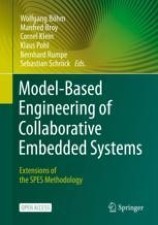
Model-Based Engineering of Collaborative Embedded Systems : Extensions of the SPES Methodology
This book presents the results of the "Collaborative Embedded Systems" (CrESt) project, aimed at adapting and complementing the methodology underlying modeling techniques developed to cope with the challenges of the dynamic structures of collaborative embedded systems (CESs) based on the SPES development methodology.
