



الصفحة 11
الصفحة 11

Cross-linguistic Variation in Sentence Processing : Evidence From R C Attachment Preferences in Greek
This book argues in favour of cross-linguistic variation in sentence processing by providing empirical data from ambiguity resolution in Greek as L1 and L2. It is maintained that in highly inflected languages, like Greek, initial parsing decisions are determined by the interaction of morphological and lexical cues rather than by universal parsing principles. During the initial parse, discourse-level information is constrained by lexical considerations, which indicates that the human sentence processor is a multi-stage mechanism.

Core Java ; Vol. I : Fundamentals ; 12th ed.
The definitive guide to writing robust, maintainable code. Whatever version of Java you are using—up to and including Java 17—this book will help you achieve a deep and practical understanding of the language and APIs. With hundreds of realistic examples, Cay S. Horstmann reveals the most powerful and effective ways to get the job done.
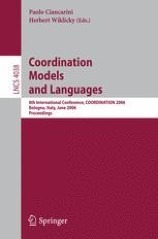
Coordination models and languages ; Vol.4038 ; 8th International Conference, COORDINATION 2006, Bologna, Italy, June 14-16, 2006, Proceedings
This book constitutes the refereed proceedings of the 8th International Conference on Coordination Models and Languages, COORDINATION 2006, held in Bologna, Italy, June 2006. The 17 revised full papers presented were carefully reviewed and selected from 50 submissions. Among the topics addressed are component connectors, negotiation in service-oriented computing, process algebraic specification, workflow patterns, reactive XML, ubiquitous coordination, type systems, ad-hoc network coordination, choreography, communication coordination, and distributed embedded systems.

Coordination models and languages ; Vol.3454 : 7th international conference, COORDINATION 2005, Namur, Belgium, April 20-23, 2005, Proceedings
This book constitutes the refereed proceedings of the 7th International Conference on Coordination Models and Languages, COORDINATION 2005, held in Namur, Belgium in April 2005. The 19 revised full papers presented were carefully reviewed and selected from 88 submissions. Among the topics addressed are Web services, safe ambients, process calculus, abstract verification, role-based software, delegation modeling, distributed information flow, adaptive Web content provision, global computing, mobile agents, mobile computing, multithreaded code generation, shared data space coordination languages, automata specifications, time aware coordination, and service discovery.

Coordination models and languages ; 9th International Conference, COORDINATION 2007, Paphos, Cyprus, June 6-8, 2007, Proceedings
he volume examines how to increase modularity, simplify reasoning, and ultimately enhance today's software development by exploring the spectrum of languages, middleware, services, and algorithms. The papers are organized in topical sections on middleware, logic programming, formal approaches, concurrency, components and services, as well as MANets.

Coordination models and languages ; 23rd IFIP WG 6.1 International Conference, COORDINATION 2021, Held as Part of the 16th International Federated Conference on Distributed Computing Techniques, DisCoTec 2021, Valletta, Malta, June 14–18, 2021, Proceedings
This book constitutes the refereed proceedings of the 23rd IFIP WG 6.1 International Conference on Coordination Models and Language, COORDINATION 2021, held in Valletta, Malta, in June 2021, as part of the 16th International Federated Conference on Distributed Computing Techniques, DisCoTec 2021. The 15 regular papers, 2 short papers, and 1 tutorial paper presented in this book were carefully reviewed and selected from 31 submissions. COORDINATION provides a well-established forum for the growing community of researchers interested in coordination models and languages, architectures, verification and implementation techniques necessary to cope with the complexity induced by the demands of today's software development.
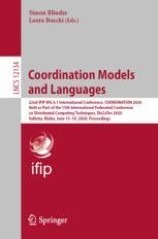
Coordination models and languages ; 22nd IFIP WG 6.1 International Conference, COORDINATION 2020, Held as Part of the 15th International Federated Conference on Distributed Computing Techniques, DisCoTec 2020, Valletta, Malta, June 15–19, 2020, Proceedings
This book constitutes the proceedings of the 22nd International Conference on Coordination Models and Languages, COORDINATION 2020, which was due to be held in Valletta, Malta, in June 2020, as part of the 15th International Federated Conference on Distributed Computing Techniques, DisCoTec 2020. The conference was held virtually due to the COVID-19 pandemic. The 12 full papers and 6 short papers included in this volume were carefully reviewed and selected from 30 submissions. They are presented in this volume together with 2 invited tutorials and 4 tool papers. The papers are organized in the following topical sections: tutorials; coordination languages; message-based communication; communications: types & implementations; service-oriented computing; large-scale decentralized systems; smart contracts; modelling; verification & analysis.

Coordination models and languages ; 10th International Conference, COORDINATION 2008, Oslo, Norway, June 4-6, 2008. Proceedings
This book constitutes the refereed proceedings of the 10th International Conference on Coordination Models and Languages, COORDINATION 2008, held in Oslo, Norway, in June 2008, as one of the federated conferences on Distributed Computing Techniques, DisCoTec 2008.

Constraint solving and language processing
Contains selected and thoroughly revised papers plus contributions from invited speakers presented at the First International Workshop on C- straint Solving and Language Processing, held in Roskilde, Denmark, September 1–3, 2004. Constraint Programming and Constraint Solving, in particular Constraint Logic Programming, appear to be a very promising platform, perhaps the most promising present platform, for bringing forward the state of the art in natural language processing, this due to the naturalness in speci?cation and the direct relation to e?cient implementation. Language, in the present context, may - fer to written and spoken language, formal and semiformal language, and even general input data to multimodal and pervasive systems, which can be handled in very much the same ways using constraint programming. The notion of constraints, with slightly differing meanings, apply in the characterization of linguistic and cognitive phenomena, in formalized linguistic m- els as well as in implementation-oriented frameworks. Programming techniques for constraint solving have been, and still are, in a period with rapid devel- ment of new eficient methods and paradigms from which language processing can prompt. A common metaphor for human language processing is one big c- straint solving process in which the differently specified linguistic and cognitive phases take place in parallel and with mutual cooperation, which ?ts quite well with current constraint programming paradigms.

Constraint handling rules : Current research topics
The Constraint Handling Rules (CHR) language is a declarative concurrent committed-choice constraint logic programming language consisting of guarded rules that transform multisets of relations called constraints until no more change occurs. The aim of this volume was to attract high-quality research papers on these recent advances in Constraint Handling Rules.
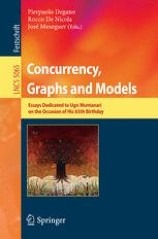
Concurrency, Graphs and Models : Essays Dedicated to Ugo Montanari on the Occasion of His 65th Birthday
The volume consists of seven sections, six of which are dedicated to the main research areas to which Ugo Montanari has contributed: Graph Transformation; Constraint and Logic Programming; Software Engineering; Concurrency; Models of Computation; and Software Verification.

Concurrency Theory : Calculi an Automata for Modelling Untimed and Timed Concurrent Systems
Concurrency Theory is a synthesis of one of the major threads of theoretical computer science research focusing on languages and graphical notations for describing collections of simultaneously evolving components that interact through synchronous communication. The main specification notation focused on in this book is LOTOS. An extensive introduction to this particular process calculus is given, highlighting how the approach differs from competitor techniques, such as CCS and CSP.

CONCUR 2008 - Concurrency Theory ; 19th International Conference, CONCUR 2008, Toronto, Canada, August 19-22, 2008. Proceedings
This book constitutes the refereed proceedings of the 19th International Conference on Concurrency Theory, CONCUR 2008, held in Toronto, Canada, August 19-22, 2008.

CONCUR 2007 – Concurrency Theory ; 18th International Conference, CONCUR 2007, Lisbon, Portugal, September 3-8, 2007, Proceedings
This book includes model checking, process calculi, minimization and equivalence checking, types, semantics, probability, bisimulation and simulation, real time, and formal languages.

Conceptual Structures : Knowledge Visualization and Reasoning; 16th International Conference on Conceptual Structures, ICCS 2008 Toulouse, France, July 7-11, 2008 Proceedings
This book constitutes the refereed proceedings of the 16th International Conference on Conceptual Structures, ICCS 2008, held in Toulouse, France, in July 2008.

Conceptual Modeling of Information Systems
When designing an information system, conceptual modeling is the activity that elicits and describes the general knowledge the system needs to know. This description, called the conceptual schema, is necessary in order to develop an information system.textbook explains in detail the principles of conceptual modeling independently from particular methods and languages and shows how to apply them in real-world projects. It covers all aspects of the engineering process from structural modeling over behavioral modeling to meta-modeling, and completes the presentation with an extensive case study based on the osCommerce system, an online store-management software program freely available under the GNU General Public License. His presentation is based on well-known industry standards like UML and OCL as a particular conceptual modeling language, yet also delivers the basics of the formal logical language background.

Conceptual Modeling - ER 2008 ; 27th International Conference on Conceptual Modeling, Barcelona, Spain, October 20-24, 2008. Proceedings
This book constitutes the refereed proceedings of the 27th International Conference on Conceptual Modeling, ER 2008, held in Barcelona, Spain, in October 2008.

Conceptual Modeling - ER 2007 ; 26th International Conference on Conceptual Modeling, Auckland, New Zealand, November 5-9, 2007, Proceedings
Conceptual modeling is fundamental to the development of complex systems, because it provides the key communication means between systems developers, end-users and customers.Conceptua lmodeling provides languages,methods and tools to understand and represent the application domain;to elicitate,concepalize and formalize system requirements and user needs;to communicate systems designs to all stakeholders; to formally verify and validate system designs on high levels of abstractions; and to minimize ambiguities in system development. Initially, conceptual modeling mainly addressed data-intensive information s- tems and contributed to data modeling and database application engineering. The area of conceptual modeling has now matured to encompass all kinds of application areas such as e-applications (including e-business and e-learning), web-based systems (including the semantic web and ubiquitous systems), life science and geographic applications.

Concepts and Semantics of Programming Languages 2 : Modular and Object-oriented Constructs with OCaml, Python, C++, Ada and Java
Explores the syntactical constructs of the most common programming languages, and sheds a mathematical light on their semantics, providing also an accurate presentation of the material aspects that interfere with coding. Presents an original semantic model, collectively taking into account all of the constructs and operations of modules and classes: visibility, import, export, delayed definitions, parameterization by types and values, extensions, etc. The model serves for the study of Ada and OCaml modules, as well as C header files. It can be deployed to model object and class features, and is thus used to describe Java, C++, OCaml and Python classes.

Concepts and Semantics of Programming Languages 1 : A Semantical Approach with OCaml and Python
Explores the syntactical constructs of the most common programming languages, and sheds a mathematical light on their semantics, while also providing an accurate presentation of the material aspects that interfere with coding. It is dedicated to functional and imperative features. Included is the formal study of the semantics of typing and execution; their acquisition is facilitated by implementation into OCaml and Python, as well as by worked examples. Data representation is considered in detail: endianness, pointers, memory management, union types and pattern-matching, etc., with examples in OCaml, C and C++. The second volume introduces a specific model for studying modular and object features and uses this model to present Ada and OCaml modules, and subsequently Java, C++, OCaml and Python classes and objects.
