



الصفحة 11
الصفحة 11

Exogenous and endogenous factors affecting happiness, happy mind, happy life
Emotions are the language of the soul. Our brain is the emotional center where every emotion is produced including happiness. Happiness underlying factors are considerable from two dimensions: endogenous factors and exogenous factors Therefore, this research aimed to consider biological factors that underlie happiness. The research is divided into several sub-groups (brain, genetics, neurotransmitters, endocrinology, hormones, drugs, diseases, and other exogenous factors). In spite of difficulties in finding special genes, several genes distributed to emotion and mood. Neuroscience studies showed that some part of brain (e.g. amygdala, hipocamp and limbic system) and neurotransmitters (e.g. dopamine, serotonin, norepinefrine and endorphin) play a role in control of happiness. A few studies pointed to the role of cortisol and adrenaline (adrenal gland) and oxitocin (pituitary gland) in controlling happiness.

Evolvable systems : From biology to hardware ; 6th International Conference, ICES 2005, Sitges, Spain, September 12-14, 2005, Proceedings
The flying machines proposed by Leonardo da Vinci in the fifteenth century, the se- reproducing automata theory proposed by John von Neumann in the middle of the twentieth century and the current possibility of designing electronic and mechanical systems using evolutionary principles are all examples of the efforts made by humans to explore the mechanisms present in biological systems that permit them to tackle complex tasks. These initiatives have recently given rise to the emergent field of b- inspired systems and evolvable hardware. The inaugural workshop, Towards Evolvable Hardware, took place in Lausanne in October 1995, followed by the successive events of the International Conference on Evolvable Systems: From Biology to Hardware, held in Tsukuba (Japan) in October 1996, in Lausanne (Switzerland) in September 1998, in Edinburgh (UK) in April 2000, in Tokyo (Japan) in October 2001, and in Trondheim (Norway) in March 2003. Following the success of these past events the sixth international conference was aimed at presenting the latest developments in the field, bringing together researchers who use biologically inspired concepts to implement real systems in artificial intelligence, artificial life, robotics, VLSI design, and related domains. The sixth conference consolidated this biennial event as a reference meeting for the community involved in bio-inspired systems research. All the papers received were reviewed by at least three independent reviewers, thus guaranteeing a high-quality bundle for ICES 2005.

Evolutionary Scheduling
Evolutionary scheduling is a vital research domain at the interface of two important sciences - artificial intelligence and operational research. Scheduling problems are generally complex, large scale, constrained, and multi-objective in nature, and classical operational research techniques are often inadequate at solving them effectively. With the advent of computation intelligence, there is renewed interest in solving scheduling problems using evolutionary computational techniques. These techniques, which include genetic algorithms, genetic programming, evolutionary strategies, memetic algorithms, particle swarm optimization, ant colony systems, etc, are derived from biologically inspired concepts and are well-suited to solve scheduling problems since they are highly scalable and flexible in terms of handling constraints and multiple objectives. This edited book gives an overview of many of the current developments in the large and growing field of evolutionary scheduling, and demonstrates the applicability of evolutionary computational techniques to solve scheduling problems, not only to small-scale test problems, but also fully-fledged real-world problems.

Evolutionary Microeconomics
Classical microeconomics is intended to explain how a price system is able to coordinate the economic agents. But even if it can be extended to incomplete information and externalities, it remains grounded on very heroic assumptions. Agents are endowed with a very strong rationality, equilibrium is stated without a concrete process to achieve it, market is the unique institution considered. Evolutionary microeconomics is aimed at bypassing these limitations by considering a dynamic approach, however not biologically oriented.

Evolutionary Genomics : Statistical and Computational Methods
This book addresses the challenge of analyzing and understanding the evolutionary dynamics of complex biological systems at the genomic level, and elaborates on some promising strategies that would bring us closer to uncovering of the vital relationships between genotype and phenotype. After a few educational primers, the book continues with sections on sequence homology and alignment, phylogenetic methods to study genome evolution, methodologies for evaluating selective pressures on genomic sequences as well as genomic evolution in light of protein domain architecture and transposable elements, population genomics and other omics, and discussions of current bottlenecks in handling and analyzing genomic data. Written for the highly successful Methods in Molecular Biology series, chapters include the kind of detail and expert implementation advice that lead to the best results.

Evolutionary Computer Music
The evolutionary computation approach to music is an exciting new development for composers and musicologists alike. For composers, it provides an innovative and natural means for generating musical ideas from a specifiable set of primitive components and processes. For musicologists, these techniques are used to model the cultural transmission and change of a population's body of musical ideas over time. In both cases, musical evolution can be guided by a variety of constraints and tendencies built into the system, such as realistic psychological factors that influence the way music is expressed, experienced, learned, stored, modified, and passed on among individuals. This book discusses not only the applications of evolutionary computation to music, but also the tools needed to create and study such systems. These tools are drawn in part from research into the origins and evolution of biological organisms, ecologies, and cultural systems on the one hand, and from computer simulation methodologies on the other. They can be combined to create surrogate artificial worlds populated by interacting simulated organisms in which complex musical experiments can be performed that would otherwise be impossible.
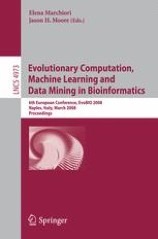
Evolutionary computation, machine learning and data mining in bioinformatics ; 6th European Conference, EvoBIO 2008, Naples, Italy, March 26-28, 2008. Proceedings
The feld of bioinformatics has two main objectives: the creation and main- nance of biological databases, and the discovery of knowledge from life sciences data in order to unravel the mysteries of biological function, leading to new drugs and therapies for human disease. Life sciences data come in the form of biological sequences, structures, pathways, or literature. One major aspect of discovering biological knowledge is to search, predict, or model specifc infortioninagivendatasetinorderto generate new in teresting knowledge.Computer science methods such as evolutionary computation, machine learning, and data mining all have a great deal to ofer the feld of bioinformatics.

Evolutionary computation, machine learning and data mining in bioinformatics ; 5th European Conference, EvoBIO 2007, Valencia, Spain, April 11-13, 2007, Proceedings
This book Covers brings together experts in computer science with experts in bioinformatics and the biological sciences. It presents contributions on fundamental and theoretical issues along with papers dealing with different applications areas.

Evolutionary Computation for Modeling and Optimization
Evolutionary Computation for Optimization and Modeling is an introduction to evolutionary computation, a field which includes genetic algorithms, evolutionary programming, evolution strategies, and genetic programming. The text is a survey of some application of evolutionary algorithms. It introduces mutation, crossover, design issues of selection and replacement methods, the issue of populations size, and the question of design of the fitness function. It also includes a methodological material on efficient implementation. Some of the other topics in this book include the design of simple evolutionary algorithms, applications to several types of optimization, evolutionary robotics, simple evolutionary neural computation, and several types of automatic programming including genetic programming. The book gives applications to biology and bioinformatics and introduces a number of tools that can be used in biological modeling, including evolutionary game theory. Advanced techniques such as cellular encoding, grammar based encoding, and graph based evolutionary algorithms are also covered.

Evolutionary Biology from Concept to Application
this book provides an up-to-date overview of evolutionary concepts and how these concepts can be applied to a better understanding of various biological aspects. It is divided into the following four parts: Modelization of Evolution - Concepts in Evolutionary Biology - Knowledge - Applied Evolutionary Biology.This book is an invaluable source of information not only for evolutionary biologists, but also for biologists in general.

Evolution from Cellular to Social Scales
Evolution is a critical challenge for many areas of science, technology and development of society. The book reviews general evolutionary facts such as origin of life and evolution of the genome and clues to evolution through simple systems. Emerging areas of science such as "systems biology" and "bio-complexity" are founded on the idea that phenomena need to be understood in the context of highly interactive processes operating at different levels and on different scales. This is where physics meets complexity in nature, and where we must begin to learn about complexity if we are to understand it. Similarly, there is an increasingly urgent need to understand and predict the evolutionary behavior of highly interacting man-made systems, in areas such as communications and transport, which permeate the modern world. The same applies to the evolution of human networks such as social, political and financial systems, where technology has tended to vastly increase both the complexity and speed of interaction, which is sometimes effectively instantaneous.

Eukaryotic Membranes and Cytoskeleton : Origins and Evolution
Eukaryotic Membranes and Cytoskeleton: Origins and Evolution discusses the evolutionary origin and diversification of eukaryotic endomembranes and cytoskeleton from a cell biological and comparative genomic perspective. Many of the chapters present original research data from comparative genomic surveys. The presence/absence of gene families with central roles in endomembrane and cytoskeleton dynamics in a variety of eukaryotic taxa and an understanding of eukaryote phylogeny allow us to accurately reconstruct the cellular machineries present in the last common ancestor of eukaryotes. Such a reconstruction is fundamental if we are to understand eukaryotic diversification since this is the ancestral cell from which all diversity arose. Comparative genomics can likewise tell us which lineages expanded or reduced certain gene families and the associated cellular machineries.

Ethylene Action in Plants
The plant hormone ethylene plays a prominent role among several intrinsic and extrinsic factors that control growth and physiology of plants. Its biological activity was discovered over a century ago. However, extensive studies on its mode of action came later. To date, it is well documented that ethylene is a versatile signaling molecule that plays an important role in many physiological processes - like growth, senescence, fruit ripening, stress responses, symbioses, and photosynthesis. Molecular-genetic analyses have revealed mechanisms responsible for ethylene production, perception, and signal transduction. The present work brings into focus the recent developments on the biochemical, physiological, and molecular basis for ethylene action in plants.

Ethnobotany and ethnopharmacology of medicinal and aromatic plants : steps towards drug discovery
Medicinal and aromatic plants are beneficial to human health. Plant-derived molecules possess biological activities that can be used to prevent many infectious diseases and metabolic disorders. Ethnobotany and Ethnopharmacology of Medicinal and Aromatic Plants summarizes techniques and methods used to study the biological activities of plant-derived extracts and compounds to study ethnobotanical and ethnopharmacological features of medicinal and aromatic plants.

Ethical and Philosophical Consideration of the Dual-Use Dilemma in the Biological Sciences
This book examines the kinds of life-science experiments that give rise to the dual-use dilemma and provides philosophical analysis of the ethical issues and policy options surrounding dual-use research. this is the first book-length treatment of the topic by professional ethicists. It also challenges, and offers an alternative perspective to, the hugely influential U.S. National Research Council position on the dual-use dilemma.

Estrogen Effects in Psychiatric Disorders
A number of studies, mostly focusing on estrogen replacement therapy in women, have reported beneficial actions of these hormones on various neurobiological and neuropathological parameters in health and disease. Recent research has focused on gender differences and there is increasing evidence that estrogens exert protective effects in schizophrenia. Hormonal fluctuations or lack of estrogen may increase the risk of depression among vulnerable women. Treatment of depression with estrogen may stabilize and restore disrupted homeostasis – as during post-partum, premenstrual, or perimenopausal conditions – and act as a psychomodulator to offset vulnerability to dysphoric mood when estrogen levels are significantly decreased, as in the case of postmenopausal women. Studies on the effect of estrogens on Alzheimer’s Disease are still rather controversial, they do, however, facilitate the hypothesis that estrogens may have a modifying effect on the onset and course of AD, at least in subgroups of patients.

Essentials of Restenosis : For the Interventional Cardiologist
Essentials of Restenosis provides the practicing cardiologists and biologists an elaborate review of the current advances in the field. The book explore the process of restenosis from bench to bedside, encompassing in equal detail the newest scientific findings of the biological mechanisms as well as the progression in development of diagnostics and treatments. The volume also provides the reader with a basic understanding of the biological process and the latest diagnostics and treatments of the disease, with an up-to-date detailed discussion of the most important recent findings.

Essentials of Dental Caries
Provides readers with an up-to-date, clinically relevant guide to dental caries. Written in an accessible style, the authors explain the biological and socioeconomic background of lesion development and progress. Current methods of clinical diagnosis and evidence based management are outlined in clearly laid out and highly illustrated chapters. This book is essential reading for students and practitioners of dentistry, dental therapy, dental hygiene, and oral health educators.

Ergodic Dynamics : From Basic Theory to Applications
This textbook provides a broad introduction to the fields of dynamical systems and ergodic theory. Motivated by examples throughout, the author offers readers an approachable entry-point to the dynamics of ergodic systems. Modern and classical applications complement the theory on topics ranging from financial fraud to virus dynamics, offering numerous avenues for further inquiry. Starting with several simple examples of dynamical systems, the book begins by establishing the basics of measurable dynamical systems, attractors, and the ergodic theorems. From here, chapters are modular and can be selected according to interest. Highlights include the Perron–Frobenius theorem, which is presented with proof and applications that include Google PageRank. An in-depth exploration of invariant measures includes ratio sets and type III measurable dynamical systems using the von Neumann factor classification. Topological and measure theoretic entropy are illustrated and compared in detail, with an algorithmic application of entropy used to study the papillomavirus genome. A chapter on complex dynamics introduces Julia sets and proves their ergodicity for certain maps. Cellular automata are explored as a series of case studies in one and two dimensions, including Conway’s Game of Life and latent infections of HIV. Other chapters discuss mixing properties, shift spaces, and toral automorphisms.

Equidosimetry : Ecological Standardization and Equidosimetry for Radioecology and Environmental Ecology
Considerable experience with radioecological and related ecological research on terrestrial and aquatic ecosystems has been achieved, especially after the Chernobyl accident. The combined effects of the radiation, chemical and biological factors, after a contamination of the environment and during its remediation have shown an interactive complexity that highlights the need for equidosimetrical evaluations of the influence of the various stressors and the need for their ecological normalization. In radioecology and radiation protection, methods of radiation dosimetry are key for dose assessment. It is therefore highly desirable to develop a clear theoretical approach as well as a practical method of equidosimetry that would allow for an ecological normalization of the different stressors in unified uniform units, especially for comparison purposes.
