



الصفحة 102
الصفحة 102
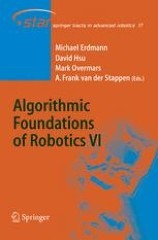
Algorithmic Foundations of Robotics VI
Robot algorithms are abstractions of computational processes that control or reason about motion and perception in the physical world. Because actions in the physical world are subject to physical laws and geometric constraints, the design and analysis of robot algorithms raises a unique combination of questions in control theory, computational and differential geometry, and computer science. Algorithms serve as a unifying theme in the multi-disciplinary field of robotics. This volume consists of selected contributions to the sixth Workshop on the Algorithmic Foundations of Robotics. This is a highly competitive meeting of experts in the field of algorithmic issues related to robotics and automation.

Algorithmic Foundation of Robotics VII : Selected Contributions of the 7th International Workshop on the Algorithmic Foundations of Robotics
This book contains the proceedings from the 2006 Workshop on the Algorithmic Foundations of Robotics. The 32 papers in this book span a wide variety of topics: from fundamental motion planning algorithms to applications in medicine and biology, but they have in common a foundation in the algorithmic problems of robotic systems.

Algorithmic Aspects in Information and Management ; 4th International Conference, AAIM 2008, Shanghai, China, June 23-25, 2008. Proceedings
This book constitutes the refereed proceedings of the 4th International Conference on Algorithmic Aspects in Information and Management, AAIM 2008, held in Shanghai, China, in June 2008.

Algorithmic Aspects in Information and Management ; 3rd International Conference, AAIM 2007, Portland, OR, USA, June 6-8, 2007, Proceedings
This Book is intended for or- inal algorithmic research on immediate applications and/or fundamental pr- lems pertinent to information management and management science, broadly construed.

Algorithmic Aspects in Information and Management ; 14th International Conference, AAIM 2020, Jinhua, China, August 10–12, 2020, Proceedings
This volume constitutes the proceedings of the 14th International Conference on Algorithmic Aspects in Information and Management, AAIM 2020, held in Jinhua, China in August 2020. The 39 full papers and 17 short papers presented were carefully reviewed and selected from 76 submissions. The papers deal with emerging important algorithmic problems with a focus on the fundamental background, theoretical technology development, and real-world applications associated with information and management analysis, modeling and data mining. Special considerations are given to algorithmic research that was motivated by real-world applications.

Algorithmic applications in management ; 1st international conference, AAIM 2005, Xian, China, June 22-25, 2005, Proceedings
The papers in this volume were presented at the 1st International Conference onAlgorithmic Applications in Management (AAIM 2005), in China. The topics cover algorithmic applications in most management-related areas.including Programming Techniques Business Strategy/Leadership Theory of Computation Algorithm Analysis and Problem Complexity Data Structures Discrete Mathematics in Computer Science
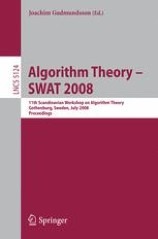
Algorithm Theory - SWAT 2008 ; 11th Scandinavian Workshop on Algorithm Theory, Gothenburg, Sweden, July 2-4, 2008. Proceedings
his book constitutes the refereed proceedings of the 11th Scandinavian Workshop on Algorithm Theory, SWAT 2008, held in Gothenborg, Sweden, in July 2008.

Algorithm Theory - SWAT 2006 ; 10th Scandinavian Workshop on Algorithm Theory, Riga, Latvia, July 6-8, 2006, Proceedings
This book constitutes the refereed proceedings of the 10th Scandinavian Workshop on Algorithm Theory, SWAT 2006, held in Riga, Latvia, in July 2006. The proceedings includes 36 revised full papers presented together with 3 invited papers, addressing issues of theoretical algorithmics and applications in various fields including graph algorithms, computational geometry, scheduling, approximation algorithms, network algorithms, data storage and manipulation, combinatorics, sorting, searching, online algorithms, optimization, amd more.
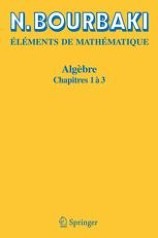
Algèbre, Chapitres 1 à 3 = Algebra, Chapters 1 to 3
To do algebra is essentially to calculate, that is to say to perform, on elements of a set, (<algebraic operations n, the best-known example of which is provided by the (<four rules)) of elementary arithmetic. This is not the place to retrace the slow process of progressive abstraction by which the notion of algebraic operation, initially restricted to natural integers and to measurable quantities, gradually widened its field, as it grew. at the same time generalized the notion of ((number O, until, going beyond the latter, it came to apply to elements which no longer had any character ((numeric)>, for example to permutations of a - seems (see Historical Note in chap. 1).
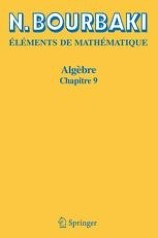
Algèbre, Chapitre 9 = Algebra, Chapter 9
Sesquilinear and quadratic forms : The Mathematics Elements of Nicolas BOURBAKI aim to provide a rigorous, systematic presentation without prerequisites of mathematics from their foundations. This ninth chapter of the Book of Algebra, the second Book of the treatise, is devoted to quadratic, symplectic or Hermitian forms and to associated groups.
Algèbre, Chapitre 4 à 7 = Algebra, Chapter 4 to 7
The Mathematics Elements of Nicolas BOURBAKI aim to provide a rigorous, systematic presentation without prerequisites of mathematics from their foundations. Deals in particular with extensions of fields and Galois theory. It includes the chaptires: 4. Polynomials and rational fractions; 5. Commutative bodies 6. Orderly groups and bodies; 7. Modules on the main rings
Algèbre commutative, Chapitre 10 = Commutative Algebra, Chapter 10
Depth, Regularity, Duality The Mathematics Elements of Nicolas BOURBAKI aim to provide a rigorous, systematic presentation without prerequisites of mathematics from their foundations. This volume of the Book of Commutative Algebra, Book 7 of the treatise, is a continuation of the earlier chapters. It introduces in particular the notions of depth and smoothness, fundamental in algebraic geometry. It ends with the introduction of the dualizing modules and the Grothendieck duality.
Algèbre commutative : Chapitres 5 à 7 = Commutative algebra : Chapters 5 to 7
The Mathematics Elements of Nicolas BOURBAKI aim to provide a rigorous, systematic presentation without prerequisites of mathematics from their foundations.This second volume of the Book of Commutative Algebra, Seventh Book of the treatise, introduces two fundamental notions in commutative algebra, that of algebraic integer and that of valuation, which have many applications in number theory and algebraic geometry.
Algebras, Rings and Modules: Vol.1
Covers the major topics in ring and module theory and includes both fundamental classical results and more developments. This book is devoted to a study of special classes of rings and algebras, such as serial rings, hereditary rings, semidistributive rings and tiled orders.
Algebras, Rings and Modules ; Vol.2
This book provides both the classical aspects of the theory of groups and their representations as well as a general introduction to the modern theory of representations including the representations of quivers and finite partially ordered sets and their applications to finite dimensional algebras.
Algebraic Theory of Locally Nilpotent Derivations
This book explores the theory and application of locally nilpotent derivations, which is a subject of growing interest and importance not only among those in commutative algebra and algebraic geometry, but also in fields such as Lie algebras and differential equations. The author provides a unified treatment of the subject, beginning with 16 First Principles on which the entire theory is based. These are used to establish classical results, such as Rentschler’s Theorem for the plane, right up to the most recent results, such as Makar-Limanov’s Theorem for locally nilpotent derivations of polynomial rings.
Algebraic Multiplicity of Eigenvalues of Linear Operators
This book brings together all the most important known results of research into the theory of algebraic multiplicities, from well-known classics like the Jordan Theorem to recent developments such as the uniqueness theorem and the construction of multiplicity for non-analytic families.
Algebraic Methods for Nonlinear Control Systems
A self-contained introduction to algebraic control for nonlinear systems suitable for researchers and graduate students.The most popular treatment of control for nonlinear systems is from the viewpoint of differential geometry yet this approach proves not to be the most natural when considering problems like dynamic feedback and realization. Professors Conte, Moog and Perdon develop an alternative linear-algebraic strategy based on the use of vector spaces over suitable fields of nonlinear functions. This algebraic perspective is complementary to, and parallel in concept with, its more celebrated differential-geometric counterpart.Algebraic Methods for Nonlinear Control Systems describes a wide range of results, some of which can be derived using differential geometry but many of which cannot.

Algebraic Methodology and Software Technology ; 11th International Conference, AMAST 2006, Kuressaare, Estonia, July 5-8, 2006, Proceedings
This is the proceedings of the 11th edition of the Algebraic Methodology and Software Technology (AMAST) conference series. The rst conference was held in the USA in 1989, and since then AMAST conferences have been held on (or near) fve diferent continents and have been hosted by many of the most prominent people and organizations in the ?eld. The AMAST initiative has always sought to have practical efects by dev- oping the science of software and basing it on a ?rm mathematical foundation. AMAST hasinterpretedsoftwaretechnologybroadly,andhas, for example, held AMAST workshops in areas as diverse as real-time systems and (natural) l- guage processing. Similarly, algebraic methodology is interpreted broadly and includes abstract algebra, category theory, logic, and a range of other ma- ematical subdisciplines.
Algebraic Groups and Lie Groups with Few Factors
Algebraic groups are treated in this volume from a group theoretical point of view and the obtained results are compared with the analogous issues in the theory of Lie groups. The main body of the text is devoted to a classification of algebraic groups and Lie groups having only few subgroups or few factor groups of different type. In particular, the diversity of the nature of algebraic groups over fields of positive characteristic and over fields of characteristic zero is emphasized. This is revealed by the plethora of three-dimensional unipotent algebraic groups over a perfect field of positive characteristic, as well as, by many concrete examples which cover an area systematically. In the final section, algebraic groups and Lie groups having many closed normal subgroups are determined.
