



الصفحة 10
الصفحة 10

Model-based Process Supervision : A Bond Graph Approach
Model-based fault detection and isolation requires a mathematical model of the system behaviour. Modelling is important and can be difficult because of the complexity of the monitored system and its control architecture. The authors use bond-graph modelling, a unified multi-energy domain modelling method, to build dynamic models of process engineering systems by composing hierarchically arranged sub-models of various commonly encountered process engineering devices. The structural and causal properties of bond-graph models are exploited for supervisory systems design.

Model driven Engineering Languages and Systems; 10th International Conference, MoDELS 2007, Nashville, USA, September 30 - October 5, 2007, Proceedings
This book constitutes the refereed proceedings of the 10th International Conference on Model Driven Engineering Languages and Systems (formerly the UML series of conferences), MODELS 2007, held in Nashville, USA, September 30 - October 5, 2007. The 45 revised full papers were carefully reviewed and selected from 158 initial submissions.

Model Driven Engineering Languages and Systems ; Vol. 4199 ; 9th International Conference, MoDELS 2006, Genova, Italy, October 1-6, 2006, Proceedings
This book constitutes the refereed proceedings of the 9th International Conference on Model Driven Engineering Languages and Systems (formerly the UML series of conferences), MoDELS 2006, held in Genova, Italy, in October 2006. The 51 revised full papers and 2 invited papers presented were carefully reviewed and selected from 178 initial submissions. The papers are organized in topical sections on evaluating UML, MDA in software development, concrete syntax, applying UML to interaction and coordination, aspects, model integration, formal semantics of UML, security, model transformation tools and implementation, analyzing dynamic models, specifying transformations, MOF, bridging models, risk, trust and dependability, tool environments, OCL, roundtrip engineering, real time and embedded systems, as well as workshops, tutorials and panels.
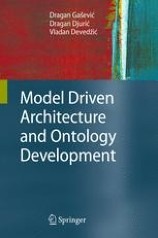
Model Driven Architecture and Ontology Development
Gaševic and his co-authors try to fill this gap by covering the subject of MDA application for ontology development on the Semantic Web. Part I of their book describes existing technologies, tools, and standards like XML, RDF, OWL, MDA, and UML. Part II presents the first detailed description of OMG’s new ODM (Ontology Definition Metamodel) initiative, a specification which is expected to be in the form of an OMG language like UML. Finally, Part III is dedicated to applications and practical aspects of developing ontologies using MDA-based languages.

Model Driven Architecture ; European MDA Workshops : Foundations and Applications, MDAFA 2003 and MDAFA 2004, Twente, The Netherlands, June 26-27, 2003, and Linköping, Sweden, June 10-11, 2004, Revised Selected Papers
Model-Driven Architecture (MDA) is an initiative proposedby the Object M- agement Group (OMG) for platform-generic software development. MDA s- arates the specification of system functionality from the implementation on a specific platform. It is aimed at making software assets more resilient to changes caused by emerging technologies. While stressing the importance of modeling, the MDA initiative covers a wide spectrum of research areas. Further efforts are required to bring them into a coherent approach based on open standards and supported by matured tools and techniques. This volume contains the selected papers of two workshops on “Model-Driven Architecture – Foundations and Applications” (MDAFA): MDAFA 2003 held at the University of Twente, Twente, The Netherlands, June 26–27, 2003, and MDAFA 2004 held at Linko ¨ping University, Link¨ oping, Sweden, June 10–11, 2004. The goal of the workshops was to understand the foundations of MDA, to share experience in applying MDA techniques and tools, and to outline future research directions. The workshops organizers encouraged authors of accepted papers to re-submit their papers to a post-workshop reviewing process; 15 of these papers were accepted to appear in this volume on MDA.
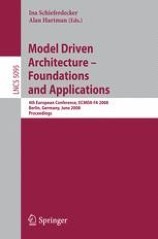
Model Driven Architecture - Foundations and Applications ; 4th European Conference, ECMDA-FA 2008, Berlin, Germany, June 9-13, 2008. Proceedings
The 31 revised full papers presented - 21 research papers and 10 industry papers - were carefully reviewed and selected from 87 submissions. The papers address all current issues of model-driven architecture, i.e. model management, executable models, concrete syntaxes, aspects, and concerns, validation and testing, model-based systems engineering, model-driven development and service-oriented architectures, and the application of model-driven development. The papers are organized in topical sections on model management, executable models, concrete syntaxes, aspects and concerns, validation and testing, model-based systems engineering, model-driven development and service-oriented architectures, as well as surveys on applying model-driven development.
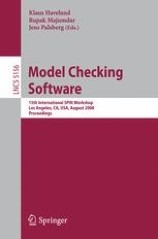
Model Checking Software ; 15th International SPIN Workshop, Los Angeles, CA, USA, August 10-12, 2008 Proceedings
This book constitutes the refereed proceedings of the 15th International SPIN workshop on Model Checking Software, SPIN 2008, held in Los Angeles, CA, USA, in August 2008.The 17 revised full papers presented together with 1 tool paper and 4 invited talks were carefully reviewed and selected from 41 submissions. The main focus of the workshop series is software systems, including models and programs. The papers cover theoretical and algorithmic foundations as well as tools for software model checking and foster interactions and exchanges of ideas with related areas in software engineering, such as static analysis, dynamic analysis, and testing.

Model Abstraction in Dynamical Systems : Application to Mobile Robot Control
The subject of this book is model abstraction of dynamical systems. The p- mary goal of the work embodied in this book is to design a controller for the mobile robotic car using abstraction. Abstraction provides a means to rep- sent the dynamics of a system using a simpler model while retaining important characteristics of the original system. A second goal of this work is to study the propagation of uncertain initial conditions in the framework of abstraction. The summation of this work is presented in this book.

Mobility, data mining and privacy : Geographic knowledge discovery
This book assesses this research frontier from a computer science perspective, investigating the various scientific and technological issues, open problems, and roadmap. The editors manage a research project called GeoPKDD, Geographic Privacy-Aware Knowledge Discovery and Delivery, funded by the EU Commission and involving 40 researchers from 7 countries, and this book tightly integrates and relates their findings in 13 chapters covering all related subjects, including the concepts of movement data and knowledge discovery from movement data; privacy-aware geographic knowledge discovery; wireless network and next-generation mobile technologies; trajectory data models, systems and warehouses; privacy and security aspects of technologies and related regulations; querying, mining and reasoning on spatiotemporal data; and visual analytics methods for movement data.

Mobile Wireless Middleware, Operating Systems and Applications ; 9th EAI International Conference, MOBILWARE 2020, Hohhot, China, July 11, 2020, Proceedings
This book constitutes the refereed conference proceedings of the 9th International Conference on Mobile Wireless Middleware, Operating Systems and Applications, MOBILWARE 2020, held in Hohhot, China, in July 2020. Due to COVID-19 pandemic the conference was held virtually. The 21 revised full papers were reviewed and selected from 69 submissions and are organized in tracks on MobilWare; Big data, data mining and artificial intelligence workshop; Blockchain and internet of things workshop.

Mobile Virtual Work : A New Paradigm?
This is a book about mobile virtual work. It aims at clarifying the basic concepts and showing present practices and future challenges. With this book we realise our intention to present a ‘state of the art’ collection of knowledge on this subject. We very much hope that you will find the discussion about present day reality and future challenges of mobile virtual work as exciting as we do. It is possibly a new paradigm.

Mobile computing, applications, and services ; 11th EAI International Conference, MobiCASE 2020, Shanghai, China, September 12, 2020, Proceedings
This book constitutes the thoroughly refereed post-conference proceedings of the 11th International Conference on Mobile Computing, Applications, and Services, MobiCASE 2020, held in Shanghai, China, in September 2020. The conference was held virtually due to the COVID-19 pandemic. The 15 full papers were carefully reviewed and selected from 49 submissions. The papers are organized in topical sections on mobile application and framework; mobile application with data analysis; and AI application.

Mixed Hodge Structures
The text of this book has its origins more than twenty- ve years ago. In the seminar of the Dutch Singularity Theory project in 1982 and 1983, the second-named author gave a series of lectures on Mixed Hodge Structures and Singularities, accompanied by a set of hand-written notes. The publication of these notes was prevented by a revolution in the subject due to Morihiko Saito: the introduction of the theory of Mixed Hodge Modules around 1985. Understanding this theory was at the same time of great importance and very hard, due to the fact that it uni es many di erent theories which are quite complicated themselves: algebraic D-modules and perverse sheaves. The present book intends to provide a comprehensive text about Mixed Hodge Theory with a view towards Mixed Hodge Modules.

Misbehaving Proteins : Protein (Mis)Folding, Aggregation, and Stability
Misfoldedaggregatedproteinoncewasconsideredasinterestingasyesterday’strash—a bothersome by-product of important and productive activities, to be disposed of and forgotten as quickly as possible. Yesterday’s trash has become today’s focus of cons- erable scienti?c interest for at least two reasons: (1) protein aggregates are at the core of a number of chronic degenerative diseases such as Alzheimer’s disease, and (2) - gregation poses signi?cant obstacles to the manufacture of safe, ef?cacious, and stable protein products. As interest in protein misfolding, aggregation, and stability has soared beyond the core group of traditional protein-folding scientists, and as substantial scienti?c progress in understanding and controlling protein misfolding has been achieved, the need to summarize the state of the art became manifest. Although there are many excellent texts and edited collections on protein structure and folding, these volumes tend to relegate protein misfolding and aggregation to a minor role. Review articles and books focused on the biological role of protein aggregates in diseases have been published recently.

Mirror Geometry of Lie Algebras, Lie Groups and Homogeneous Spaces
As K. Nomizu has justly noted [K. Nomizu, 56], Differential Geometry ever will be initiating newer and newer aspects of the theory of Lie groups. This monograph is devoted to just some such aspects of Lie groups and Lie algebras. New differential geometric problems came into being in connection with so called subsymmetric spaces, subsymmetries, and mirrors introduced in our works dating back to 1957 [L.V. Sabinin, 58a,59a,59b]. In addition, the exploration of mirrors and systems of mirrors is of interest in the case of symmetric spaces. Geometrically, the most rich in content there appeared to be the homogeneous Riemannian spaces with systems of mirrors generated by commuting subsymmetries, in particular, so called tri-symmetric spaces introduced in [L.V. Sabinin, 61b]. As to the concrete geometric problem which needs be solved and which is solved in this monograph, we indicate, for example, the problem of the classification of all tri-symmetric spaces with simple compact groups of motions. Passing from groups and subgroups connected with mirrors and subsymmetries to the corresponding Lie algebras and subalgebras leads to an important new concept of the involutive sum of Lie algebras [L.V. Sabinin, 65]. This concept is directly concerned with unitary symmetry of elementary par- cles (see [L.V. Sabinin, 95,85] and Appendix 1). The first examples of involutive (even iso-involutive) sums appeared in the - ploration of homogeneous Riemannian spaces with and axial symmetry. The consideration of spaces with mirrors [L.V. Sabinin, 59b] again led to iso-involutive sums.

Minimally invasive periodontal therapy : Clinical techniques and visualization technology
The long-term success of periodontal therapy is dependent on proper diagnosis and removal of subgingival tooth-borne accretions in the form of calculus and bacteria. From a clinical perspective, better visualization during the diagnostic and therapeutic phases has been shown to yield better results compared to traditional approaches.Minimally Invasive Periodontal Therapy evaluates the advantages of using minimal invasive techniques, the technologies available for enhancing visualization during minimally invasive therapy, and step-by-step illustrates the clinical use of each technique.

Mineral Deposit Research : Meeting the Global Challenge ; Proceedings of the Eighth Biennial SGA Meeting, Beijing, China, 18 - 21 August 2005
Represents a comprehensive summary of the developments across a range of subject matters that are relevant to the global research, mining and exploration community. This proceedings volume (including CD-ROM) is a compilation of approximately 400 extended abstracts (up to 4 pages long) of presentations given at the 8th Biennial SGA Meeting.

Mid-Infrared Coherent Sources and Applications
Coherent sources of mid-infrared (mid-IR) radiation are of great interest for a wide range of scienti?c and technological applications from spectroscopy and frequency metrology to information technology, industrial process control, pho- chemistry, photobiology and photomedicine. The mid-IR spectrum, which may be de?ned as wavelengths beyond ?2µm, covers important atmospheric windows, and numerous molecular gases, toxic agents, air, water, and soil pollutants, c- ponents of human breath, and several explosive agents have strong absorption ?ngerprints in this region. The development of practical coherent solid-state sources in the mid-IR can thus provide indispensable tools for a variety of - plications in environmental monitoring and pollution control, detection of water and soil contaminants, food quality control, agriculture and life sciences, and n- invasive disease diagnosis and therapy through breath analysis.
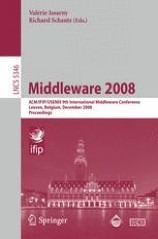
Middleware 2008 ; ACM/IFIP/USENIX 9th International Middleware Conference Leuven, Belgium, December 1-5, 2008 Proceedings
This book constitutes the refereed proceedings of the ACM/IFIP/USENIX 9th International Middleware Conference 2008, held in Leuven, Belgium, in December 2008.The 21 revised full papers presented were carefully reviewed and selected from 117 submissions for inclusion in the book. The papers are organized in topical sections on platforms extended to new capabilities, advanced software engineering focusing on specific system properties, system management techniques, as well as components and system algorithms and properties.

Middleware 2006 ; ACM/IFIP/USENIX 7th International Middleware Conference, Melbourne, Australia, November 27 - December 1, 2006, Proceedings
This book constitutes the refereed proceedings of the ACM/IFIP/USENIX 7th International Middleware Conference 2006, held in Melbourne, Australia, in November/December 2006. The 21 revised full papers presented were carefully reviewed and selected from 122 submissions. The papers are organized in topical sections on performance, composition, management, publish/subscribe technology, databases, mobile and ubiquitous computing, security, and data mining techniques.
