



الصفحة 10
الصفحة 10

Mechanizing Mathematical Reasoning : Essays in Honor of Jörg H. Siekmann on the Occasion of His 60th Birthday
By presenting state-of-the-art results in logical reasoning and formal methods in the context of artificial intelligence and AI applications, this book commemorates the 60th birthday of Jörg H. Siekmann. The 30 revised reviewed papers are written by former and current students and colleagues of Jörg Siekmann; also included is an appraisal of the scientific career of Jörg Siekmann entitled "A Portrait of a Scientist: Logics, AI, and Politics." The papers are organized in four parts on logic and deduction, applications of logic, formal methods and security, and agents and planning.

Mechanisms, Symbols, and Models Underlying Cognition ; 1st International Work-Conference on the Interplay Between Natural and Artificial Computation, IWINAC 2005, Las Palmas, Canary Islands, Spain, June 15-18, 2005, Proceedings, Part I
Constitute the refereed proceedings of the First International Work-Conference on the Interplay between Natural and Artificial Computation, IWINAC 2005. This two-volume set contains papers that are related with the conceptual developments in the fields of Neurophysiology and cognitive science, and also to bioinspired programming strategies.

Measuring Precipitation from Space : EURAINSAT and the Future
More than 20 years after the last book on the subject the worldwide precipitation community has produced a comprehensive overview of its activities, achievements, ongoing research and future plans. Measuring Precipitation from Space presents state-of-the-art rainfall estimation algorithms, validation strategies, precipitation modelling, and assimilation in numerical weather prediction models. Clouds and precipitation observations and modelling are addressed for the improvement of the rainfall product quality. Special attention is given to the applications to monitoring and forecasting weather events and to climate monitoring in a frame of growing public interest.

Max-Plus Methods for Nonlinear Control and Estimation
The central focus of this book is the control of continuous-time/continuous-space nonlinear systems. Using new techniques that employ the max-plus algebra, the author addresses several classes of nonlinear control problems, including nonlinear optimal control problems and nonlinear robust/H-infinity control and estimation problems. Several numerical techniques are employed, including a max-plus eigenvector approach and an approach that avoids the curse-of-dimensionality.. The max-plus-based methods examined in this monograph belong to an entirely new class of numerical methods for the solution of nonlinear control problems.The potential advantages of the max-plus-based approaches lie in the fact that solution operators for nonlinear HJB problems are linear over the max-plus algebra, and this linearity is exploited in the construction of algorithms.

Matrix Algebra : Theory, Computations, and Applications in Statistics
Matrix algebra is one of the most important areas of mathematics for data analysis and for statistical theory. The first part of this book presents the relevant aspects of the theory of matrix algebra for applications in statistics. This part begins with the fundamental concepts of vectors and vector spaces, next covers the basic algebraic properties of matrices, then describes the analytic properties of vectors and matrices in the multivariate calculus, and finally discusses operations on matrices in solutions of linear systems and in eigenanalysis. This part is essentially self-contained.

Mathematics of Program Construction ; 9th International Conference, MPC 2008, Marseille, France, July 15-18, 2008. Proceedings
This book constitutes the refereed proceedings of the 9th International Conference on Mathematics of Program Construction, MPC 2008, held in Marseille, France in July 2008.The 18 revised full papers presented together with 1 invited talk were carefully reviewed and selected from 41 submissions. Issues addressed range from algorithmics to support for program construction in programming languages and systems. Topics of special interest are type systems, program analysis and transformation, programming language semantics, program logics.

Mathematics of Program Construction ; 8th International Conference, MPC 2006, Kuressaare, Estonia, July 3-5, 2006, Proceedings
This volume contains the proceedings of the 8th International Conference on Mathematics of ProgramConstruction, MPC 2006,held at Kuressaare, Estonia, July 3-5, 2006, colocated with the 11th International Conference on Algebraic Methodology and Software Technology, AMAST 2006, July 5-8, 2006. TheMPCconferencesaimtopromotethedevelopmentofmathematicalpr- ciples and techniques that are demonstrably useful and usable in the process of constructing computer programs. Topics of interest range from algorithmics to support for program construction in programming languages and systems.

Mathematics and Technology
Mathematics and Technology presents technological applications of mathematics making use of elegant mathematical concepts. The selected subjects consist of: public key cryptography, error correcting codes, the global positioning system (GPS) and cartography, image compression using fractals and the JPEG format, digital recording, robot movement, DNA computing, Google's PageRank algorithm, savings and loans, gamma ray surgery and random number generators. The authors highlight how mathematical modeling, together with the power of mathematical tools, have been crucial for innovation in technology. The exposition is clear, straightforward, motivated by excellent examples, and user-friendly. Numerous exercises at the end of every chapter reinforce the material. An engaging quality is the various historical notes accompanying the mathematical development.

Mathematics and Democracy : Recent Advances in Voting Systems and Collective Choice
In this book, different quantitative approaches to the study of electoral systems have been developed: game-theoretic, decision-theoretic, statistical, probabilistic, combinatorial, geometric, and optimization ones. All the authors are prominent scholars from these disciplines. Quantitative approaches offer a powerful tool to detect inconsistencies or poor performance in actual systems. Applications to concrete settings such as EU, American Congress, regional, and committee voting are discussed.

Mathematics and Computation, a Contemporary View ; The Abel Symposium 2006
The 2006 Abel symposium is focusing on contemporary research involving interaction between computer science, computational science and mathematics. In recent years, computation has been affecting pure mathematics in fundamental ways. Conversely, ideas and methods of pure mathematics are becoming increasingly important within computational and applied mathematics. At the core of computer science is the study of computability and complexity for discrete mathematical structures. Studying the foundations of computational mathematics raises similar questions concerning continuous mathematical structures. There are several reasons for these developments. The exponential growth of computing power is bringing computational methods into ever new application areas.
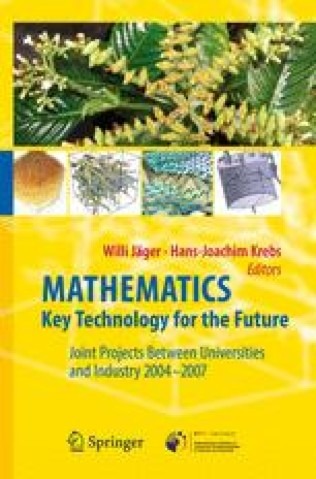
Mathematics - Key Technology for the Future : Joint Projects Between Universities and Industry 2004–2007
This book is about the results of a number of projects funded by the BMBF in the initiative "Mathematics for Innovations in Industry and Services". It shows that a broad spectrum of analytical and numerical mathematical methods and programming techniques are used to solve a lot of different specific industrial or services problems. The main focus is on the fact that the mathematics used is not usually standard mathematics or black box mathematics but is specifically developed for specific industrial or services problems. Mathematics is more than a tool box or an ancilarry science for other scientific disciplines or users. Through this book the reader will gain insight into the details of mathematical modeling and numerical simulation for a lot of industrial applications.

Mathematical Software - ICMS 2006 ; 2nd International Congress on Mathematical Software, Castro Urdiales, Spain, September 1-3, 2006, Proceedings
This volume contains the outstanding collection of invited papers and refereed papers selected for the Second International Congress on Mathematical Software, ICMS 2006, held in Castro Urdiales, Spain, September 1-3, 2006. This congress was devoted to all aspects of mathematical software, whose appearance is — in our opinion — one of the most important events in mathematics. Mathematical software systems are used to construct examples, to prove theorems, and to find new mathematical phenomena. Conversely, mathematical research often motivates developments of new algorithms and new systems. Beyond mathematics, mathematical software systems are becoming indispensable tools in many branches of science and technology.

Mathematical Problems from Applied Logic I : Logics for the XXIst Century
Mathematical Problems from Applied Logic I presents chapters from selected, world renowned, logicians. Important topics of logic are discussed from the point of view of their further development in light of requirements arising from their successful application in areas such as Computer Science and AI language. An overview of the current state as well as open problems and perspectives are clarified in such fields as non-standard inferences in description logics, logic of provability, logical dynamics and computability theory. The book contains interesting contributions concerning the role of logic today, including some unexpected aspects of contemporary logic and the application of logic. This should be of interest to logicians and mathematicians in general.

Mathematical Morphology : 40 Years On ; Proceedings of the 7th International Symposium on Mathematical Morphology, April 18-20, 2005
Mathematical Morphology is a speciality in Image Processing and Analysis, which considers images as geometrical objects, to be analyzed through their interactions with other geometrical objects. It relies on several branches of mathematics, such as discrete geometry, topology, lattice theory, partial differential equations, integral geometry and geometrical probability. It has produced fast and efficient algorithms for computer analysis of images, and has found applications in bio-medical imaging, materials science, geoscience, remote sensing, quality control, document processing and data analysis. This book contains the 43 papers presented at the 7th International Symposium on Mathematical Morphology, held in Paris on April 18-20, 2005. It gives a lively state of the art of current research topics in this field. It also marks a milestone, the 40 years of uninterrupted development of this ever-expanding domain.

IoT and AI Technologies for Sustainable Living : A Practical Handbook
Brings together all the latest methodologies, tools and techniques related to the Internet of Things and Artificial Intelligence in a single volume to build insight into their use in sustainable living. The areas of application include agriculture, smart farming, healthcare, bioinformatics, self-diagnosis systems, body sensor networks, multimedia mining, and multimedia in forensics and security. Provides a comprehensive discussion of modeling and implementation in water resource optimization, recognizing pest patterns, traffic scheduling, web mining, cyber security and cyber forensics. It will help develop an understanding of the need for AI and IoT to have a sustainable era of human living. The tools covered include genetic algorithms, cloud computing, water resource management, web mining, machine learning, block chaining, learning algorithms, sentimental analysis and Natural Language Processing (NLP).
Introduction to Reliable Distributed Programming
Guerraoui and Rodrigues present an introductory description of fundamental reliable distributed programming abstractions as well as algorithms to implement these abstractions. The authors follow an incremental approach by first introducing basic abstractions in simple distributed environments, before moving to more sophisticated abstractions and more challenging environments. Each core chapter is devoted to one specific class of abstractions, covering reliable delivery, shared memory, consensus and various forms of agreement. This textbook comes with a companion set of running examples implemented in Java. These can be used by students to get a better understanding of how reliable distributed programming abstractions can be implemented and used in practice. Combined, the chapters deliver a full course on reliable distributed programming. The book can also be used as a complete reference on the basic elements required to build reliable distributed applications.

Introduction to Reconfigurable Computing : Architectures, Algorithms, and Applications
“Introduction to Reconfigurable Computing” provides a comprehensive study of the field Reconfigurable Computing. It provides an entry point to the novice willing to move in the research field reconfigurable computing, FPGA and system on programmable chip design. The book can also be used as teaching reference for a graduate course in computer engineering, or as reference to advance electrical and computer engineers. It provides a very strong theoretical and practical background to the field of reconfigurable computing, from the early Estrin’s machine to the very modern architecture like coarse-grained reconfigurable device and the embedded logic devices.

Introduction to Machine Learning with Applications in Information Security
Provides a classroom-tested introduction to a wide variety of machine learning and deep learning algorithms and techniques, reinforced via realistic applications. The book is accessible and doesn't prove theorems, or dwell on mathematical theory. The goal is to present topics at an intuitive level, with just enough detail to clarify the underlying concepts. The book covers core classic machine learning topics in depth, including Hidden Markov Models (HMM), Support Vector Machines (SVM), and clustering. Additional machine learning topics include k-Nearest Neighbor (k-NN), boosting, Random Forests, and Linear Discriminant Analysis (LDA). The fundamental deep learning topics of backpropagation, Convolutional Neural Networks (CNN), Multilayer Perceptrons (MLP), and Recurrent Neural Networks (RNN) are covered in depth. A broad range of advanced deep learning architectures are also presented, including Long Short-Term Memory (LSTM), Generative Adversarial Networks (GAN), Extreme Learning Machines (ELM), Residual Networks (ResNet), Deep Belief Networks (DBN), Bidirectional Encoder Representations from Transformers (BERT), and Word2Vec.
Introduction to Intelligent Construction Technology of Transportation Infrastructure
Expounds on the related technologies of intelligent transportation infrastructure construction. Based on the essential characteristics of intelligent construction, "perception, analysis, decision-making, and execution," the basic structure of intelligent construction technology (ICT) is established. With the integration of engineering construction technologies, the analyses of the essence of intelligent algorithms and the feasibility of Artificial Intelligence (AI) are provided. The book introduces the essential characteristics of Big Data and the Internet of Things and their relationship with engineering construction. On this basis, the feasibility and implementation plan of intelligent technology applications in design, construction, and maintenance are analyzed and demonstrated with engineering examples.

Introduction to Genetic Algorithms
This book is designed to provide an in-depth knowledge on the basic operational features and characteristics of Genetic Algorithms. The various operators and techniques given in the book are pertinent to carry out Genetic Algorithm Research Projects. The book also explores the different types are Genetic Algorithms available with their importance. Implementation of Genetic Algorithm concept has been performed using the universal language C/C++ and the discussion also extends to Genetic Algorithm MATLAB Toolbox. Few Genetic Algorithm problems are programmed using MATLAB and the simulated results are given for the ready reference of the reader. The applications of Genetic Algorithms in Machine learning, Mechanical Engineering, Electrical Engineering, Civil Engineering, Data Mining, Image Processing, and VLSI are dealt to make the readers understand where the concept can be applied.
