



الصفحة 10
الصفحة 10

Java : how to program. Late objects : Introducing Jshell
Introduction to Computers, the Internet and Java / Introduction to Java Applications; Input/Output and Operators / Control Statements: Part 1; Assignment, ++ and Operators / Control Statements: Part 2; Logical Operators / Methods / Arrays and ArrayLists / Introduction to Classes and Objects / Classes and Objects: A Deeper Look / Object-Oriented Programming: Inheritance / Object-Oriented Programming: Polymorphism and Interfaces / Exception Handling: A Deeper Look / JavaFX Graphical User Interfaces / JavaFX GUI / Strings, Characters and Regular Expressions / Files, Input/Output Streams, NIO and XML Serialization / Generic Collections / Lambdas and Streams / Recursion / Searching, Sorting and Big O / Generic Classes and Methods: A Deeper Look / Custom Generic Data Structures / JavaFX Graphics and Multimedia / Concurrency / Accessing Databases with JDBC / Introduction to JShell: Java 9's REPL for Interactive Java

Component-based software engineering ; 11th International Symposium, CBSE 2008, Karlsruhe, Germany, October 14-17, 2008. Proceedings
This book constitutes the refereed proceedings of the 11th International ACM SIGSOFT Symposium on Component-Based Software Engineering, CBSE 2008, held in Karlsruhe, Germany in October 2008.
Component-Based Software Development for Embedded Systems : An Overview of Current Research Trends
Embedded systems are ubiquitous. They appear in cell phones, microwave ovens, refrigerators, consumer electronics, cars, and jets. Some of these embedded s- tems are safety- or security-critical such as in medical equipment, nuclear plants, and X-by-wire control systems in naval, ground and aerospace transportation - hicles. With the continuing shift from hardware to software, embedded systems are increasingly dominated by embedded software. Embedded software is complex. Its engineering inherently involves a mul- disciplinary interplay with the physics of the embedding system or environment. Embedded software also comes in ever larger quantity and diversity. The next generation of premium automobiles will carry around one gigabyte of binary code. The proposed US DDX submarine is e?ectively a ?oating embedded so- ware system, comprising 30 billion lines of code written in over 100 programming languages. Embedded software is expensive. Cost estimates are quoted at around US$15– 30 per line (from commencement to shipping). In the defense realm, costs can range up to $100, while for highly critical applications, such as the Space Shuttle, the cost per line approximates $1,000. In view of the exponential increase in complexity, the projected costs of future embedded software are staggering.
Compiling ESTEREL
Esterel is based on the simple idea of providing a software language that has a synchronous model of time. That is, the execution of the program is divided into discrete instants, and statements are either guaranteed to execute in a single instant, or take multiple instants as requested by the programmer. Suitable for programming safety-critical real-time systems, Esterel and its model of computation have found use in industrial applications such as avionics, integrated circuit design, and other safety-critical environments. While Compiling Esterel does not assume prior knowledge of the Esterel language, readers will appreciate having prior knowledge of programming language semantics and compiler technology, along with some familiarity with synchronous digital hardware design.

Compiler construction ; Vol. 3923 : 15th International Conference, CC 2006, Held as Part of the Joint European Conferences on Theory and Practice of Software, ETAPS 2006, Vienna, Austria, March 30-31, 2006, Proceedings
ETAPS 2006 was the ninth instance of the European Joint Conferences on Theory and Practice of Software. ETAPS is an annual federated conference that was established in 1998 by combining a number of existing and new conferences. The events that comprise ETAPS address various aspects of the system devel- ment process, including speci?cation, design, implementation, analysis and impro- ment. The languages, methodologies and tools which support these activities are all well within its scope. Di?erent blends of theory and practice are represented, with an inclination towards theory with a practical motivation on the one hand and soundly based practice on the other.

Compiler construction ; Vol. 3443 : 14th International Conference, CC 2005, Held as Part of the Joint European Conferences on Theory and Practice of Software, ETAPS 2005, Edinburgh, UK, April 4-8, 2005. Proceedings
"This book constitutes the refereed proceedings of 14th International Conference, CC 2005, Held as Part of the Joint European Conferences on Theory and Practice of Software, ETAPS 2005, including Topics Programming Languages, Compilers, Interpreters Logics and Meanings of Programs / Mathematical Logic and Formal Languages / Software Engineering / Artificial Intelligence"
Compiler construction ; 17th International Conference, CC 2008, Held as Part of the Joint European Conferences on Theory and Practice of Software, ETAPS 2008, Budapest, Hungary, March 29 - April 6, 2008. Proceedings
This book constitutes the proceedings of the 17th International Conference on Compiler Construction, CC 2008. It covers analysis and transformations, compiling for parallel architectures, runtime techniques and tools, analyses, and atomicity and transactions.
Competitive Programming in Python : 128 Algorithms to Develop your Coding Skills
Learn all the algorithmic techniques and programming skills you need from two experienced coaches, problem setters, and jurors for coding competitions. The authors highlight the versatility of each algorithm by considering a variety of problems and show how to implement algorithms in simple and efficient code. What to expect: * Master 128 algorithms in Python. * Discover the right way to tackle a problem and quickly implement a solution of low complexity.

Communicating sequential processes : The first 25 years : Symposium on the Occasion of 25 Years of CSP, London, UK, July 7-8, 2004. Revised Invited Papers
This volume, like the symposium CSP25 which gave rise to it, commemorates the semi-jubilee of Communicating Sequential Processes. 1 Tony Hoare’s paper “Communicating Sequential Processes” is today widely regarded as one of the most in?uential papers in computer science. To comm- orate it, an event was organized under the auspices of BCS-FACS (the British Computer Society’s Formal Aspects of Computing Science specialist group). CSP25 was one of a series of such events organized to highlight the use of formal methods, emphasize their relevance to modern computing and promote their wider application.

Central European Functional Programming School ; 1st Central European Summer School, CEFP 2005, Budapest, Hungary, July 4-15, 2005, Revised Selected Lectures
This volume presents eight carefully revised texts of selected lectures given by leading researchers of the field at the first Central European Functional Programming School, CEFP 2005, held in Budapest, Hungary, in July 2005. The eight revised full papers presented were carefully selected during two rounds of reviewing and improvement for inclusion in the book. The lectures cover a wide range of topics such as new programming language concepts for subtyping.
Central European Functional Programming School : 2nd Summer School, CEFP 2007, Cluj-Napoca, Romania, June 23-30, 2007, Revised Selected Lectures
This volume presents texts from selected lectures given by leading researchers at the Second Central European Functional Programming School, CEFP 2007, held in Cluj-Napoca, Romania, in June 2007.
Cálculo científico com MATLAB e Octave = Scientific calculus with MATLAB and Octave
Its objective is to present various numerical methods for solving certain mathematical problems on the computer that cannot be treated in a simpler way. Classical issues such as the computation of zeros or integrals of continuous functions, the solving of linear systems, the approximation of functions by polynomials and the construction of precise approximations for solutions of differential equations are addressed. All algorithms are presented in the programming languages MATLAB and Octave, whose main commands and instructions are introduced gradually, aiming in particular at their compatibility in both languages.

C++ for Engineers and Scientists
Introduce the power and practicality of C++ programming to entry-level engineers with Bronson's C++ FOR ENGINEERS AND SCIENTISTS, 4E. This proven, pragmatic text is designed specifically for today's first- and second-year engineering and science students with a wealth of new applications and examples taken from real situations involving electrical and structural engineering, fluid mechanics, mathematics, power generation, and heat transfer challenges.
C++ /CLI : The Visual C++ Language for .NET
C++/CLI: The Visual C++ Language for .NET introduces Microsoft's extensions to the C++ syntax that allow you to target the common language runtime the key to the heart of the .NET 3.0 platform. In 12 no-fluff chapters, Microsoft insider Gordon Hogenson takes you into the core of the C++/CLI language and explains both how the language elements work and how Microsoft intends them to be used.

C# 10 Quick Syntax Reference : A Pocket Guide to the Language, APIs, and Library
Reviews the essential C# 10 and earlier syntax, not previously covered, in a well-organized format that can be used as a handy reference. Specifically, unions, generic attributes, CallerArgumentExpression, params span, Records, Init only setters, Top-level statements, Pattern matching enhancements, Native sized integers, Function pointers and more. You will: Employ nullable reference types / Work with ranges and indices / Apply recursive patterns to your applications / Use switch expressions
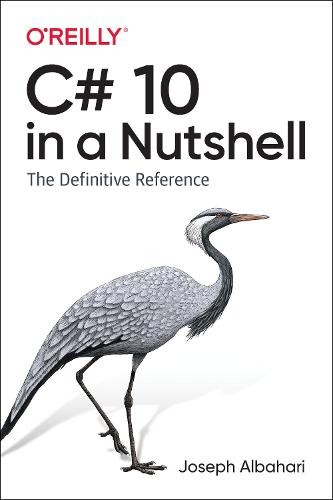
C# 10 in a Nutshell : The Definitive Reference
When you have questions about C# 10.0 or .NET 6, this guide has the answers you need. C# is a language of unusual flexibility and breadth, but with its continual growth, there's so much more to learn. In the tradition of O'Reilly's Nutshell guides, this thoroughly updated edition is simply the best one-volume reference to the C# language available today. Organized around concepts and use cases, this comprehensive and complete reference provides intermediate and advanced programmers with a concise map of C# and .NET that also plumbs significant depths
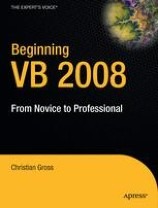
Beginning VB 2008 : From novice to professional
This book is for anyone who wants to write good Visual Basic 2008 code, even if you have never programmed before. Writing good code can be a challenge, there are so many options, especially in a language like Visual Basic. If you want to really get the best from a programming language you need to know which features work best in which situations and understand their strengths and weaknesses. It is this understanding that makes the difference between coding and coding well.

Beginning VB .NET Databases : From novice to professional
Visual Basic .NET is a powerful .NET programming language that is often considered the “workhorse” of programming. Further, development in VB .NET accounts for a huge portion of all programming efforts. To understand VB .NET is to meet challenging programming projects head-on. Author Dan Maharry livens the topic with his unique style, and presents you with the skill set you want and need, to enter today's VB .NET programming jobs. This book is an ideal read for beginning and intermediate VB .NET students who want to understand the core of VB .NET and database programming.
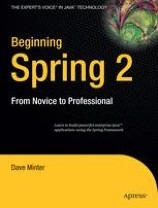
Beginning Spring 2 : From novice to professional
Beginning Spring 2 is the first Spring–authorized book that takes you through the first steps of using Spring, and requires no prior J2EE experience. It discusses relevant integrated technologies that you should be aware of, and illustrates how Spring makes using them easier.
Beginning Scala 3 : A functional and Object-Oriented Java Language
Introduces you to the Scala programming language, its object-oriented and functional programming characteristics, and then guides you through Scala constructs and libraries that allow you to assemble small components into high-performance, scalable systems. You will understand why Scala is judiciously used for critical business applications by leading companies such as Twitter, LinkedIn, Foursquare, the Guardian, Morgan Stanley, Credit Suisse, UBS, and HSBC – and you will be able to use it in your own projects. You will: Get started with Scala 3 or Scala language programming in general / Understand how to utilitze OOP in Scala / Perform functional programming in Scala / Master the use of Scala collections, traits and implicits / Leverage Java and Scala interopability / Employ Scala for DSL programming / Use patterns and best practices in Scala
