



الصفحة 1
الصفحة 1

Nonlinear Dynamics in Geosciences
Nonlinear Dynamics in Geosciences is comprised of the proceedings of "20 Years of Nonlinear Dynamics in Geosciences", held June 11-16, 2006 in Rhodes, Greece as part of the Aegean Conferences. The volume brings together the most up-to-date research from the atmospheric sciences, hydrology, geology, and other areas of geosciences, and discusses the advances made in the last two decades and the future directions of nonlinear dynamics. Topics covered include predictability, ensemble prediction, nonlinear prediction, nonlinear time series analysis, low-dimensional chaos, nonlinear modeling, fractals and multifractals, bifurcation, complex networks, self-organized criticality, extreme events, and other aspects of nonlinear science.

Noise and Vibration Mitigation for Rail Transportation Systems ; Proceedings of the 9th International Workshop on Railway Noise, Munich, Germany, 4 - 8 September 2007
This volume contains the contributions to the 9th International Workshop on Railway Noise, held Sept 04-08, 2007, in Munich, Germany. The workshop featured lectures by international leaders in the field of railway noise and vibration. All subjects relating to railway noise as noise sources (rolling noise, aerodynamic noise, bridge noise, sonic boom), prediction tools and theoretical models, new noise reduction, technology as well as ground-borne vibration are tackled.

Neuro–Fuzzy Associative Machinery for Comprehensive Brain and Cognition Modelling
Neuro–Fuzzy Associative Machinery for Comprehensive Brain and Cognition Modelling" is a graduate–level monographic textbook. It represents a comprehensive introduction into both conceptual and rigorous brain and cognition modelling. It is devoted to understanding, prediction and control of the fundamental mechanisms of brain functioning. The reader will be provided with a scientific tool enabling him to perform a competitive research in brain and cognition modelling.

Neural Networks and Sea Time Series : Reconstruction and Extreme-Event Analysis
This book, a careful blend of theory and applications, is an excellent introduction to the use of ANN, which may encourage readers to try analogous approaches in other important application areas. Researchers, practitioners, and advanced graduate students in neural networks, hydraulic and marine engineering, prediction theory, and data analysis will benefit from the results and novel ideas presented in this useful resource.

Neural Networks : Methodology and Applications
Neural networks represent a powerful data processing technique that has reached maturity and broad application. When clearly understood and appropriately used, they are a mandatory component in the toolbox of any engineer who wants make the best use of the available data, in order to build models, make predictions, mine data, recognize shapes or signals, etc. Ranging from theoretical foundations to real-life applications, this book is intended to provide engineers and researchers with clear methodologies for taking advantage of neural networks in industrial, financial or banking applications, many instances of which are presented in the book. For the benefit of readers wishing to gain deeper knowledge of the topics, the book features appendices that provide theoretical details for greater insight, and algorithmic details for efficient programming and implementation. The chapters have been written by experts ands seemlessly edited to present a coherent and comprehensive, yet not redundant, practically-oriented introduction.

Natural Disasters and Extreme Events in Agriculture : Impacts and Mitigation
Agricultural production is highly dependent on weather, climate and water availability and is adversely affected by the weather and climate-related disasters. Droughts and natural disasters such as floods can result in crop failures, food insecurity, famine, loss of property and life, mass migration and negative national economic growth. It may not be possible to prevent the occurrence of these natural disasters, but the resultant disastrous effects can be reduced considerably through proper planning and effective preparation. Vulnerability associated with the hazards of natural disasters can be controlled to some extent by accurate and timely prediction and by taking counter-measures to reduce their impacts on agriculture. This book based on an expert meeting held in Beijing, China should be of interest to all organizations involved in disasters reduction and mitigation of extreme events.
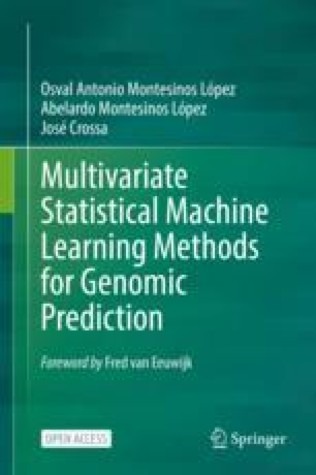
Multivariate Statistical Machine Learning Methods for Genomic Prediction
This book brings together the latest genome base prediction models currently being used by statisticians, breeders and data scientists. It provides an accessible way to understand the theory behind each statistical learning tool, the required pre-processing, the basics of model building, how to train statistical learning methods, the basic R scripts needed to implement each statistical learning tool, and the output of each tool. To do so, for each tool the book provides background theory, some elements of the R statistical software for its implementation, the conceptual underpinnings, and at least two illustrative examples with data from real-world genomic selection experiments.

Multiple Classifier Systems ; 7th International Workshop, MCS 2007, Prague, Czech Republic, May 23-25, 2007, Proceedings
These proceedings are a record of the Multiple Classifier Systems Workshop, MCS 2007, held at the Institute of Information Theory and Automation, Czech Academy of Sciences, Prague in May 2007. the workshop achieved its objective of bringing together researchers from diverse communities (neural networks, pattern rec- nition, machine learning and statistics) concerned with this research topic.

Morphological Models of Random Structures
This book covers methods of Mathematical Morphology to model and simulate random sets and functions (scalar and multivariate). The introduced models concern many physical situations in heterogeneous media, where a probabilistic approach is required, like fracture statistics of materials, scaling up of permeability in porous media, electron microscopy images (including multispectral images), rough surfaces, multi-component composites, biological tissues, textures for image coding and synthesis. The common feature of these random structures is their domain of definition in n dimensions, requiring more general models than standard Stochastic Processes.The main topics of the book cover an introduction to the theory of random sets, random space tessellations, Boolean random sets and functions, space-time random sets and functions (Dead Leaves, Sequential Alternate models, Reaction-Diffusion), prediction of effective properties of random media, and probabilistic fracture theories.

Modern Genome Annotation : The Biosapiens Network
An accurate description of current scientific developments in the field of bioinformatics and computational implementation is presented by research of the BioSapiens Network of Excellence. Bioinformatics is essential for annotating the structure and function of genes, proteins and the analysis of complete genomes and to molecular biology and biochemistry. Included is an overview of bioinformatics, the full spectrum of genome annotation approaches including; genome analysis and gene prediction, gene regulation analysis and expression, genome variation and QTL analysis, large scale protein annotation of function and structure, annotation and prediction of protein interactions, and the organization and annotation of molecular networks and biochemical pathways. Also covered is a technical framework to organize and represent genome data using the DAS technology and work in the annotation of two large genomic sets: HIV/HCV viral genomes and splicing alternatives potentially encoded in 1% of the human genome.

Models for Polymeric and Anisotropic Liquids
Models should be as simple as possible, but no simpler. For the physics of polymeric liquids, whose relevant lengths and time scales are out of reach for first principles calculations, this means that we have to choose a minimum set of sufficiently detailed descriptors such as architecture (linear, ring, branched), connectivity, semiflexibility, stretchability, excluded volume, and hydrodynamic interaction. These 'universal' fluids allow the prediction of material properties under external flow- or electrodynamic fields, the results being expressed in terms of reference units, specific for any particular chosen material. This book provides an introduction to the kinetic theory and computer simulation methods needed to handle these models and to interpret the results. Also included are a number of sample applications and computer codes.

Modelling community structure in freshwater ecosystems
"The book presents approaches and methodologies for predicting the structure and diversity of key aquatic communities (namely diatoms, benthic macroinvertebrates and fish), under natural conditions and under man-made disturbance. Such an approach will make it possible to: 1) set up procedures for robust and sensitive ecosystem evaluation, based on the prediction of the excepted community structure; 2) model community structure in disturbed ecosystems, taking into account all the relevant ecological variables; 3) test ecosystem sensitivity to natural and anthropic disturbance; and 4) explore specific actions to be taken for the restoration of ecosystem integrity."--Jacket.

Modeling Solar Radiation at the Earth’s Surface : Recent Advances
Solar radiation data is important for a wide range of applications, e.g. in engineering, agriculture, health sector, and in many fields of the natural sciences. A few examples showing the diversity of applications may include: architecture and building design e.g. air conditioning and cooling systems; solar heating system design and use; solar power generation; weather and climate prediction models; evaporation and irrigation; calculation of water requirements for crops; monitoring plant growth and disease control; skin cancer research.

Modeling and simulation of complex communication networks
Covers important topics and approaches related to the modeling and simulation of complex communication networks from a complex adaptive systems perspective. The authors present different modeling paradigms and approaches as well as surveys and case studies. Modern network systems such as Internet of Things, Smart Grid, VoIP traffic, Peer-to-Peer protocol, and social networks, are inherently complex. They require powerful and realistic models and tools not only for analysis and simulation but also for prediction. With contributions from an international panel of experts, this book is essential reading for networking, computing, and communications professionals, researchers and engineers in the field of next generation networks and complex information and communication systems, and academics and advanced students working in these fields.

Model-based Geostatistics
Geostatistics is concerned with estimation and prediction problems for spatially continuous phenomena, using data obtained at a limited number of spatial locations. The name reflects its origins in mineral exploration, but the methods are now used in a wide range of settings including public health and the physical and environmental sciences. Model-based geostatistics refers to the application of general statistical principles of modeling and inference to geostatistical problems. This volume is the first book-length treatment of model-based geostatistics. The authors have written an expository text, emphasizing statistical methods and applications rather than the underlying mathematical theory. Analyses of datasets from a range of scientific contexts feature prominently, and simulations are used to illustrate theoretical results. Readers can reproduce most of the computational results in the book by using the authors' R-based software package, geoR, whose usage is illustrated in a computation section at the end of each chapter.

Mobile and Wireless Communications with Practical Use-Case Scenarios
While wireless technologies had a spectacular evolution over the past years, the present trend is to adopt a global heterogeneous network of shared standards that enables the provisioning of Quality of Service and Quality of Experience to the end-user. To this end, enabling technologies like Machine Learning, Internet of Things, Digital Twins, are seen as promising solutions for next generation networks that will enable an intelligent adaptive interconnected environment with support for prediction and decision making so that the heterogeneous applications and users requirements can be highly satisfied. The aim of this textbook is to provide the readers with a comprehensive technical foundation of the mobile communication systems and wireless network design, operations and applications of various radio access technologies. Additionally, it also introduces the reader to the latest advancements in technologies in terms of Internet of Things ecosystem, Machine Learning and Digital Twins for IoT-enabled intelligent environments. Furthermore, this textbook also includes practical use-case scenarios using Altair WinProp Software as well as Phyton, TensorFlow and Jupiter as support for practice-based laboratory sessions"

Micromechanics of Heterogeneous Materials
The micromechanics of random structure heterogeneous materials is a burgeoning multidisciplinary research area which overlaps the scientific branches of materials science, mechanical engineering, applied mathematics, technical physics, geophysics, and biology. Micromechanics of Heterogeneous Materials features rigorous theoretical methods of applied mathematics and statistical physics in materials science of microheterogeneous media. The prediction of the behavior of heterogeneous materials by the use of properties of constituents and their microstructures is a central issue of micromechanics. This book is the first in micromechanics to provide a useful and effective demonstration of the systematic and fundamental research of the microstructure of the wide class of heterogeneous materials of natural and synthetic nature.

Medium-Range Weather Prediction : The European Approach
The European Centre for Medium-Range Weather Forecasts is widely acknowledged to be a world leader in the field of numerical weather prediction." "This authoritative and readable book tells the interesting story of how the Centre was conceived in the confusing and difficult political period of the 1960s in Europe. It summarises the political, scientific, technical and financial discussions that led to its establishment, and how it came to be built 60 km west of London, England.

Measuring Precipitation from Space : EURAINSAT and the Future
More than 20 years after the last book on the subject the worldwide precipitation community has produced a comprehensive overview of its activities, achievements, ongoing research and future plans. Measuring Precipitation from Space presents state-of-the-art rainfall estimation algorithms, validation strategies, precipitation modelling, and assimilation in numerical weather prediction models. Clouds and precipitation observations and modelling are addressed for the improvement of the rainfall product quality. Special attention is given to the applications to monitoring and forecasting weather events and to climate monitoring in a frame of growing public interest.

Ionospheric Precursors of Earthquakes
Changes included changing my career from the field of space plasma physics to Earth sciences and geophysics, and changes in my personal life giving me h- piness and compliance in my present family.
