



الصفحة 1
الصفحة 1
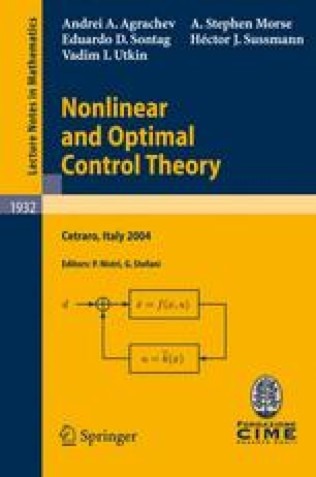
Nonlinear and Optimal Control Theory : Lectures given at the C.I.M.E. Summer School held in Cetraro, Italy June 19–29, 2004
The lectures gathered in this volume present some of the different aspects of Mathematical Control Theory. Adopting the point of view of Geometric Control Theory and of Nonlinear Control Theory, the lectures focus on some aspects of the Optimization and Control of nonlinear, not necessarily smooth, dynamical systems. Specifically, three of the five lectures discuss respectively: logic-based switching control, sliding mode control and the input to the state stability paradigm for the control and stability of nonlinear systems. The remaining two lectures are devoted to Optimal Control: one investigates the connections between Optimal Control Theory, Dynamical Systems and Differential Geometry, while the second presents a very general version, in a non-smooth context, of the Pontryagin Maximum Principle.
Nonlinear and Adaptive Control with Applications
Nonlinear and Adaptive Control with Applications provides a detailed treatment of the design of robust adaptive controllers for nonlinear systems with uncertainties. The authors employ a new tool based on the ideas of system immersion and manifold invariance.

Nonblocking Supervisory Control of State Tree Structures
This monograph proposes how to manage complexity by organizing the system as a State Tree Structure (STS). an efficient recursive symbolic algorithm is presented that can perform nonblocking supervisory control design in reasonable time and memory for complex systems.

New Directions and Applications in Control Theory
This volume contains a collection of papers in control theory and applications presented at a conference in honor of Clyde Martin on the occasion of his 60th birthday, held in Lubbock, Texas, November 14-15, 2003.
Multibody Dynamics : Computational Methods and Applications
Multibody Dynamics is an area of Computational Mechanics which blends together various disciplines such as structural dynamics, multi-physics - chanics, computational mathematics, control theory and computer science, in order to deliver methods and tools for the virtual prototyping of complex mechanical systems. Multibody dynamics plays today a central role in the modeling, analysis, simulation and optimization of mechanical systems in a variety of ?elds and for a wide range of industrial applications.

Modern Sliding Mode Control Theory : New Perspectives and Applications
This book is a collection of invited chapters covering several areas of modern sliding mode control theory. The authors identify key contributions defining the theoretical and applicative state of the art of the sliding mode control theory and the most promising trends of the ongoing research activities. The contributions is divided in four main parts: Part I: Basic Theory. Part II: Design Methods. Part III: Observers and Fault Detection. Part IV: Applications.

Modern Control Theory
This book presents a unified, systematic description of basic and advanced problems, methods and algorithms of the modern control theory treated as a foundation for the design of computer control and management systems.

Modern Control Systems ; 14th ed.
Written to be equally useful for all engineering disciplines, this text is organized around the concepts of control systems theory in the context of frequency and time domains. It provides coverage of both classical and modern methods of control engineering to give students a strong foundation in basic principles that they can utilize to explore advanced topics in later chapters. Emphasis is placed on real-world complex control systems and practical design applications as well as evolving design strategies like green engineering and human-centered design. Problem solving is strongly emphasized, with an abundance of problems of increasing complexity that help students learn to apply theory to computer-aided design and analysis concepts using MATLAB® and LabVIEW MathScript.

Modern Control Systems ; 13th ed.
Presents the structure of feedback control theory and to provide a sequence of exciting discoveries. The book demonstrates various real-world, global engineering problems while touching on evolving design strategies like green technology. Some of the themes at-hand include climate change, clean water, sustainability, waste management, emissions reduction, and minimizing energy. Throughout the text, students apply theory to the design and analysis of control systems.

Modelling and Identification with Rational Orthogonal Basis Functions
Models of dynamical systems are of great importance in almost all fields of science and engineering and specifically in control, signal processing and information science.

Modelling and Control of Mini-Flying Machines
Modelling and Control of Mini-Flying Machines is an exposition of models developed for various types of mini-aircraft. Modelling and Control of Mini-Flying Machines provides valuable insights to the application of real-time nonlinear techniques in an always challenging area.

Modeling, Estimation and Control : Festschrift in Honor of Giorgio Picci on the Occasion of his Sixty-Fifth Birthday
Coefficients of Variations in Analysis of Macro-Policy Effects: An example of two-parameter Poisson-Dirichlet distributions.- How Many Experiments Are Needed to Adapt?- A Mutual Information Based Distance for Multivariate Gaussian Processes.- Differential Forms and Dynamical Systems.- An Algebraic Framework for Bayes Nets of Time Series.- A Birds Eye View on System Identification.- Further Results on the Byrnes-Georgiou-Lindquist Generalized Moment Problem.- Factor Analysis and Alternating Minimization.- Tensored PolynomialModels.- Distances Between Time-Series and Their Autocorrelation Statistics.- Global Identifiability of Complex Models, Constructed from Simple Submodels.- Identification of Hidden MarkovModels - Uniform LLN-s.- Identifiability and Informative Experiments in Open and Closed-Loop Identification.- On Interpolation and the Kimura-Georgiou Parametrization.- The Control of Error in Numerical Methods.- Contour Reconstruction and Matching Using Recursive Smoothing Splines.- Role of LQ Decomposition in Subspace Identification Methods.- Canonical Operators on Graphs.

Modeling Uncertainty : An Examination of Stochastic Theory, Methods, and Applications
Modeling Uncertainty: An Examination of Stochastic Theory, Methods, and Applications, is a volume undertaken by the friends and colleagues of Sid Yakowitz in his honor. Fifty internationally known scholars have collectively contributed 30 papers on modeling uncertainty to this volume. Each of these papers was carefully reviewed and in the majority of cases the original submission was revised before being accepted for publication in the book. The papers cover a great variety of topics in probability, statistics, economics, stochastic optimization, control theory, regression analysis, simulation, stochastic programming, Markov decision process, application in the HIV context, and others. There are papers with a theoretical emphasis and others that focus on applications. A number of papers survey the work in a particular area and in a few papers the authors present their personal view of a topic. It is a book with a considerable number of expository articles, which are accessible to a nonexpert - a graduate student in mathematics, statistics, engineering, and economics departments, or just anyone with some mathematical background who is interested in a preliminary exposition of a particular topic. Many of the papers present the state of the art of a specific area or represent original contributions which advance the present state of knowledge. In sum.

Modeling and Control of Discrete-event Dynamic Systems : with Petri Nets and Other Tools
Discrete-event dynamic systems (DEDs) permeate our world, being of great importance in modern manufacturing processes, transportation and various forms of computer and communications networking. Modeling and Control of Discrete-event Dynamic Systems begins with the mathematical basics required for the study of DEDs and moves on to present various tools used in their modeling and control. Among the instruments explained are many forms of Petri net, Grafcet (the sequential function chart), state charts, formal languages and max-plus algebra; all essential for control students to become proficient with DEDs and to make use of them in practical applications.

Modeling and Control of Antennas and Telescopes
Modeling and Control of Antennas and Telescopes presents the author’s research and field experience in the area of antenna modeling, dynamics, and control. The required spacecraft tracking accuracy of 1 mdeg was the impetus for the new approaches to the antenna controls that use model based controllers (LQG and H¥ ). Consequently, modeling also required a new approach using system identification techniques. Most of the material presented is new in the telescope industry. The methods have been not only analyzed and tested, but actually implemented, giving confidence in the final result, which is significantly increased antenna pointing accuracy.

Model-based Fault Diagnosis Techniques : Design Schemes, Algorithms, and Tools
The objective of this book is to introduce basic model-based FDI schemes, advanced analysis and design algorithms and the needed mathematical and control theory tools at a level for graduate students and researchers as well as for engineers.

Model Abstraction in Dynamical Systems : Application to Mobile Robot Control
The subject of this book is model abstraction of dynamical systems. The p- mary goal of the work embodied in this book is to design a controller for the mobile robotic car using abstraction. Abstraction provides a means to rep- sent the dynamics of a system using a simpler model while retaining important characteristics of the original system. A second goal of this work is to study the propagation of uncertain initial conditions in the framework of abstraction. The summation of this work is presented in this book.

Introduction to Mathematical Systems Theory : Linear Systems, Identification and Control
This book provides an introduction to the theory of linear systems and control for students in business mathematics, econometrics, computer science, and engineering. The focus is on discrete time systems, which are the most relevant in business applications, as opposed to continuous time systems, requiring less mathematical preliminaries. The subjects treated are among the central topics of deterministic linear system theory: controllability, observability, realization theory, stability and stabilization by feedback, LQ-optimal control theory. Kalman filtering and LQC-control of stochastic systems are also discussed, as are modeling, time series analysis and model specification, along with model validation.

Instability in Models Connected with Fluid Flows II
Instability in Models Connected with Fluid Flows II presents chapters from world renowned specialists. The stability of mathematical models simulating physical processes is discussed in topics on control theory, first order linear and nonlinear equations, water waves, free boundary problems, large time asymptotics of solutions, stochastic equations, Euler equations, Navier-Stokes equations, and other PDEs of fluid mechanics. Fields covered include: the free surface Euler (or water-wave) equations, the Cauchy problem for transport equations, irreducible Chapman--Enskog projections and Navier-Stokes approximations, randomly forced PDEs, stability of equilibrium figures of uniformly rotating viscous incompressible liquid, Navier-Stokes equations in cylindrical domains, Navier-Stokes-Poisson flows in a vacuum.
Instability in Models Connected with Fluid Flows I
Instability in Models Connected with Fluid Flows I presents chapters from world renowned specialists. The stability of mathematical models simulating physical processes is discussed in topics on control theory, first order linear and nonlinear equations, water waves, free boundary problems, large time asymptotics of solutions, stochastic equations, Euler equations, Navier-Stokes equations, and other PDEs of fluid mechanics. Fields covered include: controllability and accessibility properties of the Navier- Stokes and Euler systems, nonlinear dynamics of particle-like wavepackets, attractors of nonautonomous Navier-Stokes systems, large amplitude monophase nonlinear geometric optics, existence results for 3D Navier-Stokes equations and smoothness results for 2D Boussinesq equations, instability of incompressible Euler equations, increased stability in the Cauchy problem for elliptic equations.
