



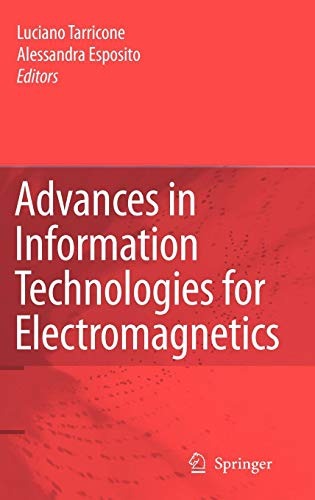
Advances in Information Technologies for Electromagnetics
Simple tutorial chapters introduce the reader to cutting edge technologies, such as parallel and distributed computing, object-oriented technologies, grid computing, semantic grids, agent based computing and service-oriented architectures. On such bases, a variety of EM applications is proposed: 1) parallel FDTD codes (both for antenna analysis and for metamaterial applications), 2) grid computing for computational EM (CEM) (with applications to antenna arrays, wireless and remote-sensing systems) 3) mobile agents for parametric CEM modeling 4) complex/hybrid EM software environments (with applications to planar circuits, quasi-optical systems,…) 5) semantic grids for CAE of antennas arrays.
كتب مشابهة

Hotel building in Damascus city
Show a hotel building in Damascus. The project is a facility consisting of one basement use as a storage rooms and shelter, and ground story and twelve story.

A structural study and study of the site of Al-Rahma hospital - Deir Ez-Zour
Presents the structural study and design of Al-Rahma Hospital, located in Deir Ez-Zour, Al-Kanamat area near the Euphrates River. The hospital includes two basement levels and ten floors above ground. The basements house medical imaging rooms, storage spaces, and a shelter.

Introduction to finite element analysis : A textbook for engineering students
Covers the basic concepts and applications of finite element analysis. It is specifically aimed at introducing this advanced topic to undergraduate-level engineering students and practicing engineers in a lucid manner. It also introduces a structural and heat transfer analysis software FEASTSMT which has wide applications in civil, mechanical, nuclear and automobile engineering domains.

Fundamentals of durable reinforced concrete
The book presents a framework for specification through internationally adopted codes and standards and summarises the background to probabilistic approaches to durability design, providing a state-of-the-art review of mathematical modelling of deterioration mechanisms along with current directions in test methods for performance-based specifications.
