



الصفحة 1
الصفحة 1

Natural language processing and information systems ; 12th International Conference on Applications of Natural Language to Information Systems, NLDB 2007, Paris, France, June 27-29, 2007, Proceedings
NLP techniques may substantially enhance most phases of the information system lifecycle, starting with requirement analysis, specification and validation, and going up to conflict resolution, result processing and presentation.

Multiparadigm Programming in Mozart/Oz ; 2nd International Conference, MOZ 2004, Charleroi, Belgium, October 7-8, 2004, Revised Selected Papers
Oz's concurrency model yields simplicity and clarity (because Oz makes it easier to express complex programs with many interacting components), g- erality, and better interfaces (because the data?ow model automatically makes interfaces more lightweight). Constraint programming in Oz again yields simplicity and clarity (because theprogrammercanexpresswhatneedstobetrueratherthanthemorecomplex issue of how to make it true), and o?ers a powerful mathematical notation that is di?cult to implement on top of languages that do not support it natively. Mozart's distributed computing model makes for improved interfaces and eases the evolution of systems. In my own work, one of the most important concernsistobeabletoquicklyscaleupaprototypeimplementationintoalar- scale service that can run reliably on thousands of computers, serving millions of users.

Multi-access Edge Computing : Software Development at the Network Edge
The book aims not only at providing a comprehensive technology and standard reference overview for students, but also useful research insights and practical exercises for edge software developers and investigators in the area (and for students looking to apply their skills). A particular emphasis is given Multi-access Edge Computing (MEC) as defined in European Telecommunications Standards Institute (ETSI), in relationship with other standard organizations like 3GPP, thus in alignment with the recent industry efforts to produce harmonized standards for edge computing leveraging both ETSI ISG MEC and 3GPP specifications.

Modelling Distributed Systems
Process algebras are languages for the description of elementary parallel systems and are used to study the behavioural properties of distributed systems, but they often lack the ability to handle data. This textbook guides students through algebraic specification and verification of distributed systems, and some of the most prominent formal verification techniques.

Model-Driven Testing : Using the UML Testing Profile
Written by the original members of this standardization group, this book shows you how to use UML to test complex software systems. The authors introduce UTP step-by-step, using a case study that illustrates how UTP can be used for test modeling and test specification. You’ll learn how UTP concepts can be used for functional and non-functional testing, with example applications and best practices for user-interfaces and service oriented architectures. In addition, the authors demonstrate how to apply UTP using frameworks like TTCN-3 and the JUnit test framework for Java.

Model-driven architecture in practice ; A Software Production Environment Based on Conceptual Modeling
This book introduces all the relevant information required to understand and put Model Driven Architecture (MDA) into industrial practice. The book combines a sound theoretical approach based on more than 10 years' research.

Model driven Engineering Languages and Systems; 10th International Conference, MoDELS 2007, Nashville, USA, September 30 - October 5, 2007, Proceedings
This book constitutes the refereed proceedings of the 10th International Conference on Model Driven Engineering Languages and Systems (formerly the UML series of conferences), MODELS 2007, held in Nashville, USA, September 30 - October 5, 2007. The 45 revised full papers were carefully reviewed and selected from 158 initial submissions.

Model Driven Engineering Languages and Systems ; Vol. 3713 : 8th International Conference, MoDELS 2005, Montego Bay, Jamaica, October 2-7, 2005, Proceedings
Constitutes the proceedings of the 8th International Conference on Model Driven Engineering Languages and Systems, MoDELS 2005, held in Montego Bay, Jamaica, in October 2005. This book includes 52 papers and 2 keynote abstracts. It covers such topics as process modelling, product families, state/behavioral modeling, design strategies and more.
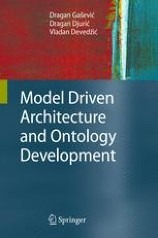
Model Driven Architecture and Ontology Development
Gaševic and his co-authors try to fill this gap by covering the subject of MDA application for ontology development on the Semantic Web. Part I of their book describes existing technologies, tools, and standards like XML, RDF, OWL, MDA, and UML. Part II presents the first detailed description of OMG’s new ODM (Ontology Definition Metamodel) initiative, a specification which is expected to be in the form of an OMG language like UML. Finally, Part III is dedicated to applications and practical aspects of developing ontologies using MDA-based languages.

Model Driven Architecture ; European MDA Workshops : Foundations and Applications, MDAFA 2003 and MDAFA 2004, Twente, The Netherlands, June 26-27, 2003, and Linköping, Sweden, June 10-11, 2004, Revised Selected Papers
Model-Driven Architecture (MDA) is an initiative proposedby the Object M- agement Group (OMG) for platform-generic software development. MDA s- arates the specification of system functionality from the implementation on a specific platform. It is aimed at making software assets more resilient to changes caused by emerging technologies. While stressing the importance of modeling, the MDA initiative covers a wide spectrum of research areas. Further efforts are required to bring them into a coherent approach based on open standards and supported by matured tools and techniques. This volume contains the selected papers of two workshops on “Model-Driven Architecture – Foundations and Applications” (MDAFA): MDAFA 2003 held at the University of Twente, Twente, The Netherlands, June 26–27, 2003, and MDAFA 2004 held at Linko ¨ping University, Link¨ oping, Sweden, June 10–11, 2004. The goal of the workshops was to understand the foundations of MDA, to share experience in applying MDA techniques and tools, and to outline future research directions. The workshops organizers encouraged authors of accepted papers to re-submit their papers to a post-workshop reviewing process; 15 of these papers were accepted to appear in this volume on MDA.

Model Checking Software ; Vol. 3639 : 12th International SPIN Workshop, San Francisco, CA, USA, August 22-24, 2005, Proceedings
Constitutes the refereed proceedings of the 12th International SPIN workshop on Model Checking Software, SPIN 2005, held in San Francisco, USA in August 2005. The papers are organized in topical sections on state representation and abstraction, dealing with concurrency, dealing with complex data, checking temporal properties, and more.

Model checking software ; 14th International SPIN Workshop, Berlin, Germany, July 1-3, 2007, Proceedings
This book presents the proceedings of the 14th International SPIN workshop on Model Checking Software, held in Berlin, Germany. The papers are organized into topical sections covering directed model checking, partial order reduction, program analysis, exploration advances, modeling and case studies, and tool demonstrations.

IPv6 in Practice: A Unixer's Guide to the Next Generation Internet
This book is a practical guide to IPv6 addressing Unix and network administrators with experience in TCP/IP(v4) but not necessarily any IPv6 knowledge. It focuses on reliable and efficient operation of IPv6 implementations available today rather than on protocol specifications. Consequently, it covers the essential concepts - using instructive and thoroughly tested examples - on how to configure, to administrate, and to debug IPv6 setups.
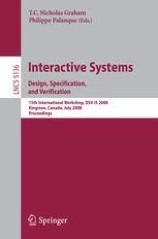
Interactive systems. design, specification, and verification ; 15th International Workshop, DSV-IS 2008 Kingston, Canada, July 16-18, 2008 Revised Papers
This book constitutes the refereed proceedings of the 15th International Workshop on Design, Specification, and Verification of Interactive Systems, DSV-IS 2008, held in Kingston, Canada, in July 2008.The 21 revised full papers and 10 late breaking and experience report papers presented were carefully reviewed and selected from numerous submissions for inclusion in the book. The papers cover user interface evaluation and specification, with particular emphasis on the use of task models to provide high-level approaches for capturing the intended functionality of a user interface; examining techniques for modeling user interfaces, particularly for mobile and ubiquitous applications.
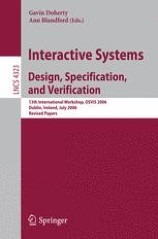
Interactive systems design, specification, and verification ; 13th International Workshop, DSVIS 2006, Dublin, Ireland, July 26-28, 2006, Revised Papers
This book constitutes the thoroughly refereed post-proceedings of the 13th International Workshop on Design, Specification, and Verification of Interactive Systems, DSVIS 2006, held in Dublin, Ireland in July 2006.
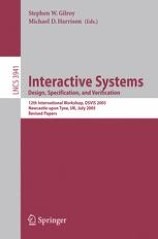
Interactive systems : Design specification, and verification ; 12th International Workshop, DSVIS 2005, Newcastle upon Tyne, UK, July 13-15, 2005, Revised Papers
This book constitutes the refereed post-proceedings of the 12th International Workshop on Design, Specification, and Verification of Interactive Systems, DSV-IS 2005. The 20 revised full papers, 1 keynote paper, and 4 summaries of group discussions are organized in topical sections on teams and groups, sketches and templates, away from the desktop, migration and mobility, analysis tools, model-based design processes and tools, and group discussions.
Integrated formal methods ; 6th International Conference, IFM 2007, Oxford, UK, July 2-5, 2007, Proceedings
It addresses all aspects of formal methods integration, including of a process of analysis or design application of formal methods to analysis or design, extension of one method based upon the inclusion of ideas or concepts from others, and semantic integration or practical application.

Integrated formal methods ; 5th International conference, IFM 2005, Eindhoven, The Netherlands, November 29 - December 2, 2005. Proceedings
This book constitutes the refereed proceedings of the 5th International Conference on Integrated Formal Methods, IFM 2005, held in Eindhoven, The Netherlands, in November/December 2005. The 19 revised full papers presented together with 3 invited papers were carefully reviewed and selected from 40 submissions. The papers are organized in topical sections on components, state/event-based verification, system development, applications of B, tool support, non-software domains, semantics, as well as UML and statecharts.

Inconsistency tolerance
Inconsistency arises in many areas in advanced computing. Often inconsistency is unwanted, for example in the specification for a plan or in sensor fusion in robotics; however, sometimes inconsistency is useful. Whether inconsistency is unwanted or useful, there is a need to develop tolerance to inconsistency in application technologies such as databases, knowledge bases, and software systems. To address this situation, inconsistency tolerance is being built on foundational technologies for identifying and analyzing inconsistency in information, for representing and reasoning with inconsistent information, for resolving inconsistent information, and for merging inconsistent information. The idea for this book arose out of a Dagstuhl Seminar on the topic held in summer 2003. The nine chapters in this first book devoted to the subject of inconsistency tolerance were carefully invited and anonymously reviewed. The book provides an exciting introduction to this new field.

Handbook of networked and embedded control systems
The Handbook of Networked and Embedded Control Systems, the first of its kind, provides engineers, computer scientists, mathematicians, and students a broad, comprehensive source of information and technology to address many questions and aspects of embedded and networked control. A carefully organized collection of important results, tools, software, and technology, this work unifies into a single reference many scattered articles, websites, and specification sheets—information that might otherwise be difficult to find.
