



الصفحة 1
الصفحة 1
Informatics Education - The Bridge between Using and Understanding Computers ; International Conference on Informatics in Secondary Schools - Evolution and Perspectives, ISSEP 2006, Vilnius, Lithuania, November 7-11, 2006, Proceedings
Although the school system is subject to specific national regulations, didactical issues warrant discussion on an international level. This applies specifically to informatics didactics. In contrast to most other scientific disciplines, informatics undergoes substantial technical and scientific changes and shifts of paradigms even at the basic level taught in secondary school. Moreover, informatics education is under more stringent observation from parents, potential employers, and policy makers than other disciplines. It is considered to be a modern discipline. Hence, being well-educated in informatics seemingly ensures good job perspectives. Further, policy makers pay attention to informatics education, hoping that a young population well-educated in this modern technology will contribute to the future wealth of the nation.
Informatics education - supporting computational thinking ; 3rd International Conference on informatics in secondary schools : Evolution and perspectives, ISSEP 2008 Torun Poland, July 1-4, 2008 Proceedings
Informatics Education – Supporting Computational Thinking contains papers presented at the Third International Conference on Informatics in Secondary Schools – Evolution and Perspective, ISSEP 2008, held in July 2008 in Torun, Poland. As with the proceedings of the two previous ISSEP conferences (2005 in Klag- furt, Austria, and 2006 in Vilnius, Lithuania), the papers presented in this volume address issues of informatics education transcending national boundaries and, the- fore, transcending differences in the various national legislation and organization of the educational system. Observing these issues, one might notice a trend. The p- ceedings of the First ISSEP were termed From Computer Literacy to Informatics F- damentals [1]. There, broad room was given to general education in ICT.
From computer literacy to informatics fundamentals ; International conference on informatics in secondary schools : Evolution and perspectives, ISSEP 2005, Klagenfurt, Austria, March 30-April 1, 2005, Proceedings
Duetothepenetrationofinformationtechnologyintosocietyatlargeandinto schools in particular, the relationship between informatics and education leading togeneralcomputerliteracyortotheuseofIT-basedapproachesinconventional subjects, e-learning in school, is an evident focus of many contributions. According to the broad scope of the conference its proceedings are split into two volumes. This volume, From Computer Literacy to Informatics Fundam- tals, covers papers reporting on national strategies of informatics instruction and their evolution in accordance with the penetration of information proce- ing equipment in our daily life. In one way or another, these strategies strive to accommodate the needs of basic skills in information and communication te- nology (ICT) with educational principles that can be conveyed by informatics instruction in a traditional sense. Hence, the papers on national strategies are complementedintwoways: ?rstly, bycontributionsthatstrivetoidentifyfun- mental issues, informatics can contribute to the general education process of the youth; and, secondly, by papers presenting approaches on how to link or even to combine instruction about such informatics fundamentals with the need to introduce pupils to the productive use of ICT.
Explainable Artificial Intelligence : An Introduction to Interpretable Machine Learning
Offers a curriculum for introducing interpretability to machine learning at every stage. The authors provide compelling examples that a core teaching practice like leading interpretive discussions can be taught and learned by teachers and sustained effort. And what better way to strengthen the quality of AI and Machine learning outcomes. I hope that this book will become a primer for teachers, data Science educators, and ML developers, and together we practice the art of interpretive machine learning.

Discovery Science ; 10th International Conference, DS 2007 Sendai, Japan, October 1-4, 2007. Proceedings
This volume consists of three parts. The first part contains the papers/abstracts of the invited talks, the second part contains the accepted long papers, and the third part contains the accepted regular papers.
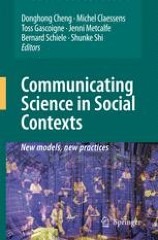
Communicating Science in Social Contexts : New models, new practices
Science communication, as a multidisciplinary field, has developed remarkably in recent years. It is now a distinct and exceedingly dynamic science that melds theoretical approaches with practical experience. Formerly well-established theoretical models now seem out of step with the social reality of the sciences, and the previously clear-cut delineations and interacting domains between cultural fields have blurred. Communicating Science in Social Contexts examines that shift, which itself depicts a profound recomposition of knowledge fields, activities and dissemination practices, and the value accorded to science and technology.
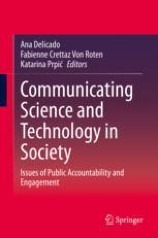
Communicating science and technology in society
Addresses the engagement between science and society from multiple viewpoints. At a time when trust in experts is being questioned, misinformation is rife and scientific and technological development show growing social impact, the volume examines the challenges in involving the public in scientific debates and decisions. It takes into account societal needs and concerns in research, and analyses the interface between the roles of institutions and individuals. From environmental challenges to science communication, participatory technological design to animal experimentation, and transdisciplinarity to norms and values in science, the volume brings together research on areas in which scientists and citizens interact, across diverse, often understudied, socio-cultural contexts in Europe.
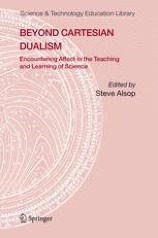
Beyond Cartesian Dualism : Encountering affect in the teaching and learning of science.
There is surprisingly little known about affect in science education. Despite periodic forays into monitoring students’ attitudes-toward-science, the effect of affect is too often overlooked. Beyond Cartesian Dualism gathers together contemporary theorizing in this axiomatic area. In fourteen chapters, senior scholars of international standing use their knowledge of the literature and empirical data to model the relationship between cognition and affect in science education. Their revealing discussions are grounded in a broad range of educational contexts including school classrooms, universities, science centres, travelling exhibits and refugee camps, and explore an array of far reaching questions. What is known about science teachers’ and students’ emotions? How do emotions mediate and moderate instruction? How might science education promote psychological
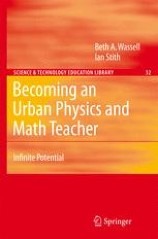
Becoming an urban physics and math teacher : Infinite potential
What happens as beginning urban teachers transition through their first few years in the classroom? This book captures one teacher's journey through the first three years of teaching science and mathematics in a large urban district in the US. The authors focus on Ian's agency as a beginning teacher and explore his success in working with diverse students. Using critical ethnography combined with first-person narrative, they investigate Ian's teaching practices in four contexts: his student teaching experience, his work with students on a summer curriculum development project, his first year of teaching in a small, urban high school, and his second year of teaching in a large, comprehensive high school. In each field, the authors describe the structural changes Ian encounters and the ways in which he re-utilizes the practices he used successfully in previous fields.
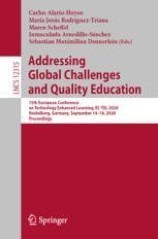
Addressing Global Challenges and Quality Education ; 15th European Conference on Technology Enhanced Learning, EC-TEL 2020, Heidelberg, Germany, September 14–18, 2020, Proceedings
The chapters: “Designing an Online Self-Assessment for Informed Study Decisions: The User Perspective”; “Living with Learning Difficulties: Two Case Studies Exploring the Relationship Between Emotion and Performance in Students With Learning Difficulties”; “Applying Instructional Design Principles on Augmented Reality Cards for Computer Science Education”; and “Teaching Simulation Literacy With Evacuations - Concept, Technology, and Material for a Novel Approach” are available open access under a Creative Commons Attribution 4.0 International License via link.springer.com.
