



الصفحة 1
الصفحة 1
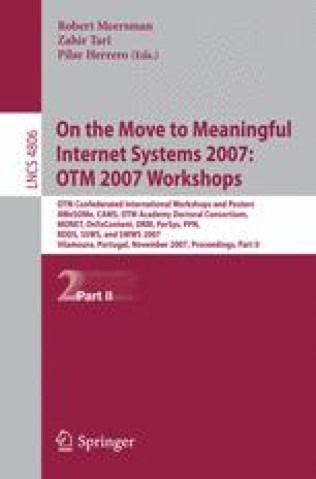
On the move to meaningful internet systems 2007 : OTM 2007 Workshops ; OTM Confederated International Workshops and Posters, AWeSOMe, CAMS, OTM Academy Doctoral Consortium, MONET, On To Content, ORM, PerSys, PPN, RDDS, SSWS, and SWWS 2007, Vilamoura, Portugal, November 25-30, 2007, Proceedings, Part II
This two-volume set LNCS 4805/4806 constitutes the refereed proceedings of 10 international workshops and papers of the OTM Academy Doctoral Consortium held as part of OTM 2007 in Vilamoura, Portugal, in November 2007. The first volume begins with 23 additional revised short or poster papers of the OTM 2007 main conferences.

On the move to meaningful internet systems 2006 : OTM 2006 Workshops ; Vol.4278 ; OTM Confederated International Conferences and Posters, AWeSOMe, CAMS, COMINF ,IS, KSinBIT, MIOS-CIAO, MONET, On To Content, ORM, PerSys, OTM Academy Doctoral Consortium, RDDS,SWWS,SeBGIS 2006, Montpellier, France, October 29 - November 3, 2006, Proceedings, Part II
This two-volume set LNCS 4277/4278 constitutes the refereed proceedings of 14 international workshops held as part of OTM 2006 in Montpellier, France in October/November 2006. The first volume begins with 26 additional revised short or poster papers of the OTM 2006 main conferences.

Multimedia big data computing for IoT applications : Concepts, paradigms and solutions
This book considers all aspects of managing the complexity of Multimedia Big Data Computing (MMBD) for IoT applications and develops a comprehensive taxonomy. It also discusses a process model that addresses a number of research challenges associated with MMBD, such as scalability, accessibility, reliability, heterogeneity, and Quality of Service (QoS) requirements, presenting case studies to demonstrate its application. Further, the book examines the layered architecture of MMBD computing and compares the life cycle of both big data and MMBD. Written by leading experts, it also includes numerous solved examples, technical descriptions, scenarios, procedures, and algorithms.

Multi-Agent Systems and Applications IV ; 4th International Central and Eastern European Conference on Multi-Agent Systems, CEEMAS 2005, Budapest, Hungary, September 15-17, 2005, Proceedings
In the very competitive field of agent oriented conferences and workshops nowadays (such as AAMAS, WI/IAT, EUMAS, CIA, MATES) the special profile of CEEMAS is that it is trying to bridge the gap between applied research achievements and theoretical research activities. Our ambition is to provide a forum for presenting theoretical research with an evident application potential, implemented application prototypes and their properties, as well as industrial case studies of successful (but also unsuccessful) agent technology deployments. This is why the CEEMAS proceedings volume provides a collection of research and application papers. The technical research paper section of the proceedings (see pages 11–499) contains pure research papers as well as research results in application settings while the application papers section (see pages 500–530) contains papers focused on application aspects. The goal is to demonstrate the real life value and commercial reality of multi-agent systems as well as to foster communication between academia and industry in this field.

Multi-Agent and Multi-Agent-Based Simulation ; Joint Workshop MABS 2004
The aim of the workshop was to provide a forum for work in both appli- tions of multi-agent-based simulation and the technical challenges of simulating large multi-agent systems (MAS). There has been considerable recent progress in modelling and analyzing multi-agent systems, and in techniques that apply MAS models to complex real-world systems such as social systems and organi- tions. Simulation is an increasingly important strand that weaves together this work. In high-risk, high-cost situations, simulations provide critical cost/benefit leverage, and make possible explorations that cannot be carried out in situ: – Multi-agent approaches to simulating complex systems are keytools in interdisciplinary studies of social systems. Agent-based social simulation (ABSS) research simulates and synthesizes social behavior in order to understand real social systems with properties of self-organization, scalability, robustness, and openness. – In the MAS community, simulation has been applied to awide range of MAS research and design problems, from models of complex individual agents - ploying sophisticated internal mechanisms to models of large-scale societies of relatively simple agents which focus more on the interactions between agents.

Morphological Models of Random Structures
This book covers methods of Mathematical Morphology to model and simulate random sets and functions (scalar and multivariate). The introduced models concern many physical situations in heterogeneous media, where a probabilistic approach is required, like fracture statistics of materials, scaling up of permeability in porous media, electron microscopy images (including multispectral images), rough surfaces, multi-component composites, biological tissues, textures for image coding and synthesis. The common feature of these random structures is their domain of definition in n dimensions, requiring more general models than standard Stochastic Processes.The main topics of the book cover an introduction to the theory of random sets, random space tessellations, Boolean random sets and functions, space-time random sets and functions (Dead Leaves, Sequential Alternate models, Reaction-Diffusion), prediction of effective properties of random media, and probabilistic fracture theories.
Modeling and Management of Fuzzy Semantic RDF Data
Presents the latest research findings in fuzzy RDF data modeling and management. Fuzziness widely exist in many data and knowledge intensive applications. With the increasing amount of metadata available, efficient and scalable management of massive semantic data with uncertainty is of crucial importance. This book goes to great depth concerning the fast-growing topic of technologies and approaches of modeling and managing fuzzy metadata with Resource Description Framework (RDF) format. Its major topics include representation of fuzzy RDF data, fuzzy RDF graph matching, query of fuzzy RDF data, and persistence of fuzzy RDF data in diverse databases. The objective of the book is to provide the state-of-the-art information to researchers, practitioners, and postgraduates students who work on the area of big data intelligence and at the same time serve as the uncertain data and knowledge engineering professional as a valuable real-world reference.

Model checking software ; 14th International SPIN Workshop, Berlin, Germany, July 1-3, 2007, Proceedings
This book presents the proceedings of the 14th International SPIN workshop on Model Checking Software, held in Berlin, Germany. The papers are organized into topical sections covering directed model checking, partial order reduction, program analysis, exploration advances, modeling and case studies, and tool demonstrations.

Microsoft Visual C# Step by Step
Guide to Microsoft Visual C# fundamentals with Visual Studio. Expand your expertiseand teach yourself the fundamentals of programming with the latest version of Visual C# with Visual Studio. If you are an experienced software developer, you'll get all the guidance, exercises, and code you need to start building responsive, scalable, cloud-connected applications that can run almost anywhere. Discover how to: Quickly start creating Visual C# code and projects with Visual Studio Work with variables, operators, expressions, methods, and program flow Build more robust apps with error, exception, and resource management Spot problems fast with the Visual Studio debugger Make the most of improvements to C# methods, parameters, and switch statements Master the C# object model, and create your own functional data structures Leverage advanced properties, indexers, generics, and collection classes Create Windows 10 apps that share data, collaborate, and use cloud services Integrate Cortana to voice-enable your applications Perform complex queries over object collections with LINQ

Innovative techniques in instruction technology, e-learning, e-assessment, and education
Innovative Techniques in Instruction Technology, E-Learning, E-Assessment and Education is a collection of world-class paper articles addressing the following topics:E-Learning including development of courses and systems for technical and liberal studies programs; online laboratories; intelligent testing using fuzzy logic; evaluation of on line courses in comparison to traditional courses; mediation in virtual environments; and methods for speaker verification.

Innovative Concepts for Autonomic and Agent-Based Systems ; 2nd International Workshop on Radical Agent Concepts, WRAC 2005, Greenbelt, MD, USA, September 20-22, 2005, Revised Papers
This volume includes revised versions of papers presented at the workshop. The workshop was structured so as to allow adequate time for discussion and interaction, to exchange ideas and reflect on the motivations, scientific grounds and practical consequences of the concepts presented. Many of the ideas are truly “radical”, and so authors were given time to revise their papers to reflect further thoughts on the ideas presented and to reflect feedback received at the workshop. We are grateful to Jeff Kephart for a very interesting keynote speech describing IBM’s current and future work in this field, which fit very well with the aims and scope of the workshop.

Innovations and advanced techniques in systems, computing sciences and software engineering
Innovations and Advanced Techniques in Systems, Computing Sciences and Software Engineering includes a set of rigorously reviewed world-class manuscripts addressing and detailing state-of-the-art research projects in the areas of Computer Science, Software Engineering, Computer Engineering, and Systems Engineering and Sciences.Innovations and Advanced Techniques in Systems, Computing Sciences and Software Engineering includes selected papers form the conference proceedings of the International Conference on Systems.

Infrastructure for Agents, Multi-Agent Systems, and Scalable Multi-Agent Systems ; International Workshop on Infrastructure for Scalable Multi-Agent Systems, Barcelona, Spain, June 3-7, 2000 Revised Papers
Building research grade multi-agent systems usually involves a broad variety of software infrastructure ingredients like planning, scheduling, coordination, communication, transport, simulation, and module integration technologies and as such constitutes a great challenge to the individual researcher active in the area. The book presents a collection of papers on approaches that will help make deployed and large scale multi-agent systems a reality. The first part focuses on available infrastructure and requirements for constructing research-grade agents and multi-agent systems. The second part deals with support in infrastructure and software development methods for multi-agent systems that can directly support coordination and management of large multi-agent communities; performance analysis and scalability techniques are needed to promote deployment of multi-agent systems to professionals in software engineering and information technology.

Hybrid Systems : Computation and Control ; Vol.3927 ; 9th International Workshop, HSCC 2006, Santa Barbara, CA, USA, March 29-31, 2006, Proceedings
The focus is on modeling, analysis, and implementation of dynamic and reactive systems involving both discrete and continuous behaviors. Topics addressed include tools for analysis and verification, control and optimization, modeling, engineering applications, and new directions in language support and implementation.

How to engineer software : A model-based approach
The book promotes development scalability through domain partitioning and subdomain partitioning. It also explores software documentation that specifically and intentionally adds value for development and maintenance. Contains many illustrative examples of model-based software engineering, from semantic model all the way to executable code Explains how to derive verification (acceptance) test cases from a semantic model Describes project estimation, along with alternative software development and maintenance processes Shows how to develop and maintain cost-effective software that solves real-world problems
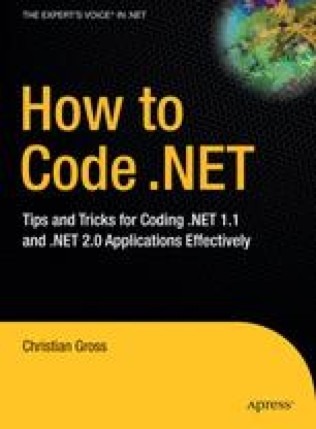
How to Code .NET : Tips and Tricks for Coding .NET 1.1 and .NET 2.0 Applications Effectively
How to Code .NET: Tips and Tricks for Coding .NET 1.1 and .NET 2.0 Applications Effectively provides solutions to certain problems. That is, specific problems. This book provides detailed, authoritative explanations of good .NET coding techniques.
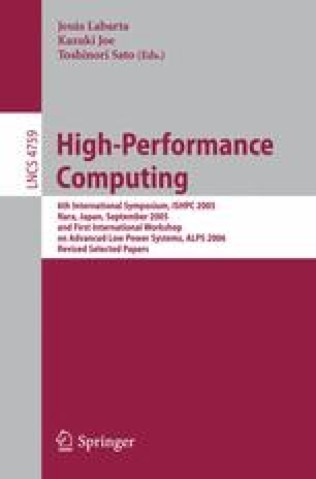
High-Performance Computing ; 6th International Symposium, ISHPC 2005, Nara, Japan, September 7-9, 2005, First International Workshop on Advanced Low Power Systems, ALPS 2006, Revised Selected Papers
This is the joint post-proceedings of the 6th International Symposium on High Performance Computing (ISHPC-VI) and the First International Workshop on Advanced Low Power Systems 2006 (ALPS2006). The post-proceedings also contain the papers presented at the Second HPF International Workshop: - periences and Progress (HiWEP2005) and the Workshop on Applications for PetaFLOPS Computing (APC2005), which are workshops of ISHPC-VI. ISHPC-VI, HiWEP2005 and APC2005 were held in Nara, Japan during September 7–9, 2005. Fifty-eight papers from 11 countries were submitted to ISHPC-VI. After the reviews of the submitted papers, the ISHPC-VI Program Committee selected 15 regular (12-page) papers for oral presentation. In ad- tion, several other papers with favorable reviews were recommended for poster presentation, and 14 short (8-page) papers were also selected.

High performance computing for computational science - VECPAR 2006 ; 7th International Conference, Rio de Janeiro, Brazil, June 10-13, 2006, Revised Selected and Invited Papers
This book constitutes the thoroughly refereed post-proceedings of the 7th International Conference on High Performance Computing for Computational Science, VECPAR 2006, held in Rio de Janeiro, Brazil, in June 2006.
High performance computing - HiPC 2008 ; 15th International Conference, Bangalore, India, December 17-20, 2008. Proceedings
This book constitutes the refereed proceedings of the 15th International Conference on High-Performance Computing, HiPC 2008, held in Bangalore, India, in December 2008.The 46 revised full papers presented together with the abstracts of 5 keynote talks were carefully reviewed and selected from 317 submissions. The papers are organized in topical sections on applications performance optimizazion, parallel algorithms and applications, scheduling and resource management, sensor networks, energy-aware computing, distributed algorithms, communication networks as well as architecture.

Hierarchical Bayesian Optimization Algorithm : Toward a New Generation of Evolutionary Algorithms
This book provides a framework for the design of competent optimization techniques by combining advanced evolutionary algorithms with state-of-the-art machine learning techniques. The book focuses on two algorithms that replace traditional variation operators of evolutionary algorithms by learning and sampling Bayesian networks: the Bayesian optimization algorithm (BOA) and the hierarchical BOA (hBOA). BOA and hBOA are theoretically and empirically shown to provide robust and scalable solution for broad classes of nearly decomposable and hierarchical problems. A theoretical model is developed that estimates the scalability and adequate parameter settings for BOA and hBOA. The performance of BOA and hBOA is analyzed on a number of artificial problems of bounded difficulty designed to test BOA and hBOA on the boundary of their design envelope.
