



الصفحة 1
الصفحة 1

Multimedia Retrieval
The single chapters of this textbook explain the general architecture of multimedia information retrieval systems; various metadata languages like Dublin Core, RDF, or MPEG; pattern recognition through Markov models, unsupervised learning, and pattern clustering; various indexing approaches to audio and video streams; interaction and control; the protection of content and user privacy; and search effectiveness and efficiency.
Modeling and Management of Fuzzy Semantic RDF Data
Presents the latest research findings in fuzzy RDF data modeling and management. Fuzziness widely exist in many data and knowledge intensive applications. With the increasing amount of metadata available, efficient and scalable management of massive semantic data with uncertainty is of crucial importance. This book goes to great depth concerning the fast-growing topic of technologies and approaches of modeling and managing fuzzy metadata with Resource Description Framework (RDF) format. Its major topics include representation of fuzzy RDF data, fuzzy RDF graph matching, query of fuzzy RDF data, and persistence of fuzzy RDF data in diverse databases. The objective of the book is to provide the state-of-the-art information to researchers, practitioners, and postgraduates students who work on the area of big data intelligence and at the same time serve as the uncertain data and knowledge engineering professional as a valuable real-world reference.
Model Driven Architecture and Ontology Development
Gaševic and his co-authors try to fill this gap by covering the subject of MDA application for ontology development on the Semantic Web. Part I of their book describes existing technologies, tools, and standards like XML, RDF, OWL, MDA, and UML. Part II presents the first detailed description of OMG’s new ODM (Ontology Definition Metamodel) initiative, a specification which is expected to be in the form of an OMG language like UML. Finally, Part III is dedicated to applications and practical aspects of developing ontologies using MDA-based languages.

Information Sharing on the Semantic Web
The more information is available, the harder it is to locate any particular piece of it. And even when it has been successfully found, it is even harder still to usefully combine it with other information we may already possess. It is commonly understood that this problem of information sharing can only be solved by giving computers better access to the semantics of the information. While it has been recognized that ontologies play a crucial role in solving the open problems, most approaches rely on the existence of well-established data structures. To overcome these shortcomings, Stuckenschmidt and van Harmelen describe ontology-based approaches for resolving semantic heterogeneity in weakly structured environments, in particular the World Wide Web. Addressing problems like missing conceptual models, unclear system boundaries, and heterogeneous representations, they design a framework for ontology-based information sharing in weakly structured environments like the Semantic Web. For researchers and students in areas related to the Semantic Web, the authors provide not only a comprehensive overview of the State of the art, but also present in detail recent research in areas like ontology design for information integration, metadata generation and management, and representation and management of distributed ontologies. For professionals in areas such as e-commerce and knowledge management, the book provides decision support on the use of novel technologies, information about potential problems, and guidelines for the successful application of existing technologies.
Foundation of semantic web technologies
Concentrates on Semantic Web technologies standardized by the World Wide Web Consortium: RDF and SPARQL enable data exchange and querying, RDFS and OWL provide expressive ontology modeling, and RIF supports rule-based modeling. The text also describes methods for specifying, querying, and reasoning with ontological information. In addition, it explores topics that are clearly beyond foundations, such as tools, applications, and engineering aspects.
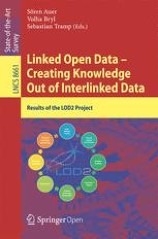
Linked Open Data -- Creating Knowledge Out of Interlinked Data : Results of the LOD2 Project
Linked Open Data (LOD) is a pragmatic approach for realizing the Semantic Web vision of making the Web a global, distributed, semantics-based information system. This book presents an overview on the results of the research project “LOD2 -- Creating Knowledge out of Interlinked Data”. LOD2 is a large-scale integrating project co-funded by the European Commission within the FP7 Information and Communication Technologies Work Program. Commencing in September 2010, this 4-year project comprised leading Linked Open Data research groups, companies, and service providers from across 11 European countries and South Korea.
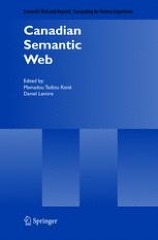
Canadian Semantic Web
This book covers a variety of well known topics of interest to practitioners in industry and research scientists. The range of topics includes languages, tools and methodologies for the semantic Web, semantic Web-based ontology management and engineering, semantic Web services, practical applications of the semantic Web techniques, artificial intelligence methods and tools for the semantic Web, software agents on the semantic Web, visualization and modeling of the semantic Web. The goal of this book is to provide a state-of-the-art review of the research as well as to introduce topics of interest to experts.

Annotating, Extracting and Reasoning about Time and Events ; International Seminar, Dagstuhl Castle, Germany, April 20-15, 2005, Revised Papers
The book presented centers around an emergingde factost and ardfortime and event annotation: TimeML. TimeML has recently been adopted as a candidate for an ISO standard, and is currently being reviewed in this capacity.It discussions focussed on the following three Time- related issues: using the TimeML language efiectively for consistent annotation, determining how useful such annotation is for further processing,and describing modifications that should be applied to the standard for applications such as question-answering and information retrieval. Discussions at the Dagstuhl Seminar led to new researchideas, and a variety
