



الصفحة 1
الصفحة 1

Inside deep learning : Math, algorithms, models
Journey through the theory and practice of modern deep learning, and apply innovative techniques to solve everyday data problems. In Inside Deep Learning, you will learn how to: Implement deep learning with PyTorch Select the right deep learning components Train and evaluate a deep learning model Fine tune deep learning models to maximize performance Understand deep learning terminology Adapt existing PyTorch code to solve new problems Inside Deep Learning is an accessible guide to implementing deep learning with the PyTorch framework. It demystifies complex deep learning concepts and teaches you to understand the vocabulary of deep learning so you can keep pace in a rapidly evolving field. No detail is skipped--you'll dive into math, theory, and practical applications. Everything is clearly explained in plain English.

Hands-On Data Structures and Algorithms with Python : Store, manipulate, and access data effectively ; 3rd ed.
Expands your understanding of key structures, including stacks, queues, and lists, and also show you how to apply priority queues and heaps in applications. You'll learn how to analyze and compare Python algorithms, and understand which algorithms should be used for a problem based on running time and computational complexity. You will also become confident organizing your code in a manageable, consistent, and scalable way, which will boost your productivity as a Python developer. By the end of this Python book, you'll be able to manipulate the most important data structures and algorithms to more efficiently store, organize, and access data in your applications

Fluent Python : Clear, Concise, and Effective Programming
You’ll learn how to write effective, modern Python 3 code by leveraging its best ideas. Don’t waste time bending Python to fit patterns you learned in other languages. Discover and apply idiomatic Python 3 features beyond your past experience. Author Luciano Ramalho guides you through Python’s core language features and libraries and teaches you how to make your code shorter, faster, and more readable.

Concepts and Semantics of Programming Languages 2 : Modular and Object-oriented Constructs with OCaml, Python, C++, Ada and Java
Explores the syntactical constructs of the most common programming languages, and sheds a mathematical light on their semantics, providing also an accurate presentation of the material aspects that interfere with coding. Presents an original semantic model, collectively taking into account all of the constructs and operations of modules and classes: visibility, import, export, delayed definitions, parameterization by types and values, extensions, etc. The model serves for the study of Ada and OCaml modules, as well as C header files. It can be deployed to model object and class features, and is thus used to describe Java, C++, OCaml and Python classes.

Concepts and Semantics of Programming Languages 1 : A Semantical Approach with OCaml and Python
Explores the syntactical constructs of the most common programming languages, and sheds a mathematical light on their semantics, while also providing an accurate presentation of the material aspects that interfere with coding. It is dedicated to functional and imperative features. Included is the formal study of the semantics of typing and execution; their acquisition is facilitated by implementation into OCaml and Python, as well as by worked examples. Data representation is considered in detail: endianness, pointers, memory management, union types and pattern-matching, etc., with examples in OCaml, C and C++. The second volume introduces a specific model for studying modular and object features and uses this model to present Ada and OCaml modules, and subsequently Java, C++, OCaml and Python classes and objects.
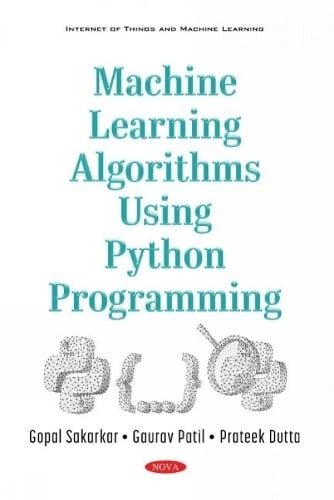
Machine Learning Algorithms Using Python Programming
Presents the key concepts of Machine Learning which includes Python concepts and Interpreter, Foundation of Machine Learning, Data Pre-processing, Supervised Machine Learning, Unsupervised Machine Learning, Reinforcement Learning, Kernel Machine, Design and analysis of Machine Learning experiment and Data visualization. The theoretical concepts along with coding implementation are covered. This book aims to pursue a middle ground between a theoretical textbook and one that focuses on applications. The book concentrates on the important ideas in machine learning.
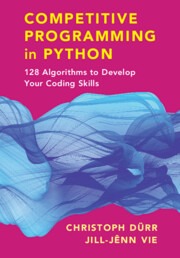
Competitive Programming in Python : 128 Algorithms to Develop your Coding Skills
Learn all the algorithmic techniques and programming skills you need from two experienced coaches, problem setters, and jurors for coding competitions. The authors highlight the versatility of each algorithm by considering a variety of problems and show how to implement algorithms in simple and efficient code. What to expect: * Master 128 algorithms in Python. * Discover the right way to tackle a problem and quickly implement a solution of low complexity.
Applied Deep Learning with TensorFlow 2 : Learn to Implement Advanced Deep Learning Techniques with Python
Focuses on the fundamental concepts and at the same time on practical aspects of implementing neural networks and deep learning for your research projects. This book is designed so that you can focus on the parts you are interested in. You will explore topics as regularization, optimizers, optimization, metric analysis, and hyper-parameter tuning. In addition, you will learn the fundamentals ideas behind autoencoders and generative adversarial networks. All the code presented in the book will be available in the form of Jupyter notebooks which would allow you to try out all examples and extend them in interesting ways. A companion online book is available with the complete code for all examples discussed in the book and additional material more related to TensorFlow and Keras. All the code will be available in Jupyter notebook format and can be opened directly in Google Colab (no need to install anything locally) or downloaded on your own machine and tested locally. You will: Understand the fundamental concepts of how neural networks work / Learn the fundamental ideas behind autoencoders and generative adversarial networks / Be able to try all the examples with complete code examples that you can expand for your own projects / Have available a complete online companion book with examples and tutorials.
