



الصفحة 1
الصفحة 1

Ontology Management : Semantic Web, Semantic Web Services, and Business Applications
This volume describes relevant tasks, practical and theoretical challenges, limitations and methodologies, plus available software tools. The editors discuss integrating the conceptual and technical dimensions with a business view on using ontologies, by stressing the cost dimension of ontology engineering and by providing guidance on how up-to-date tooling helps to build, maintain, and use ontologies. Also included is a one-stop reference on all aspects of managing ontological data and best practices on ontology management for a number of application domains.

Ontologies for Software Engineering and Software Technology
The editors structured the contributions into three parts: first, a detailed introduction into the use of ontologies in software engineering and software technology in general; second, the use of ontologies to conceptualize different process-related domains such as software maintenance, software measurement, or SWEBOK, initiated by IEEE; third, the use of ontologies as artifacts in several software processes, like, for example, in OMG’s MOF or MDA.

Ontologies for Agents : Theory and Experiences
On the other hand, ontologies have established themselves as a powerful tool to enable kno- edge sharing, and a growing number of applications have bene?ted from the use of ontologies as a means to achieve semantic interoperability among heterogeneous, distributed systems. In principle ontologies and agents are a match made in heaven, that has failed to happen. What makes a simple piece of software an agent is its ability to communicate in a ”social” environment, to make autonomous decisions, and to be proactive on behalf of its user. Communication ultimately depends on und- standing the goals, preferences, and constraints posed by the user. Autonomy is theabilitytoperformataskwithlittleornouserintervention,whileproactiveness involves acting autonomously with no need for user prompting. Communication, but also autonomy and proactiveness, depend on knowledge. The ability to c- municate depends on understanding the syntax (terms and structure) and the semantics of a language. Ontologies provide the terms used to describe a domain and the semantics associated with them. In addition, ontologies are often comp- mented by some logical rules that constrain the meaning assigned to the terms. These constraints are represented by inference rules that can be used by agents to perform the reasoning on which autonomy and proactiveness are based.
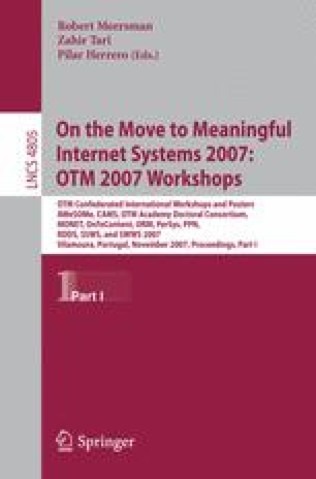
On the move to meaningful internet systems 2007 : OTM 2007 Workshops ; OTM Confederated International Workshops and Posters, AWeSOMe, CAMS, OTM Academy Doctoral Consortium, MONET, OnToContent, ORM, PerSys, PPN, RDDS, SSWS, and SWWS 2007, Vilamoura, Portugal, November 25-30, 2007,
it is clear that there is an acute and increasing need to address and discuss in an integrated forum the implied software and system issues as well as methodological, semantical, theoretical and application issues. As we all know, e-mail, the Internet, and even video conferences are not sufficient for effective and efficient scientific exchange. This is why the OnTheMove (OTM) Federated Conferences series has been created to cover the increasingly wide yet closely connected range of fundamental technologies such as data and Web Semantics.

Object-Oriented Technology. ECOOP 2007 Workshop Reader ; ECOOP 2007 Workshops, Berlin, Germany, July 30-31, 2007, Final Reports
Contains the reports from the workshopsheld at the 21st European Conference on Object-Oriented Programming - ECOOP 2007 - at Technische Universit] at Berlin. Nineteen workshops were heldin the courseofthis conference on July 30 and July 31, 2007, covering a large spectrum of hot research topics. As in previous editions of ECOOP, numerous scientists from academia and industry took the chance to present innovative and topical ideas in an environment ofering optimal conditions for exciting discussions and fruitful interactions. The Workshop Reader which contains the reports from the workshops has been a substantial part of the ECOOP conference for more than10 years

Object-Oriented Software Engineering Using UML Patterns and Java
Shows students how to use both the principles of software engineering and the practices of various object-oriented tools, processes, and products. Using a step-by-step case study to illustrate the concepts and topics in each chapter, Bruegge and Dutoit emphasize learning object-oriented software engineer through practical experience: students can apply the techniques learned in class by implementing a real-world software project. The third edition addresses new trends, in particular agile project management (Chapter 14 Project Management) and agile methodologies (Chapter 16 Methodologies).

Objective information theory
Objective Information Theory (OIT) is proposed to represent and compute the information in a large-scale complex information system with big data in this monograph. To formally analyze, design, develop, and evaluate the information, OIT interprets the information from essential nature, measures the information from mathematical properties, and models the information from concept, logic, and physic. As the exemplified applications, Air Traffic Control System (ATCS) and Smart Court SoSs (System of Systems) are introduced for practical OITs.

Nonlinear dynamics in complex systems via fractals and fractional calculus
Current advances in the knowledge of nonlinear dynamical networks, systems and processes, as well as their unified repercussions, allow us to include some typical complex natural phenomena, from the nanoscale to an extra-galactic scale, in an unitarian comprehensive manner. In other words, the physical, biological and financial data, as well as technological ones (mechanical or electronic devices), of complex systems available today can be managed by the same unique conceptual approach, both analytically and through a computer simulation, using effective nonlinear dynamics procedures. This volume collected some important advances in the fields of fractal curves, fractal analysis and fractional calculus, as well as new solutions of fractal differential equations.
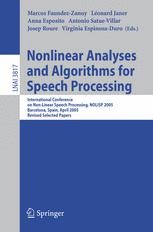
Nonlinear Analyses and Algorithms for Speech Processing ; International Conference on Non-Linear Speech Processing, NOLISP 2005, Barcelona, Spain, April 19-22, 2005, Revised Selected Papers
We present in this volume the collection of ?nally accepted papers of NOLISP 2005 conference. It has been the third event in a series of events related to N- linear speech processing, in the framework of the European COST action 277 “Nonlinear speech processing”. Many speci?cs of the speech signal are not well addressed by conv- tional models currently used in the ?eld of speech processing. The purpose of NOLISP is to present and discuss novel ideas, work and results related to alternative techniques for speech processing, which depart from mainstream approaches. With this intention in mind, we provide an open forum for discussion. Alt- nate approaches are appreciated, although the results achieved at present may not clearly surpass results based on state-of-the-art methods. The call for papers was launched at the beginning of 2005, addressing the following domains: 1. Non-Linear Approximation and Estimation 2. Non-Linear Oscillators and Predictors 3. Higher-Order Statistics 4. Independent Component Analysis 5. Nearest Neighbors 6. Neural Networks 7. Decision Trees 8. Non-Parametric Models 9. Dynamics of Non-Linear Systems 10. Fractal Methods 11. Chaos Modeling 12. Non-Linear Di?erential Equations 13. Others All the main ?elds of speech processing are targeted by the workshop, namely: 1. Speech Coding:Thebit rateavailablefor speechsignalsmustbe strictly l- ited in order to accommodate the constraints of the channel resource.

New Trends in Applied Artificial Intelligence ; 20th International Conference on Industrial, Engineering, and Other Applications of Applied Intelligent Systems. IEA/AIE 2007, Kyoto, Japan, June 26-29, 2007, Proceedings
The 20 International Conference on Industrial, Engineering and Other Applications of Applied Intelligent S- tems (IEA/AIE-2007) held in Kyoto, Japan presented such work performed by many scientists worldwide. The previous IEA/AIE conference held in Japan was the Ninth International Conference on Industrial and Engineering Applications of Arti?cial Intelligence and Expert systems (IEA/AIE-1996) in Fukuoka in 1996.

New horizons for a data-driven economy : A roadmap for usage and exploitation of big data in Europe
The book is structured in four parts: Part I “The Big Data Opportunity” explores the value potential of big data with a particular focus on the European context. It also describes the legal, business and social dimensions that need to be addressed, and briefly introduces the European Commission’s BIG project. Part II “The Big Data Value Chain” details the complete big data lifecycle from a technical point of view, ranging from data acquisition, analysis, curation and storage, to data usage and exploitation. Next, Part III “Usage and Exploitation of Big Data” illustrates the value creation possibilities of big data applications in various sectors, including industry, healthcare, finance, energy, media and public services. Finally, Part IV “A Roadmap for Big Data Research” identifies and prioritizes the cross-sectorial requirements for big data research, and outlines the most urgent and challenging technological, economic, political and societal issues for big data in Europe.

New frontiers in artificial intelligence ; JSAI-isAI International Workshops, JURISIN, AI-Biz, LENLS, Kansei-AI, Yokohama, Japan, November 10–12, 2019, Revised Selected Papers
This book constitutes extended, revised and selected papers from the 11th International Symposium of Artificial Intelligence supported by the Japanese Society for Artificial Intelligence, JSAI-isAI 2019. It was held in November 2019 in Yokohama, Japan. The 26 papers were carefully selected from 46 submissions and deal with topics of AI research and are organized into 4 sections, according to the 4 workshops: JURISIN 2019, AI-Biz 2019, LENLS 16, and Kansei-AI 2019.

New Frontiers in Artificial Intelligence ; JSAI 2007 Conference and Workshops, Miyazaki, Japan, June 18-22, 2007, Revised Selected Papers
The technology of artifcial intelligence is increasing its importance thanks to the rapid growth of the Internet and computer technology. In Japan, the annual conference series of JSAI (The Japanese Society for Arti?cial Intelligence) has been playing a leading role in promoting AI research, and selected papers of the annual conferences have been published in the LNAI series since 2003. This book consists of award papers from the 21st annual conference of JSAI (JSAI 2007) and selected papers from the four co-located workshops.

New Frontiers in Artificial Intelligence ; JSAI 2006 Conference andWorkshops
The objectives of this book are to present the award papers of the 20th annual conference of JSAI 2006 and selected papers from the three co-located international workshops and to promote the study exchange among researchers worldwide.
New Frontiers in Artificial Intelligence ; Joint JSAI 2005 Workshop Post-Proceedings
The objectives of this book are to present the award papers from the 19th annual conference of JSAI 2005 and the selected papers from the ?ve co-located international workshops and to promote the study exchange among worldwide researchers. Five papers received awards among more than 200 presentations in the conference, and 40 papers were selected from the workshops of Logic and Engineering of Natural Language Semantics 2005 (LENLS 2005), Learning with Logics and Logics for Learning (LLLL 2005), Agent Network Dynamics and Intelligence (ANDI 2005), Conversational Informatics (CI 2005) and Risk Management Systems with Intelligent Data Analysis (RMSIDA 2005).

New Directions in Human Information Behavior
The book presents chapters by an interdisciplinary range of scholars who show new directions that often challenge the established views and paradigms of information behavior studies. Beginning with an evolutionary framework, the book examines information behaviors over various epochs of human existence from the Palaeolithic Era and within pre-literate societies, to contemporary behaviors by 21st century humans. Drawing upon social and psychological science theories the book presents a more integrated and holistic approach to the understanding of information behaviors that include multitasking and non-linear longitudinal processes, individuals’ information ground, information practices and information sharing, digital behaviors and human information organizing behaviors. The final chapter of the book integrates these new approaches and presents an overview of the key trends, theories and models for further research.

New Computational Paradigms ; 1st Conference on Computability in Europe, CiE 2005, Amsterdam, The Netherlands, June 8-12, 2005, Proceedings
This book constitutes the refereed proceedings of the first International Conference on Computability in Europe, CiE 2005, held in Amsterdam, The Netherlands in June 2005. The 68 revised full papers presented were carefully reviewed and selected from 144 submissions. Among them are papers corresponding to two tutorials, six plenary talks and papers of six special sessions involving mathematical logic and computer science at the same time as offering the methodological foundations for models of computation. The papers address many aspects of computability in Europe with a special focus on new computational paradigms. These include first of all connections between computation and physical systems (e.g., quantum and analog computation, neural nets, molecular computation), but also cover new perspectives on models of computation arising from basic research in mathematical logic and theoretical computer science.

New Computational Paradigms : Changing Conceptions of What is Computable
This book examines new developments in the theory and practice of computation from a mathematical perspective, with topics ranging from classical computability to complexity, from biocomputing to quantum computing. The book opens with an introduction by Andrew Hodges, the Turing biographer, who analyzes the pioneering work that anticipated recent developments concerning computation’s allegedly new paradigms. The remaining material covers traditional topics in computability theory such as relative computability, theory of numberings, and domain theory, in addition to topics on the relationships between proof theory, computability, and complexity theory.
New challenges in software engineering ; Vol 1
Explores the key challenges shaping the future of software development, including automation, AI-driven development, security-focused engineering, resilient and autonomous architectures, business process optimization, cloud computing, microservices, high-performance distributed systems, and sustainable technologies. Software engineering is undergoing a constant transformation, driven by rapid technological advances and evolving market demands. additionally, it delves into the ethical considerations of AI, the evolution of intuitive user interfaces, and the importance of multidisciplinary collaboration.

New Algorithms, Architectures and Applications for Reconfigurable Computing
New Algorithms, Architectures and Applications for Reconfigurable Computing consists of a collection of contributions from the authors of some of the best papers from the Field Programmable Logic conference (FPL’03) and the Design and Test Europe conference (DATE’03).
