



الصفحة 1
الصفحة 1
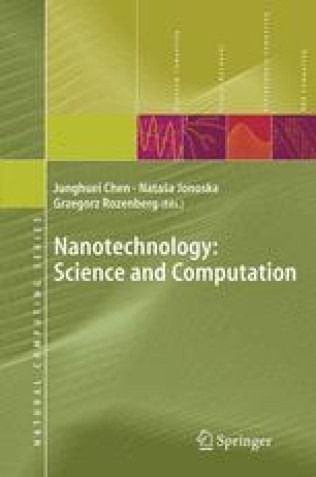
Nanotechnology : Science and Computation
This book offers a unique and authoritative perspective on current research in nanoscale science, engineering and computing. Leading researchers cover the topics of DNA self-assembly in two-dimensional arrays and three-dimensional structures, molecular motors, DNA word design, molecular electronics, gene assembly, surface layer protein assembly, and membrane computing.

Formal Modeling and Analysis of Timed Systems ; Vol.4202 ; 4th International Conference, FORMATS 2006, Paris, France, September 25-27, 2006, Proceedings
The aim of FORMATS is to promote the study of fundamental and practical aspects of timed systems, and to bring together researchers from di?erent d- ciplines that share interests in modelling and analysis of timed systems. In this volume, there are articles on: – Foundations and Semantics: contributions to the theoretical foundations of timed systems and timed formal languages as well as comparison between di?erentmodelsusedbydi?erentcommunities(timedautomata,timedPetri nets, timed MSCs, hybrid automata, timed process algebra, timed temporal logics, timed abstract state machines, as well as probabilistic models). – Methods and Tools: techniques, algorithms, data structures, and software toolsforanalyzingtimedsystemsandresolvingtemporalconstraints(mod- checking, simulation, robustness analysis, scheduling, etc).

Evolving Connectionist Systems : The Knowledge Engineering Approach
Evolving Connectionist Systems is aimed at all those interested in developing and using intelligent computational models and systems to solve challenging real world problems in computer science, engineering, bioinformatics and neuroinformatics. The book challenges scientists and practitioners with open questions about future creation of new information models inspired by Nature. This edition includes new methods for adaptive, knowledge-based learning, such as online incremental feature selection, spiking neural networks, transductive neuro-fuzzy inference, adaptive data and model integration, cellular automata and artificial life systems, particle swarm optimisation, ensembles of evolving systems, and quantum inspired neural networks. New applications to gene and protein interaction modelling, brain data analysis and brain model creation, computational neuro-genetic modelling, adaptive speech, image and multimodal recognition, language modelling, adaptive robotics, modelling dynamic financial and socio-economic systems, and ecological modelling, are covered. An important new feature of the book is the attempt to connect different structural and functional levels of a complex, intelligent system, looking for inspiration from functional relationships in natural systems, such as the genetic and the brain activity.

DNA Computing ; Vol. 4287 ; 12th International Meeting on DNA Computing, DNA12, Seoul, Korea, June 5-9, 2006, Revised Selected Papers
This book constitutes the thoroughly refereed postproceedings of the 12th International Meeting on DNA Computing, DNA12, held in Seoul, Korea in June 2006. The 34 revised full papers presented are organized in topical sections on molecular and membrane computing models, complexity analysis, sequence and tile designs and their properties, DNA tile self-assembly models, simulator and software for DNA computing, DNA computing algorithms and new applications, novel experimental approaches, and experimental solutions.

Algorithms in Bioinformatics ; Vol. 3692 ; 5th international workshop, WABI 2005, Mallorca, Spain, October 3-6, 2005, Proceedings
this book present the proceedings of the 5th Workshop on Algorithmsin Bioinformatics (WABI 2005) which took place in Spain, 2005. The Workshop on Algorithms in Bioinformatics highlights research workspecifically developed to address algorithmic problems in biosequence analysis. The emphasis is therefore on statistical and probabilistic algorithms that addressimportant problems in the field of molecular and structural biology. the workshop aims to present recent research results, includingsignificant work in progress, and to identify and explore directions of futureresearch.Original research papers (including significant work in progress) or state-of-the-art surveys were solicited on all aspects of algorithms in bioinformatics,including, but not limited to: exact and approximate algorithms for genomics,genetics, sequence analysis, gene and signal recognition, alignment, molecularevolution, phylogenetics, structure determination or prediction, gene expressionand gene networks, proteomics, functional genomics, and drug design.
