



الصفحة 1
الصفحة 1

New Algorithms, Architectures and Applications for Reconfigurable Computing
New Algorithms, Architectures and Applications for Reconfigurable Computing consists of a collection of contributions from the authors of some of the best papers from the Field Programmable Logic conference (FPL’03) and the Design and Test Europe conference (DATE’03).
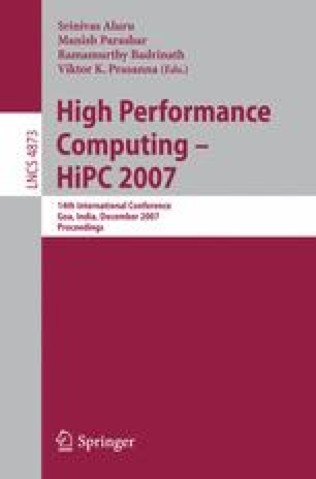
High performance computing - HiPC 2007 ; 14th International Conference, Goa, India, December 18-21, 2007, Proceedings
This book constitutes the refereed proceedings of the 14th International Conference on High-Performance Computing, HiPC 2007, held in Goa, India, in December 2007. The 53 revised full papers presented together with the abstracts of five keynote talks were carefully reviewed and selected from 253 submissions.

Euro-Par 2006 Parallel Processing ; CoreGRID 2006, UNICORE Summit 2006, Petascale Computational Biology and Bioinformatics, Dresden, Germany, August 29-September 1, 2006, Revised Selected Papers
This book contiants Petascale Computational Biology and Bioinformatics.

Embedded System Design : Topics, Techniques and Trends; IFIP TC10 Working Conference: International Embedded Systems Symposium (IESS), May 30 - June 1, 2007, Irvine (CA), USA
Embedded systems have gained an enormous amount of processing power and functionality. Many of the formerly external components can now be integrated into a single System-on-Chip. This tendency has resulted in a dramatic reduction in the size and cost of embedded systems. As a unique technology, the design of embedded systems is an essential element of many innovations. This book including design methodology, specification and modeling, embedded software and hardware synthesis, networks-on-chip, distributed and networked systems, and system verification and validation. Particular emphaisis is paid to automotive and medical applications. A set of actual case studies and special aspects in embedded system design are included as well.
Embedded Computer Systems : Architectures, Modeling, and Simulation; 20th International Conference, SAMOS 2020, Samos, Greece, July 5–9, 2020, Proceedings
This book constitutes the refereed proceedings of the 20th International Conference on Embedded Computer Systems: Architectures, Modeling, and Simulation, SAMOS 2020, held in Samos, Greece, in July 2020.* The 16 regular papers presented were carefully reviewed and selected from 35 submissions. In addition, 9 papers from two special sessions were included, which were organized on topics of current interest: innovative architectures for security and European projects on embedded and high performance computing for health applications.
Embedded Computer Systems : Architectures, Modeling, and Simulation ; 7th International Workshop, SAMOS 2007, Samos, Greece, July 16-19, 2007, Proceedings
The book is unique in the sense that not only solved research problems are presented and discussed but also (partly) unsolved pr- lems and in-depth topical reviews can be unleashed in the scientific arena. C- sequently, it provides the participants with an environment where collaboration rather than competition is fostered.

Distributed embedded systems : Design, middleware and resources ; IFIP 20th World computer congress, TC10 Working conference on distributed and parallel embedded systems (DIPES 2008), September 7-10, 2008, Milano, Italy
The IFIP series publishes state-of-the-art results in the sciences and technologies of information and communication. The principal aim of the IFIP series is to encourage education and the dissemination and exchange of information about all aspects of computing.

Data parallel C++programming accelerated systems using C++ and SYCL
Full of practical advice, detailed explanations, and code examples to illustrate key topics. SYCL enables access to parallel resources in modern accelerated heterogeneous systems. Now, a single C++ application can use any combination of devices–including GPUs, CPUs, FPGAs, and ASICs–that are suitable to the problems at hand. This book teaches data-parallel programming using C++ with SYCL and walks through everything needed to program accelerated systems. The book begins by introducing data parallelism and foundational topics for effective use of SYCL. Later chapters cover advanced topics, including error handling, hardware-specific programming, communication and synchronization, and memory model considerations.
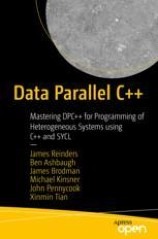
Data parallel C++ : Mastering DPC++ for programming of heterogeneous systems using C++ and SYCL
This book teaches data-parallel programming using C++ and the SYCL standard from the Khronos Group and walks through everything needed to use SYCL for programming heterogeneous systems. The book begins by introducing data parallelism and foundational topics for effective use of SYCL and Data Parallel C++ (DPC++), the open source compiler used in this book.

Computer Supported Cooperative Work in Design II ; 9th International Conference, CSCWD 2005, Coventry, UK, May 24-26, 2005, Revised Selected Papers
This book constitutes the thoroughly refereed post-proceedings of the 9th International Conference on Computer Supported Cooperative Work in Design, CSCWD 2005. it contain expanded versions of the papers presented at the conference and are organized in topical sections on CSCW techniques and methods, Grids and Web services, agents and multi-agent systems, ontology and knowledge management, collaborative design and manufacturing, enterprise collaboration, workflows, and other related approaches and applications.

Computer safety, reliability, and security ; 39th International Conference, SAFECOMP 2020, Lisbon, Portugal, September 16–18, 2020, Proceedings
This book constitutes the proceedings of the 39th International Conference on Computer Safety, Reliability and Security, SAFECOMP 2020, held in Lisbon, Portugal, in September 2020.* The 27 full and 2 short papers included in this volume were carefully reviewed and selected from 116 submissions. They were organized in topical sections named: safety cases and argumentation; formal verification and analysis; security modelling and methods; assurance of learning-enabled systems; practical experience and tools; threat analysis and risk mitigation; cyber-physical systems security; and fault injection and fault tolerance.
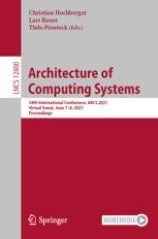
Architecture of computing systems ; 34th International Conference, ARCS 2021, Virtual Event, June 7–8, 2021, Proceedings
This book constitutes the proceedings of the 34th International Conference on Architecture of Computing Systems, ARCS 2021, held virtually in July 2021. The 12 full papers in this volume were carefully reviewed and selected from 24 submissions. 2 workshop papers (VEFRE) are also included. ARCS has always been a conference attracting leading-edge research outcomes in Computer Architecture and Operating Systems, including a wide spectrum of topics ranging from fully integrated, self-powered embedded systems up to high-performance computing systems. It also provides a platform covering newly emerging and cross-cutting topics, such as autonomous and ubiquitous systems, reconfigurable computing and acceleration, neural networks and artificial intelligence. The selected papers cover a variety of topics from the ARCS core domains, including heterogeneous computing, memory optimizations, and organic computing.
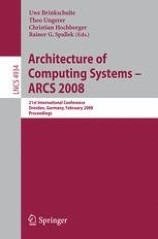
Architecture of computing systems - ARCS 2008 ; 21st International Conference, Dresden, Germany, February 25-28, 2008. Proceedings
This book constitutes the refereed proceedings of the 21st International Conference on Architecture of Computing Systems, ARCS 2008, held in Dresden, Germany, in February 2008.
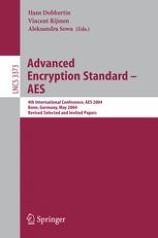
Advanced encryption standard - AES ; 4th International Conference, AES 2004, Bonn, Germany, May 10-12, 2004, Revised Selected and Invited Papers
This volume comprises the proceedings of the 4th Conference on Advanced En-cryption Standard, ‘AES — State of the Crypto Analysis,’ which was held inBonn, Germany, 2004.The conference followed a series of events organized by the US National In-stitute of Standards and Technology (NIST) in order to hold an internationalcompetition to decide on an algorithm to serve as the Advanced EncryptionStandard (AES). In 1998, at the first AES conference (AES 1), 15 different algo-rithms were presented, discussed, reviewed and verified. After a further conferencedevoted to verification, testing and examination of the candidate algorithms inorder to prove their performance and security, one winning algorithm remained.The encryption scheme Rijndael, designed by the Belgian cryptographers JoanDaemen and Vincent Rijmen, was selected in 2000 to become the successor tothe famous DES (Data Encryption Standard) and it is now the Advanced En-cryption Standard.
