



الصفحة 1
الصفحة 1

New insights in machine learning and deep neural networks
Gatheres ten exemplary papers, each delineating advancements within the spheres of machine learning and deep neural networks. Commencing with a thorough exploration by Figueira and Vaz, readers are introduced to the nuances of synthetic data generation and evaluation, followed closely by Silva and Pedroso's systematic approach to leveraging deep reinforcement learning within the intricate realm of delivery logistics. Kamran et al. contribute an astute methodology for camouflage object segmentation, whereas Pinheiro and collaborators offer a crafted semi-supervised strategy for predicting EGFR mutations via CT images. Subsequent contributions, such as Lee and Yoo's framework for portrait emotion recognition and Balakrishnan et al.'s analytical exploration of transformer models for Twitter disaster detection, further exemplify the depth of research contained herein.

Mute people aiding application
Communication is an essential tool for human survival. It is a fundamental and effective method of sharing thoughts, needs, feelings, and opinions. However, a large portion of the world's population lacks the ability to communicate with others. Such as the ones suffering from hearing loss, speech disability, or even both. Those disabilities have a significant impact on their lives in terms of work and relationships. The majority of these people are sometimes unable to support themselves financially due to the lack of job opportunities. Given these difficulties, we have decided to develop an application to help them overcome the obstacles they may encounter in their daily lives. After consulting with two deaf and mute people we customized an application that works in two ways. One of which is to translate their sign language in real time by using mobile camera and recognizing hand motion. The other works by converting text-to-voice, and accurately expressing the user’s emotions with the help of the facial emotion recognition.

Motion in Games ; 1st International Workshop, MIG 2008, Utrecht, The Netherlands, June 14-17, 2008. Revised Papers
This book constitutes the thoroughly refereed post-workshop proceedings of the First International Workshop on Motion in Games, held in Utrecht, The Netherlands, during June 14-17, 2008, in collaboration with the NLGD Festival of Games.The 24 revised papers presented during the workshop cover topics on crowd simulation; virtual humans; motion synthesis; interfaces; navigation and steering; and facial and behavioral animation.

Modeling Communication with Robots and Virtual Humans ; Second ZiF Research Group International Workshop on Embodied Communication in Humans and Machines, Bielefeld, Germany, April 5-8, 2006, Revised Selected Papers
The 17 articles in this state-of-the-art survey address artificial intelligence research on communicative agents and also provide an interdisciplinary perspective from linguistics, behavioral research, theoretical biology, philosophy, communication psychology, and computational neuroscience. The topics include studies on human multimodal communication; the modeling of feedback signals, facial expression, eye contact, and deception; the recognition and comprehension of hand gestures and head movements; communication interfaces for humanoid robots; the evolution of cognition and language; emotion and social appraisal in nonverbal communication; dialogue models and methodologies; theory of mind and intentionality; complex systems, dynamic field theory, and connectionist modeling.
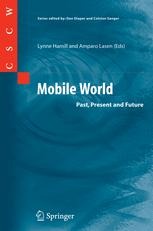
Mobile World : Past, Present and Future
Key reading for all those involved with the future of mobile communications, this book is a valuable resource, particularly for advanced undergraduate and postgraduate students on Mobile Technology courses, practitioners, and researchers working in mobile communications, CSCW and HCI. This volume is a sequel to Brown et al: Wireless World: Social and Interactional Aspects of the Mobile Age, also in the CSCW series. "This book presents a rich insight into how and why the mobile has become so important in today’s society. It explores the strong emotional attachment that people have to these devices, and argues that it is people and not the technology that developers must put at the heart of future mobile offerings. A valuable book for industry and academics alike."

Intelligent Virtual Agents ; Vol.4133 ; 6th International Conference, IVA 2006, Marina Del Rey, CA; USA, August 21-23, 2006, Proceedings
This volume contains the proceedings of the 6th International Conference on Intelligent Virtual Agents, IVA 2006, held in Marina del Rey, California, USA from August 21–23.For the second year in a row,IVA also hosted the Gathering of Animated Lifelike Agents (GALA 2006), an annual festival to showcase the latest animated lifelike agents created by university students and academic or industrial research groups. IVA 2006 received 73 submissions from Europe, the AmericasandAsia.Thepaperspublishedherearethe24fullpapersand11short papers presented at the conference, as well as one-page descriptions of posters and the featured invited talks by Brian Parkinson of Oxford University, Rod Humble of Electronic Arts, and Michael Mateas of the University of California, Santa Cruz and Andrew Stern of Procedural Arts.

Intelligent Virtual Agents ; 8th International Conference, IVA 2008, Tokyo, Japan, September 1-3, 2008. Proceedings
This book constitutes the refereed proceedings of the 8th International Workshop on Intelligent Virtual Agents, IVA 2008, held in Tokyo, Japan, in September 2008.The 18 revised full papers and 28 revised short papers presented together 42 poster papers were carefully reviewed and selected from 99 submissions. The papers are organized in topical sections on motion and empathy; narrative and augmented reality; conversation and negotiation; nonverbal behavior; models of culture and personality; markup and representation languages; architectures for robotic agents; cognitive architectures; agents for healthcare and training; and agents in games, museums and virtual worlds.

Intelligent Virtual Agents ; 7th International Working Conference, IVA 2007, Paris, France, September 17-19, 2007, Proceedings
The 19 revised full papers and 12 revised short papers presented together with five invited talks and the abstracts of 32 poster papers are organized in topical sections on rendering and analysis, culture and identity, behavior models, feedback models, dialogues, applications, evaluation, gaze models and emotions.

Intelligent tutoring systems ; 9th International Conference, ITS 2008, Montreal, Canada, June 23-27, 2008 Proceedings
This book constitutes the refereed proceedings of the 9th International Conference on Intelligent Tutoring Systems, ITS 2008, held in Montreal, Canada, in June 2008.The 63 revised full papers and 61 poster papers presented together with abstracts of 5 keynote talks were carefully reviewed and selected from 207 submissions. The papers are organized in topical sections on emotion and affect, tutor evaluation, student modeling, machine learning, authoring tools , tutor feedback and intervention, data mining, e-learning and Web-based ITS, natural language techniques and dialogue, narrative tutors and games, semantic Web and ontology, cognitive models, and collaboration.

Intelligent technologies for interactive entertainment ; 1st International Conference, INTETAIN 2005, Madonna di Campaglio, Italy, November 30 - December 2, 2005, Proceedings
Constitutes the proceedings of the First International Conference on Intelligent Technologies for Interactive Entertainment, 2005 held in Madonna di Campiglio, Italy. The papers included in this title cover topics such as intelligent interactive games, intelligent music, interactive cinema, edutainment, interactive art, and interactive real TV.

Human-computer interaction - HCI Intelligent Multimodal interaction environments ; 12th International Conference, HCI International 2007, Beijing, China, July 22-27, 2007, Proceedings, Part III
The 12th International Conference on Human-Computer Interaction, HCI Inter- tional 2007, was held in Beijing, P.R. This volume, edited by Julie A. Jacko, contains papers in the thematic area of Human-Computer Interaction, addressing the following major topics: • Multimodality and Conversational Dialogue • Adaptive, Intelligent and Emotional User Interfaces • Gesture and Eye Gaze Recognition • Interactive TV and Media.

From Digital Twins to Digital Selves and Beyond : Engineering and Social Models for a Trans-humanist World
This book aims at deepening the understanding of the relation between cyber-physical systems (CPSs) as socio-technical systems and their digital representations with intertwined artificial intelligence (AI). The authors describe why it is crucial for digital selves to be able to develop emotional behavior and why a humanity-inspired AI is necessary so that humans and humanoids can coexist.

From Animals to Animats 10 ; 10th International Conference on Simulation of Adaptive Behavior, SAB 2008, Osaka, Japan, July 7-12, 2008. Proceedings
This book constitutes the refereed proceedings of the 10th International Conference on Simulation of Adaptive Behavior, SAB 2008, held in Osaka, Japan in July 2008.The 30 revised full papers and 21 revised poster papers presented were carefully reviewed and selected from 110 submissions. The papers are organized in topical sections on the animat approach to adaptive behaviour, evolution, navigation and internal world models, perception and control, learning and adaptation, cognition, emotion and behaviour, collective and social behaviours, adaptive behaviour in language and communication, and applied adaptive behaviour.

Fadfada
Sharing personal problems and true feeling on social media has a lot of fears and is not likable nowadays, because of bullying, shaming, and making fun of the user by other users, Fadfada is a multi-platform social networking service, that aims to give the users the ability to share their problems or feeling via written newsfeed (posts) or videos (stories) that had an impact on their psychological health without revealing their true identity, by putting a mask on their faces and changing their voices after recording the story. In addition to extracting features from posts and stories to match users based on it.

Enterprise Information Systems VI
This book contains the best papers of the Sixth International Conference on Enterprise Information Systems (ICEIS 2004), held in Porto (Portugal) and organized by INSTICC (Institute for Systems and Technologies of Information, Communication and Control) in collaboration with PORTUCALENSE UNIVERSITY, who hosted the event. Following the route started in 1999, ICEIS has become a major point of contact between research scientists, engineers and practitioners on the area of business applications of information systems. This conference has received an increased interest every year, from especially from the international academic community, and it is now one of the world largest conferences in its area. This year, five simultaneous tracks were held, covering different aspects related to enterprise computing, including: “Databases and Information Systems Integration”,

EEG signal processing for biomedical applications
Focuses on electroencephalography (EEG) signal processing in biomedical engineering applications. EEG signals are used widely in clinical and research settings to provide cognitive and emotional state information. In addition to capturing complex neural patterns at high speeds, EEG signals are a reliable and non-invasive way of measuring the electrical activity in the brain. By examining various novel analysis and signal processing methods, this collection of papers provides a better understanding of cognitive states and brain activity.

Digital Human Modeling ; 1st International Conference, ICDHM 2007, Held as Part of HCI International 2007, Beijing, China, July 22-27, 2007, Proceedings
Theis book includes human aspects of design and use of computing systems.It covers the entire field of Human-Computer Interaction, addressing major - vances in knowledge and effective use of computers in a variety of application areas. It also contains thematic area of Digital Human Modeling, Shape and Movement Modeling and Anthropometry, Building and Applying Virtual Humans, Medical and Rehabilitation Applications, Industrial and Ergonomic Applications

Design, user experience, and usability interaction design ; 9th International Conference, DUXU 2020, Held as Part of the 22nd HCI International Conference, HCII 2020, Copenhagen, Denmark, July 19–24, 2020, Proceedings, Part I
This book constitutes the refereed proceedings of the 9th International Conference on Design, User Experience, and Usability, DUXU 2020, held as part of the 22nd International Conference on Human-Computer Interaction, HCII 2020, in Copenhagen, Denmark, in July 2020. The conference was held virtually due to the COVID-19 pandemic. From a total of 6326 submissions, a total of 1439 papers and 238 posters has been accepted for publication in the HCII 2020 proceedings. The 40 papers included in this volume were organized in topical sections on UX design methods, tools and guidelines, interaction design and information visualization, and emotional design.

Defence Applications of Multi-Agent Systems; International Workshop, DAMAS 2005, Utrecht, The Netherlands, July 25, 2005, Revised and Invited Papers
This book constitutes the thoroughly refereed post-proceedings of the International Workshop on Defence Applications of Multi-Agent Systems, DAMAS 2005, held in Utrecht, The Netherlands in July 2005 as an associated event of AAMAS 2005, the main international conference on autonomous agents and multi-agent systems. The 10 revised full papers presented together with 1 invited article are organized in topical sections on decision support and simulation, unmanned aerial vehicles, as well as on systems and security.

Deep learning approaches to cloud security
Covering one of the most important subjects to our society today, cloud security, this editorial team delves into solutions taken from evolving deep learning approaches, solutions allowing computers to learn from experience and understand the world in terms of a hierarchy of concepts, with each concept defined through its relation to simpler concepts.
