



الصفحة 1
الصفحة 1
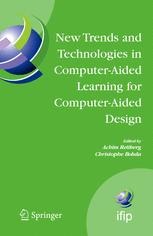
New Trends and Technologies in Computer-Aided Learning for Computer-Aided Design ; IFIP International Working Conference: EduTech 2005, Perth, Australia, October 20-21, 2005
Computation and communication technologies underpin work and development in many different areas. Among them, Computer-Aided Design of electronic systems and E-Learning technologies are two areas which are different but share many concerns. The design of CAD and E-Learning systems already touches on a number of parallels, such as system interoperability, user interfaces, standardization, EML-based formats, reusability aspects (of content or designs), and intellectual property rights. Furthermore, the teaching of Design Automation tools and methods is particularly amenable to a distant or blended learning setting, and implies the interconnection of typical CAD tools, such as simulators or synthesis tools, with e-learning tools. There are many other aspects in which synergy can be found when using E-Learning technology for teaching and learning technology. This workshop, sponsored by IFIP WG 10.5 Design and Engineering of Electronic Systems in cooperation with IFIP WG 3.6 Distance Education, will explore the interrelationship between these two subjects, where Computer-Aided Design meets Computer-Aided Learning. New Trends and Technologies in Computer-Aided Learning for Computer-Aided Design documents recent approaches and results presented at the EduTech 2005 Workshop, which was held in October 2005 in Perth, Australia and sponsored by the International Federation for Information Processing (IFIP). The topics chosen for this working conference are very timely: learning environments, tools and applications for education, education technologies and trends, and teaching in the hardware design area.

Essential discrete mathematics for computer science
An ideal introductory textbook for standard undergraduate courses, and is also suitable for high school courses, distance education for adult learners, and self-study. The essential introduction to discrete mathematics / Features thirty-one short chapters, each suitable for a single class lesson / Includes more than 300 exercises / Almost every formula and theorem proved in full / Breadth of content makes the book adaptable to a variety of courses / Each chapter includes a concise summary

Developing metaverse for AIU
Metaverse is the virtual world in which humans can see each other in the form of 3D and communicate with each other in a virtual place that looks exactly like the real world, but the developers of metaverse so far used these virtual worlds for profit purposes only, this is what prompted us to build a virtual world that basicly contain the university, which can help students communicate with each other, see teachers and obtain the information they need from university employees without having to travel long distances, this project provides a distance education service without dispensing the idea of interacting with teachers directly and seeing others. Our virtual world has the ability to connect with any virtual world because of it’s base structure, It’s scalable as much as we need because it’s connected to the blockchain.

Advances in web-based learning - ICWL 2005 ; 4th international conference, Hong Kong, China, July 31 - August 3, 2005, proceedings
With the rapid development of Web-based learning, a new set of learning - vironments including virtual classrooms, virtual laboratories and virtual universities are being developed. These new learning environments, however, also introduce new problems that need to be addressed. On the technical side, there is a need for the deployment of effective technologies on Web-based education. On the learning side, the cyber mode of learning is very different from tra- tional classroom-based learning. On the management side, the establishment of a cyber university imposes very different requirements for the set up. ICWL 2005, the 4th International Conference on Web-Based Learning, was held in Hong Kong, China from July 31 to August 3, 2005, as a continued - tempt to address many of the above-mentioned issues. Following the great success of ICWL

Advances in web based learning - ICWL 2007 ; 6th International conference Edinburgh, UK, August 15-17, 2007 Revised Papers
This book contributes the thoroughly refereed post-conference proceedings of the 6th International Conference on Web-Based Learning, ICWL 2007, held in Edinburgh, UK, in August 2007.
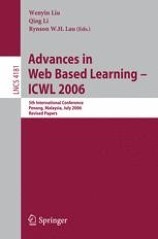
Advances in web based learning -- ICWL 2006 ; 5th International conference, Penang, Malaysia, July 19-21, 2006, Revised Papers
The conference program was organized in a single-track 3-day workshop. It included a tutorial, a keynote talk, and oral/poster paper presentations in several sessions dedicated to specific topics. Session topics included “Personalization in E-Learning,” “Designs, Model and Framework of E-Learning Systems,” “Implementations and Evaluations of E-Learning Systems,” “Tools in E-Learning,” and “Learning Resource Deployment, Organization and Management. ” We received a total of 99 submissions from all over the world.

Advances in Blended Learning ; 2nd Workshop on Blended Learning, WBL 2008, Jinhua, China, Augustl 20-22, 2008. Revised Selected Papers
This book constitutes the thoroughly refereed post-workshop proceedings of the Second Workshop on Blended Learning, WBL 2008, held in Jinhua, China, in August 2008, as a satellite event of ICWL 2008, the 7th International Conference on Web-based Learning.
