



الصفحة 1
الصفحة 1

Modular Algorithms in Symbolic Summation and Symbolic Integration
Brings together two streams in computer algebra: symbolic integration and summation on the one hand, and fast algorithmics on the other hand. In many algorithmically oriented areas of computer science, the analysis of al gorithms placed into the lime light by DonKnuth’stalkat the 1970ICM –provides a crystal-clear criterion for success. The researcher who designs an algorithm that is faster (asymptotically, in the worst case) than any previous method receives instant gratification : her result will be recognized as valuable. Al as, the downside is that such results come along quite infrequently, despite our best efforts. An alternative evaluation method is to run a new algorithm on examples; this has its obvious problems, but is sometimes the best we can do. George Collins, one of the fathers of computer algebra and a great experimenter,wrote in 1969: “I think this demonstrates again that a simple analysis is often more revealing than a ream of empirical data (although both are important). ” Within computer algebra, some areas have traditionally followed the former methodology, notably some parts of polynomial algebra and linear algebra. Other areas, such as polynomial system solving, have not yet been amenable to this - proach. The usual “input size” parameters of computer science seem inadequate, and although some natural “geometric” parameters have been identified (solution dimension, regularity), not all (potential) major progress can be expressed in this framework. Symbolic integration and summation have been in a similar state.
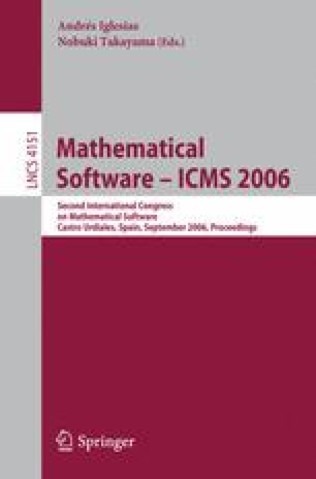
Mathematical Software - ICMS 2006 ; 2nd International Congress on Mathematical Software, Castro Urdiales, Spain, September 1-3, 2006, Proceedings
This volume contains the outstanding collection of invited papers and refereed papers selected for the Second International Congress on Mathematical Software, ICMS 2006, held in Castro Urdiales, Spain, September 1-3, 2006. This congress was devoted to all aspects of mathematical software, whose appearance is — in our opinion — one of the most important events in mathematics. Mathematical software systems are used to construct examples, to prove theorems, and to find new mathematical phenomena. Conversely, mathematical research often motivates developments of new algorithms and new systems. Beyond mathematics, mathematical software systems are becoming indispensable tools in many branches of science and technology.
Intelligent Computer Mathematics ; 9th International Conference, AISC 2008, 15th Symposium, Calculemus 2008, 7th International Conference, MKM 2008, Birmingham, UK, July 28 - August 1, 2008. Proceedings
This book constitutes the joint refereed proceedings of the 9th International Conference on Artificial Intelligence and Symbolic Computation, AISC 2008, the 15th Symposium on the Integration of Symbolic Computation and Mechanized Reasoning, Calculemus 2008, and the 7th International Conference on Mathematical Knowledge Management, MKM 2008, held in Birmingham, UK, in July/August as CICM 2008, the Conferences on Intelligent Computer Mathematics.

Intelligent Computer Mathematics ; 13th International Conference, CICM 2020, Bertinoro, Italy, July 26–31, 2020, Proceedings
This book constitutes the refereed proceedings of the 13th International Conference on Intelligent Computer Mathematics, CICM 2020, held in Bertinoro, Italy, in July 2020*. The 15 full papers, 1 invited paper and 2 abstracts of invited papers presented were carefully reviewed and selected from a total of 35 submissions. The papers focus on advances in automated theorem provers and formalization, computer algebra systems and their libraries, and applications of machine learning, among other topics.

Intelligence and security informatics : Biosurveillance ; 2nd NSF Workshop, BioSurveillance 2007, New Brunswick, NJ, USA, May 22, 2007, Proceedings
The 2007 NSF BioSurveillance Workshop (BioSurveillance 2007) was built on the success of the first NSF BioSurveillance Workshop, hosted by the University of Arizona’s NSF BioPortal Center in March 2006.

Computer Mathematics ; 8th Asian Symposium, ASCM 2007, Singapore, December 15-17, 2007. Revised and Invited Papers
This book constitutes thoroughly refereed post-conference proceedings of the 8th Asian Symposium on Computer Mathematics, ASCM 2007, held in Singapore in December 2007.
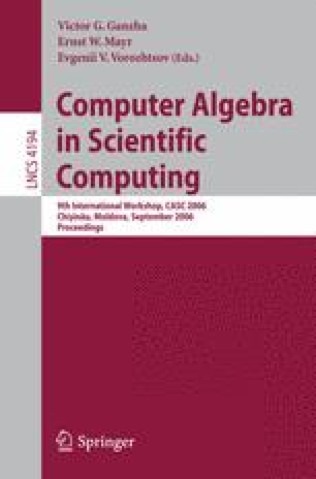
Computer Algebra in Scientific Computing ; Vol. 4194 ; 9th International Workshop, CASC 2006, Chisinau, Moldova, September 11-15, 2006, Proceedings
This volume contains revised versions of the papers submitted to the workshop by the participants and accepted by the program committee after a thorough reviewing process. The collection of papers included in the proceedings covers not only various expanding applications of computer algebra to scienti?c computing but also the computer algebra systems themselves and the CA algorithms.

Computer algebra in scientific computing ; Vol. 3718 ; 8th International workshop, CASC 2005, Kalamata, Greece, September 12-16, 2005, Proceedings
This volume contains the proceedings of the CASC 2005 continued a tradition — started in 1998 — of international con-ferences on the latest advances in the application of computer algebra systems(CASs) and methods to the solution of various problems in scientific computing.The methods of scientific computing play an important role in research andengineering applications in the natural and the engineering sciences. The signif-icance and impact of computer algebra methods and computer algebra systemsfor scientific computing has increased considerably in recent times. Nowadays,such general-purpose computer algebra systems as Maple, Magma, Mathematica,MuPAD, Singular, CoCoA and others enable their users to solve the followingthree important tasks within a uniform framework:(a) symbolic manipulation;(b) numerical computation;(c) visualization. The result of this job is reflected in this volume, which contains revised versionsof the accepted papers. The collection of papers included in the proceedingscovers various topics of computer algebra methods, algorithms, and softwareapplied to scientific computing:
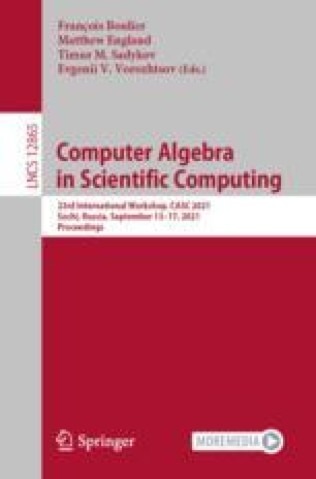
Computer algebra in scientific computing ; 23rd International Workshop, CASC 2021, Sochi, Russia, September 13–17, 2021, Proceedings
This book constitutes the proceedings of the 23rd International Workshop on Computer Algebra in Scientific Computing, CASC 2021, held in Sochi, Russia, in September 2021. The 24 full papers presented together with 1 invited talk were carefully reviewed and selected from 40 submissions. The papers cover theoretical computer algebra and its applications in scientific computing.

Computer algebra in scientific computing ; 22nd International Workshop, CASC 2020, Linz, Austria, September 14–18, 2020, Proceedings
This book constitutes the refereed proceedings of the 22nd International Workshop on Computer Algebra in Scientific Computing, CASC 2020, held in Linz, Austria, in September 2020. The conference was held virtually due to the COVID-19 pandemic. The 34 full papers presented together with 2 invited talks were carefully reviewed and selected from 41 submissions. They deal with cutting-edge research in all major disciplines of computer algebra. The papers cover topics such as polynomial algebra, symbolic and symbolic-numerical computation, applications of symbolic computation for investigating and solving ordinary differential equations, applications of CAS in the investigation and solution of celestial mechanics problems, and in mechanics, physics, and robotics.

Computer Algebra in Scientific Computing ; 10th International Workshop, CASC 2007, Bonn, Germany, September 16-20, 2007, Proceedings
The book covers not only various expanding applications of computer algebra to scientific computing but also the computer algebra systems themselves and the CA algorithms. Topics addressed are studies in polynomial and matrix algebra, quantifier elimination, and Gröbner bases, as well as stability investigation of both differential equations and difference methods for them. Several papers are devoted to the application of computer algebra methods and algorithms to the derivation of new mathematical models in biology and in mathematical physics.

Computer algebra and geometric algebra with applications ; 6th International Workshop, IWMM 2004, Shanghai, China, May 19-21, 2004 and International Workshop, GIAE 2004, Xian, China, May 24-28, 2004.Revised Selected Papers
MathematicsMechanization consistsoftheory,softwareandapplicationofc- puterized mathematical activities such as computing, reasoning and discovering. ItsuniquefeaturecanbesuccinctlydescribedasAAA(Algebraization,Algori- mization, Application). The name “Mathematics Mechanization” has its origin in the work of Hao Wang (1960s), one of the pioneers in using computers to do research in mathematics, particularly in automated theorem proving. Since the 1970s, this research direction has been actively pursued and extensively dev- oped by Prof. Wen-tsun Wu and his followers. It di?ers from the closely related disciplines like Computer Mathematics, Symbolic Computation and Automated Reasoning in that its goal is to make algorithmic studies and applications of mathematics the major trend of mathematics development in the information age.

Computational Science – ICCS 2007; 7th International Conference, Beijing China, May 27-30, 2007, Proceedings, Part I
This book contiants sections on efficient data management, parallel monte carlo algorithms, simulation of multiphysics multiscale systems, dynamic data driven application systems, computer graphics and geometric modeling, computer algebra systems, computational chemistry, computational approaches and techniques in bioinformatics, computational finance and business intelligence, geocomputation, high-level parallel programming, networks theory and applications, collective intelligence for semantic and knowledge grid, collaborative and cooperative environments, tools for program development and analysis in CS, intelligent agents in computing systems, CS in software engineering, computational linguistics in HCI, internet computing in science and engineering, workflow systems in e-science, graph theoretic algorithms and applications in cs, teaching CS, high performance data mining, mining text, semi-structured, Web, or multimedia data,

Computational Science – ICCS 2007 ; 7th International Conference, Beijing China, May 27-30, 2007, Proceedings, Part IV
This book covers computational science and related areas, from multiscale physics to wireless networks, and from graph theory to tools for program development.

Computational Science – ICCS 2007 ; 7th International Conference, Beijing China, May 27-30, 2007, Proceedings, Part III
This book covers computational science and related areas, from multiscale physics to wireless networks, and from graph theory to tools for program development.
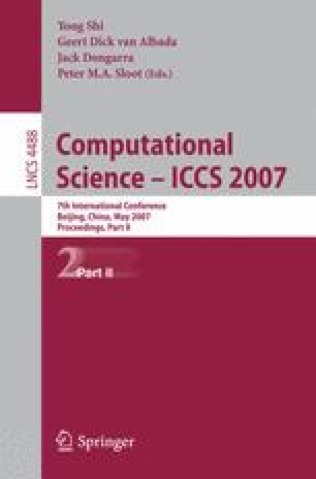
Computational Science – ICCS 2007 ; 7th International Conference, Beijing China, May 27-30, 2007, Proceedings, Part II
This book covers computational science and related areas, from multiscale physics to wireless networks, and from graph theory to tools for program development.

Computational Science - ICCS 2006 ; Vol. 3994 ; 6th International Conference, Reading, UK, May 28-31, 2006, Proceedings, Part IV
The four-volume set LNCS 3991-3994 constitutes the refereed proceedings of the 6th International Conference on Computational Science, ICCS 2006, held in Reading, UK, in May 2006. The papers span the whole range of computational science.

Computational Science - ICCS 2006 ; Vol. 3993 ; 6th International Conference, Reading, UK, May 28-31, 2006, Proceedings, Part III
The four-volume set LNCS 3991-3994 constitutes the refereed proceedings of the 6th International Conference on Computational Science, ICCS 2006, held in Reading, UK, in May 2006. The papers span the whole range of computational science.
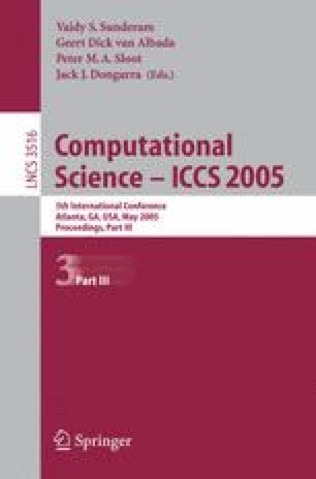
Computational Science -- ICCS 2005 ; Vol. 3516 ; 5th International Conference, Atlanta, GA, USA, May 22-25, 2005, Proceedings, Part III
This book constitutes the refereed proceedings of the Fifth International Conference on Computational Science (ICCS 2005) held in Atlanta, Georgia, USA, 2005, Computational science is rapidly maturing as a mainstream discipline. It is central to an ever-expanding variety of ?elds in which computational methods and tools enable new discoveries with greater accuracy and speed. The primary objectives of this conference were to discuss problems and solutions in allareas,toidentifynewissues,toshapefuturedirectionsofresearch,andtohelp users apply various advanced computational techniques. The event highlighted recent developments in algorithms, computational kernels, next generation c- puting systems, tools, advanced numerical methods, data-driven systems, and emerging application ?elds, such as complex systems, ?nance, bioinformatics, computational aspects of wireless and mobile networks, graphics, and hybrid computation.

Computational Science -- ICCS 2005 ; Vol. 3515 ; 5th International Conference, Atlanta, GA, USA, May 22-25, 2005, Proceedings, Part I
This book constitutes the refereed proceedings of the Fifth International Conference on Computational Science (ICCS 2005) held in Atlanta, Georgia, USA, 2005, Computational science is rapidly maturing as a mainstream discipline. It is central to an ever-expanding variety of ?elds in which computational methods and tools enable new discoveries with greater accuracy and speed. The primary objectives of this conference were to discuss problems and solutions in allareas,toidentifynewissues,toshapefuturedirectionsofresearch,andtohelp users apply various advanced computational techniques. The event highlighted recent developments in algorithms, computational kernels, next generation c- puting systems, tools, advanced numerical methods, data-driven systems, and emerging application ?elds, such as complex systems, ?nance, bioinformatics, computational aspects of wireless and mobile networks, graphics, and hybrid computation.
