



الصفحة 9
الصفحة 9
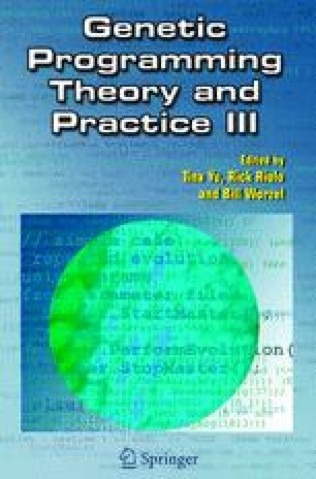
Genetic Programming Theory and Practice III
Genetic Programming Theory and Practice III explores the emerging interaction between theory and practice in the cutting-edge, machine learning method of Genetic Programming (GP). This contributed volume was developed from the third workshop at the University of Michigan’s Center for the Study of Complex Systems to facilitate the exchange of ideas and information related to this rapidly advancing field. The text provides a cohesive view of the issues facing both practitioners and theoreticians and examines the synergy between GP theory and application.

Genetic programming IV : Routine human-competitive machine intelligence
Genetic Programming IV: Routine Human-Competitive Machine Intelligence presents the application of GP to a wide variety of problems involving automated synthesis of controllers, circuits, antennas, genetic networks, and metabolic pathways. The book describes fifteen instances where GP has created an entity that either infringes or duplicates the functionality of a previously patented 20th-century invention, six instances where it has done the same with respect to post-2000 patented inventions, two instances where GP has created a patentable new invention, and thirteen other human-competitive results. The book additionally establishes: GP now delivers routine human-competitive machine intelligence GP is an automated invention machine GP can create general solutions to problems in the form of parameterized topologies GP has delivered qualitatively more substantial results in synchrony with the relentless iteration of Moore's Law
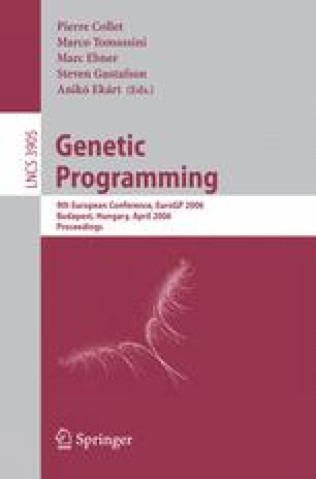
Genetic Programming ; Vol. 3905 ; 9th European Conference, EuroGP 2006, Budapest, Hungary, April 10-12, 2006. Proceedings
This book constitutes the refereed proceedings of the 9th European Conference on Genetic Programming, EuroGP 2006, held in Budapest, Hungary, in April 2006, colocated with EvoCOP 2006. The 21 revised plenary papers and 11 revised poster papers were carefully reviewed and selected from 59 submissions. The papers address fundamental and theoretical issues, along with a wide variety of papers dealing with different application areas, such as computer science, engineering, machine learning, Kolmogorov complexity, biology and computational design.

Genetic programming : Theory and practice II
This volume explores the emerging interaction between theory and practice in the cutting-edge, machine learning method of Genetic Programming (GP). The contributions developed from a second workshop at the University of Michigan's Center for the Study of Complex Systems where leading international genetic programming theorists from major universities and active practitioners from leading industries and businesses met to examine how GP theory informs practice and how GP practice impacts GP theory. Chapters include such topics as financial trading rules, industrial statistical model building, population sizing, the roles of structure in problem solving by computer, stock picking, automated design of industrial-strength analog circuits, topological synthesis of robust systems, algorithmic chemistry, supply chain reordering policies, post docking filtering, an evolved antenna for a NASA mission and incident detection on highways.

Generative programming and component engineering ; 4th International conference, GPCE 2005, Tallinn, Estonia, September 29 - October 1, 2005, Proceedings
Generative Programming and Component Engineering (GPCE) is a leading - searchconferenceonautomaticprogrammingandcomponentengineering.These approaches to software engineering have the potential to revolutionize software development as automation and components revolutionized manufacturing. The conference brings together researchers and practitioners interested in adva- ing automation for software development. It is also a premier forum for cro- fertilization between the programming language and software engineering - search communities. GPCEaroseasajointconference, mergingthepriorconferenceonGenerative and Component-Based Software Engineering (GCSE) and the Workshop on - mantics, Applications, andImplementationofProgramGeneration(SAIG). The proceedingsofthepreviousGPCEconferenceswerepublishedintheLNCSseries of Springer as volumes2487,2830, and 3286.In 2005 GPCE wasco-locatedwith the International Conference on Functional Programming (ICFP) and the s- posium on Trends in Functional Programming (TFP), re?ecting the vigorous interaction between the functional programming and generative programming research communities. GPCE and ICFP are both sponsored by the Association for Computing Machinery. The quality and breadth of the papers submitted to GPCE 2005 was impr- sive. All 86 papers, including 5 papers for tool demonstrations, were rigorously reviewed by 17 highly quali?ed Program Committee members. The members of the Program Committee ?rst provided in-depth individual reviews of the s- mitted papers, and then debated the merits of the papers through an extended electronicProgramCommitteemeeting.After much(friendly) argument,25r- ular papers and 2 tool demonstration papers were selected for publication. The ProgramCommittee provided extensive technical feedback to the authors of the submittedpapers.Theconferenceprogramwascomplementedwiththreeinvited talks, three extended tutorials, and three all-day workshops.

Generative and transformational techniques in software engineering II : International Summer School, GTTSE 2007, Braga, Portugal, July 2-7, 2007. Revised Papers
This tutorial book presents an augmented selection of the material presented at the International Summer School on Generative and Transformational Techniques in Software Engineering, GTTSE 2007, held in Braga, Portugal, in July 2007.The 7 tutorial lectures presented together with 5 short tutorials and 4 contributions to the participants workshop were carefully selected during multiple rounds of reviewing and improvement. The tutorials given by renowned representatives of complementary approaches and problem domains combine foundations, methods, examples, and tool support.

Future data and security engineering ; 7th International conference, FDSE 2020, Quy Nhon, Vietnam, November 25–27, 2020, Proceedings
This book constitutes the proceedings of the 7th International Conference on Future Data and Security Engineering, FDSE 2020, which was supposed to be held in Quy Nhon, Vietnam, in November 2020, but the conference was held virtually due to the COVID-19 pandemic. The 24 full papers (of 53 accepted full papers) presented together with 2 invited keynotes were carefully reviewed and selected from 161 submissions. The other 29 accepted full and 8 short papers are included in CCIS 1306. The selected papers are organized into the following topical headings: security issues in big data; big data analytics and distributed systems; advances in big data query processing and optimization; blockchain and applications; industry 4.0 and smart city: data analytics and security; advanced studies in machine learning for security; and emerging data management systems and applications.

Future data and security engineering : Big data, security and privacy, smart city and industry 4.0 applications ; 7th International Conference, FDSE 2020, Quy Nhon, Vietnam, November 25–27, 2020, Proceedings
This book constitutes the proceedings of the 7th International Conference on Future Data and Security Engineering, FDSE 2020, held in Quy Nhon, Vietnam, in November 2020.* The 29 full papers and 8 short were carefully reviewed and selected from 161 submissions. The selected papers are organized into the following topical headings: big data analytics and distributed systems; security and privacy engineering; industry 4.0 and smart city: data analytics and security; data analytics and healthcare systems; machine learning-based big data processing; emerging data management systems and applications; and short papers: security and data engineering.
Fundamentals of pattern recognition and machine learning
Fundamentals of Pattern Recognition and Machine Learning is designed for a one or two-semester introductory course in Pattern Recognition or Machine Learning at the graduate or advanced undergraduate level. The book combines theory and practice and is suitable to the classroom and self-study.
Fundamentals of manufacturing engineering using digital visualization
Offers a guide to core principles and practices of manufacturing engineering. It covers the design of, together with technological and measurement issues for, technical systems. Locating charts and setup schemes describing different machining processes are included. Concepts of product quality, with a focus on accuracy indicators, machining accuracy, roughness, and the impact of surface quality on exploitation properties are also explained. Furthermore, key machining methods, including turning, milling, hole machining, grinding, and gear machining, are analyzed in depth, covering their principles, applications, and techniques. The book is enriched by QR codes, linking to a mobile application presenting additional information about the content, for an interactive and extended learning experience. It also uses illustrations visualized with digital tools to promote a better understanding of the concepts.
Fundamentals of image data mining : Analysis, features, classification and retrieval
Presents a comprehensive review of the essentials of image data mining, and the latest cutting-edge techniques used in the field. The coverage spans all aspects of image analysis and understanding, offering deep insights into areas of feature extraction, machine learning, and image retrieval. The theoretical coverage is supported by practical mathematical models and algorithms, utilizing data from real-world examples and experiments. Topics and features: Describes essential tools for image mining, covering Fourier transforms, Gabor filters, and contemporary wavelet transforms / Develops many new exercises (most with MATLAB code and instructions) / Includes review summaries at the end of each chapter / Analyses state-of-the-art models, algorithms, and procedures for image mining / Integrates new sections on pre-processing, discrete cosine transform, and statistical inference and testing / Demonstrates how features like color, texture, and shape can be mined or extracted for image representation / Applies powerful classification approaches: Bayesian classification, support vector machines, neural / networks, and decision trees / Implements imaging techniques for indexing, ranking, and presentation, as well as database visualization

Fundamentals of computation theory ; 15th International symposium, FCT 2005, Lübeck, Gemany, August 17-20, 2005, Proceedings
This book constitutes the refereed proceedings of the 15th International Symposium Fundamentals of Computation Theory, FCT 2005, held in L]beck, Germany in August 2005. The 46 revised full papers presented together with 3 invited papers were carefully reviewed and selected from 105 submissions. The papers are organized in topical sections on circuits, automata, complexity, approximability, computational and structural complexity, graphs and complexity, computational game theory, visual cryptography and computational geometry, query complexity, distributed systems, automata and formal languages, semantics, approximation algorithms, average case complexity, algorithms, graph algorithms, and pattern matching.

Fundamentals of Clinical Data Science
This book comprehensively covers the fundamentals of clinical data science, focusing on data collection, modelling and clinical applications. Topics covered in the first section on data collection include: data sources, data at scale (big data), data stewardship (FAIR data) and related privacy concerns. Aspects of predictive modelling using techniques such as classification, regression or clustering, and prediction model validation will be covered in the second section. The third section covers aspects of (mobile) clinical decision support systems, operational excellence and value-based healthcare.

Fundamentals of Artificial Intelligence
Fundamentals of Artificial Intelligence introduces the foundations of present day AI and provides coverage to recent developments in AI such as Constraint Satisfaction Problems, Adversarial Search and Game Theory, Statistical Learning Theory, Automated Planning, Intelligent Agents, Information Retrieval, Natural Language & Speech Processing, and Machine Vision. The book features a wealth of examples and illustrations, and practical approaches along with the theoretical concepts. It covers all major areas of AI in the domain of recent developments. The book is intended primarily for students who major in computer science at undergraduate and graduate level but will also be of interest as a foundation to researchers in the area of AI.

Fundamentals and Methods of Machine and Deep Learning : Algorithms, Tools, and Applications
provides a practical approach by explaining the concepts of machine learning and deep learning algorithms, evaluation of methodology advances, and algorithm demonstrations with applications. In recent research studies, they are regarded as one of the disruptive technologies that will transform our future life, business, and the global economy. The recent explosion of digital data in a wide variety of domains, including science, engineering, Internet of Things, biomedical, healthcare, and many business sectors, has declared the era of big data, which cannot be analysed by classical statistics but by the more modern, robust machine learning and deep learning techniques. Since machine learning learns from data rather than by programming hard-coded decision rules, an attempt is being made to use machine learning to make computers that are able to solve problems like human experts in the field.
From Program to Product : Turning Your Code into A Saleable Product
Many would–be software entrepreneurs with expertise in many fields attempt to turn a homegrown application—one developed for use in their own business or profession—into a commercial product. Lack of knowledge, experience, or skills often prevents the idea from ever taking shape, let alone achieving its potential. Entering a new field to start a business leaves many developers unprepared and not even fully aware that it's something they know so little about. They will also often have a job that conflicts with the time commitment required to market the program well enough for it to become a complete success.
From model-driven design to resource management for distributed embedded systems ; IFIP TC 10 Working conference on distributed and parallel embedded systems (DIPES 2006) October 11-13, 2006, Braga, Portugal
From Model-Driven Design to Resource Management for Distributed Embedded Systems contains 16 original contributions as well as 12 invited papers by distinguished invited speakers. These papers were presented at the Working Conference on Distributed and Parallel Embedded Systems (DIPES 2006), which was held in October 2006 in Braga, Portugal, and sponsored by the International Federation for Information Processing (IFIP). This volume covers the following very timely topics: model-driven design, test and evolution of embedded systems, timing analysis and predictability, scheduling, allocation, communication and resource management in distributed real-time systems.

From integrated publication and information systems to information and knowledge environments : Essays dedicated to Erich J. Neuhold on the Occasion of His 65th Birthday
This book constitutes a commemorative volume devoted to Erich J. Neuhold on the occasion of his 65th birthday. The 32 invited reviewed papers presented are written by students and colleagues of Erich Neuhold throughout all periods of his scientific career. The papers are organized in the following topical sections: Database management enabling information systems Semantic Web drivers for advanced information management Securing dynamic media content integration From digital libraries to intelligent knowledge environments Visualization – key to external cognition in virtual information environments From human-computer interaction to human-artefact interaction Domains for virtual information and knowledge environments.

From Data to Models and Back ; 9th International Symposium, DataMod 2020, Virtual Event, October 20, 2020, Revised Selected Papers
This book constitutes the refereed proceedings of the 9th International Symposium on From Data Models and Back, DataMod 2020, held virtually, in October 2020. The 11 full papers and 3 short papers presented in this book were selected from 19 submissions. The papers are grouped in these topical sections: machine learning; simulation-based approaches, and data mining and processing related approaches.

Fractional calculus—theory and applications
Fractional calculus has led to tremendous progress in various areas of science and mathematics. New definitions of fractional derivatives and integrals have been uncovered, extending their classical definitions in various ways. Moreover, rigorous analysis of the functional properties of these new definitions has been an active area of research in mathematical analysis. Systems considering differential equations with fractional-order operators have been investigated thoroughly from analytical and numerical points of view, and potential applications have been proposed for use in sciences and in technology. The purpose of this Special Issue is to serve as a specialized forum for the dissemination of recent progress in the theory of fractional calculus and its potential applications.
