



الصفحة 9
الصفحة 9

Knowledge-Based Intelligent Information and Engineering Systems ; Vol. 4252 ; 10th International Conference, KES 2006, Bournemouth, UK, October 9-11 2006, Proceedings, Part II
Delegates and friends, we are very pleased to extend to you the sincerest of welcomes to this, the 10th International Conference on Knowledge Based and Intelligent Information and Engineering Systems at the Bournemouth International Centre in Bournemouth, UK, brought to you by KES International. This is a special KES conference, as it is the 10th in the series, and as such, it represents an occasion for celebration and an opportunity for reflection. The first KES conference was held in 1997 and was organised by the KES conference founder, Lakhmi Jain. In 1997, 1998 and 1999 the KES conferences were held in Adelaide, Australia.

Knowledge science, engineering and management; 13th International Conference, KSEM 2020, Hangzhou, China, August 28–30, 2020, Proceedings, Part I
Constitutes the refereed proceedings of the 13th International Conference on Knowledge Science, Engineering and Management, KSEM 2020, held in Hangzhou, China, in August 2020.* The 58 revised full papers and 27 short papers were carefully reviewed and selected from 291 submissions. The papers of the first volume are organized in the following topical sections: knowledge graph; knowledge representation; knowledge management for education; knowledge-based systems; and data processing and mining. The papers of the second volume are organized in the following topical sections: machine learning; recommendation algorithms and systems; social knowledge analysis and management; text mining and document analysis; and deep learning.

Knowledge science, engineering and management ; 13th International Conference, KSEM 2020, Hangzhou, China, August 28–30, 2020, Proceedings, Part II
Constitutes the refereed proceedings of the 13th International Conference on Knowledge Science, Engineering and Management, KSEM 2020, held in Hangzhou, China, in August 2020.* The 58 revised full papers and 27 short papers were carefully reviewed and selected from 291 submissions. The papers of the first volume are organized in the following topical sections: knowledge graph; knowledge representation; knowledge management for education; knowledge-based systems; and data processing and mining. The papers of the second volume are organized in the following topical sections: machine learning; recommendation algorithms and systems; social knowledge analysis and management; text mining and document analysis; and deep learning.
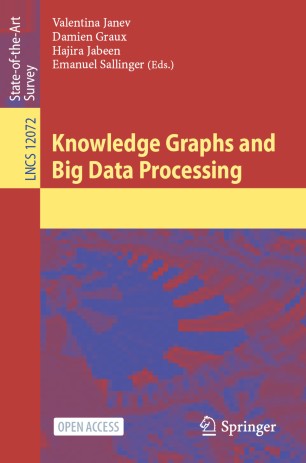
Knowledge graphs and big data processing
This book is part of the LAMBDA Project (Learning, Applying, Multiplying Big Data Analytics), funded by the European Union, GA No. 809965. Data Analytics involves applying algorithmic processes to derive insights.

Knowledge discovery, knowledge engineering and knowledge management ; 10th International Joint Conference, IC3K 2018, Seville, Spain, September 18-20, 2018, Revised Selected Papers
Constitutes the thoroughly refereed proceedings of the 10th International Joint Conference on Knowledge Discovery, Knowledge Engineering and Knowledge Management, IC3K 2018, held in Seville, Spain, in September 2018. The 12 full papers presented were carefully reviewed and selected from 167 submissions. The papers are organized in topical sections on knowledge discovery and information retrieval; knowledge engineering and ontology development; and knowledge management and information sharing.

Knowledge Discovery in Life Science Literature ; International Workshop, KDLL 2006, Singapore, April 9, 2006, Proceedings
Constitutes the refereed proceedings of the International Workshop on Knowledge Discovery in Life Science Literature, KDLL 2006, held in conjunction with the 10th Pacific-Asia Conference on Knowledge Discovery and Data Mining (PAKDD 2006). The 12 revised full papers presented together with two invited talks were carefully reviewed and selected for inclusion in the book. The papers cover all topics of knowledge discovery in life science data.

Knowledge Discovery in Inductive Databases ; Vol.3933 ; 4th International Workshop, KDID 2005, Porto, Portugal, October 3, 2005, Revised Selected and Invited Papers
The 4th International Workshop on Knowledge Discovery in Inductive Databases (KDID 2005) was held in Porto, Portugal, on October 3, 2005 in conjunction with the 16th European Conference on Machine Learning and the 9th European Conference on Principles and Practice of Knowledge Discovery in Databases. Ever since the start of the ?eld of data mining, it has been realized that the integration of the database technology into knowledge discovery processes was a crucial issue. This vision has been formalized into the inductive database perspective introduced by T. Imielinski and H. Mannila (CACM 1996, 39(11)). The main idea is to consider knowledge discovery as an extended querying p- cess for which relevant query languages are to be speci?ed.

Knowledge Discovery in Inductive Databases ; Vol.3377 : 3rd International Workshop, KDID 2004, Pisa, Italy, September 20, 2004, Revised Selected and Invited Papers
Cnstitutes the thoroughly refereed joint postproceedings of the Third International Workshop on Knowledge Discovery in Inductive Databases, KDID 2004, held in Pisa, Italy in September 2004 in association with ECML/PKDD. Inductive Databases support data mining and the knowledge discovery process in a natural way. In addition to usual data, an inductive database also contains inductive generalizations, like patterns and models extracted from the data. This book presents nine revised full papers selected from 23 submissions during two rounds of reviewing and improvement together with one invited paper. Various current topics in knowledge discovery and data mining in the framework of inductive databases are addressed.

Knowledge Discovery in Inductive Databases ; 5th International Workshop, KDID 2006 Berlin, Germany, September 18th, 2006 Revised Selected and Invited Papers
Constitutes the thoroughly refereed joint postproceedings of the 5th International Workshop on Knowledge Discovery in Inductive Databases, KDID 2006. The papers address various current topics in knowledge discovery and data mining in the framework of inductive databases such as constraint-based mining, database technology and inductive querying.
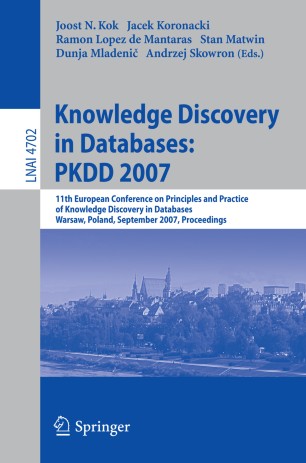
Knowledge Discovery in Databases : PKDD 2007 ; 11th European Conference on Principles and Practice of Knowledge Discovery in Databases, Warsaw, Poland, September 17-21, 2007, Proceedings
The two premier annual European conferences in the areas of machine learning and data mining have been collocated ever since the ?rst joint conference in Freiburg, 2001. The European Conference on Principles and Practice of Knowledge Discovery in Databases (PKDD) was?rstheldin1997inTrondheim, Norway.
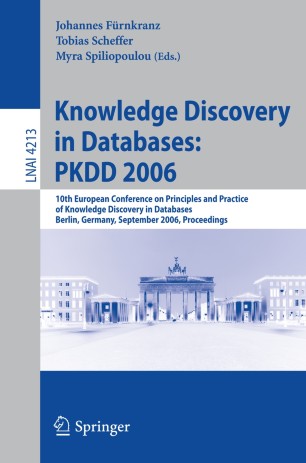
Knowledge discovery in databases : PKDD 2006 ; 10th European Conference on Principles and practice of knowledge discovery in databases, Berlin, Germany, September 18-22, 2006, Proceedings
The European Conference on Principles and Practice of Knowledge Discovery in Databases celebrates its tenth anniversary ; the first PKDD took place in 1997 in Trondheim, Norway. Over the years, the ECML/PKDD series has evolved into one of the largest and most selective international conferences in these areas, the only one that provides a common forum for the two closely related ?elds. In 2006, the 6th collocated ECML/PKDD took place during September 18-22, when the Humboldt-Universität zu Berlin hosted the 17th European Conference on Machine Learning (ECML) and the 10th European Conference on Principles and Practice of Knowledge Discovery in Databases (PKDD). The successful model of a hierarchical reviewing process that was introduced last year for the ECML/PKDD 2005 in Porto has been taken over in 2006.
Knowledge Discovery in Databases : PKDD 2005 ; 9th European Conference on Principles and Practice of Knowledge Discovery in Databases, Porto, Portugal, October 3-7, 2005, Proceedings
585 different paper submissions were received for both events, which maintains the high s- mission standard of last year. Of these, 335 were submitted to ECML only, 220 to PKDD only and 30 to both. Such a high volume of scientific work required a tremendous effort from Area Chairs, Program Committee members and some additional reviewers. On average, PC members had 10 papers to evaluate, and Area Chairs had 25 papers to decide upon. We managed to have 3 highly qua- ?ed independent reviews per paper (with very few exceptions)and one additional overall input from one of the Area Chairs. After the authors’ responses and the online discussions for many of the papers, we arrived at the final selection of 40 regular papers for ECML and 35 for PKDD. Besides these, 32 others were accepted as short papers for ECML and 35 for PKDD. This represents a joint acceptance rate of around 13% for regular papers and 25% overall. We thank all involved for all the e?ort with reviewing and selection of papers. Besides the core technical program, ECML and PKDD had 6 invited speakers, 10 workshops, 8 tutorials and a Knowledge Discovery Challenge.
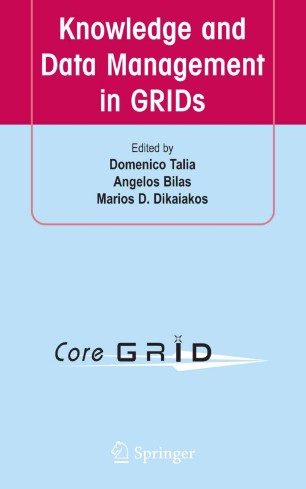
Knowledge and Data Management in GRIDs
Knowledge and Data Management in GRIDs is the third volume of the CoreGRID series and brings together scientific contributions by researchers and scientists working on storage, data, and knowledge management in GRID and Peer-to-Peer systems. This volume presents the latest GRID solutions and research results in key areas of knowledge and data management such as distributed storage management, GRID databases, Semantic GRID and GRID-aware data mining.
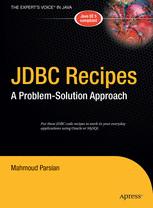
JDBC Recipes : A Problem-Solution Approach
JDBC Recipes provides easy-to-implement, usable solutions to problems in relational databases that use JDBC. You will be able to integrate these solutions into your web-based applications, such as Java servlets, JavaServer Pages, and Java server-side frameworks. This handy book allows you to cut and paste the solutions without any code changes. This book focuses on topics that have been ignored in most other JDBC books, such as database and result set metadata. It will help you develop database solutions, like adapters, connectors, and frameworks using Java/JDBC. The insightful solutions will enable you to handle all data types, including large binary objects. A unique feature of the book is that it presents JDBC solutions (result sets) in XML.

JDBC Metadata, MySQL, and Oracle Recipes : A Problem-Solution Approach
JDBC Metadata, MySQL, and Oracle Recipes is the only book that focuses on metadata or annotation-based code recipes for JDBC API for use with Oracle and MySQL. It continues where the authors other book, JDBC Recipes: A Problem-Solution Approach, leaves off. This edition is also a Java EE 5-compliant book, perfect for lightweight Java database development. And it provides cut-and-paste code templates that can be immediately customized and applied in each developer's application development.
Java : how to program. Late objects : Introducing Jshell
Introduction to Computers, the Internet and Java / Introduction to Java Applications; Input/Output and Operators / Control Statements: Part 1; Assignment, ++ and Operators / Control Statements: Part 2; Logical Operators / Methods / Arrays and ArrayLists / Introduction to Classes and Objects / Classes and Objects: A Deeper Look / Object-Oriented Programming: Inheritance / Object-Oriented Programming: Polymorphism and Interfaces / Exception Handling: A Deeper Look / JavaFX Graphical User Interfaces / JavaFX GUI / Strings, Characters and Regular Expressions / Files, Input/Output Streams, NIO and XML Serialization / Generic Collections / Lambdas and Streams / Recursion / Searching, Sorting and Big O / Generic Classes and Methods: A Deeper Look / Custom Generic Data Structures / JavaFX Graphics and Multimedia / Concurrency / Accessing Databases with JDBC / Introduction to JShell: Java 9's REPL for Interactive Java

Comparative genomics ; Vol. 3388 : RECOMB 2004 International Workshop, RCG 2004, Bertinoro, Italy, October 16-19, 2004, Revised Selected Papers
This papers investigates the problem of conservation of combinatorial structures in genome rearrangement scenarios. We give a characterization of a class of scenarios that conserve all common intervals, called commuting scenarios, and a characterization of permutations for which commuting scenarios exist. We show that measuring conservation of common intervals can be useful tool in assessing the quality of rearrangement scenarios, by investigating in detail three specific scenarios involving the mouse, rat and human X chromosomes.

Citation Analysis in Research Evaluation
This book is written for members of the scholarly research community, and for persons involved in research evaluation and research policy. More specifically, it is directed towards the following four main groups of readers: – All scientists and scholars who have been or will be subjected to a quantitative assessment of research performance using citation analysis. – Research policy makers and managers who wish to become conversant with the basic features of citation analysis, and about its potentialities and limitations. – Members of peer review committees and other evaluators, who consider the use of citation analysis as a tool in their assessments. – Practitioners and students in the field of quantitative science and technology studies, informetrics, and library and information science. Citation analysis involves the construction and application of a series of indicators of the ‘impact’, ‘influence’ or ‘quality’ of scholarly work, derived from citation data, i.e. data on references cited in footnotes or bibliographies of scholarly research publications. Such indicators are applied both in the study of scholarly communication and in the assessment of research performance. The term ‘scholarly’ comprises all domains of science and scholarship, including not only those fields that are normally denoted as science – the natural and life sciences, mathematical and technical sciences – but also social sciences and humanities.

Chinese Computational Linguistics ; 19th China National Conference, CCL 2020, Hainan, China, October 30 – November 1, 2020, Proceedings
This book constitutes the proceedings of the 19th China National Conference on Computational Linguistics, CCL 2020, held in Hainan, China, in October/November 2020. The 32 full and 2 short papers presented in this volume were carefully reviewed and selected from 99 submissions. They were organized in topical sections named: fundamental theory and methods of computational linguistics; information retrieval, dialogue and question answering; text generation and summarization; knowledge graph and information extraction; machine translation and multilingual information processing; minority language information processing; language resource and evaluation; social computing and sentiment analysis; and NLP applications.

Cellular Automata and Discrete Complex Systems ; 26th IFIP WG 1.5 International Workshop, AUTOMATA 2020, Stockholm, Sweden, August 10–12, 2020, Proceedings
This volume constitutes the refereed post-conference proceedings of the 26th IFIP WG 1.5 International Workshop on Cellular Automata and Discrete Complex Systems, AUTOMATA 2020, held in Stockholm, Sweden, in August 2020. The workshop was held virtually. The 11 full papers presented in this book were carefully reviewed and selected from a total of 21 submissions. The topics of the conference include dynamical, topological, ergodic and algebraic aspects of CA and DCS, algorithmic and complexity issues, emergent properties, formal languages, symbolic dynamics, tilings, models of parallelism and distributed systems, timing schemes, synchronous versus asynchronous models, phenomenological descriptions, scientific modeling, and practical applications.
