



الصفحة 7
الصفحة 7

Fluent Python : Clear, Concise, and Effective Programming
You’ll learn how to write effective, modern Python 3 code by leveraging its best ideas. Don’t waste time bending Python to fit patterns you learned in other languages. Discover and apply idiomatic Python 3 features beyond your past experience. Author Luciano Ramalho guides you through Python’s core language features and libraries and teaches you how to make your code shorter, faster, and more readable.

Fashionity
This project is an AI fashion design system to generate fashion images based on user textual description. The proposed system incorporates advanced technology for dissemination and machine translation with the aim of facilitating a seamless user experience for input in both Arabic and English languages. Moreover, the project encompasses the incorporation of a recommendation system that proposes appropriate visual content based on user style. The primary objective of this project is to develop a robust framework capable of generating high-quality images based on textual descriptions, providing recommendations for similar clothing items, and facilitating the retrieval of photographic and apparel articles through image search.
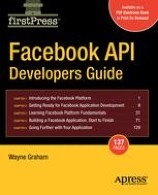
Facebook API Developers Guide
The Facebook API allows web developers to create Facebook applications and access Facebook data from other applications. Facebook API Developers Guide covers the use and implementation of the Facebook API—what the key features are and how you can access them. You will learn, through practical examples, the main features of the Facebook API including an introduction to the API–specific languages FQL and FBML. These examples are further supported by the introduction of other technologies like language libraries, relational database management systems, and XML. Covers all key features of the Facebook API Explains the API languages FQL and FBML Teaches by example, with useful code and tips you can use in your own applications

Euro-Par 2020 : Parallel Processing ; 26th International Conference on Parallel and Distributed Computing, Warsaw, Poland, August 24–28, 2020, Proceedings
This book constitutes the proceedings of the 26th International Conference on Parallel and Distributed Computing, Euro-Par 2020, held in Warsaw, Poland, in August 2020. The conference was held virtually due to the coronavirus pandemic. The 39 full papers presented in this volume were carefully reviewed and selected from 158 submissions. They deal with parallel and distributed computing in general, focusing on support tools and environments; performance and power modeling, prediction and evaluation; scheduling and load balancing; high performance architectures and compilers; data management, analytics and machine learning; cluster, cloud and edge computing; theory and algorithms for parallel and distributed processing; parallel and distributed programming, interfaces, and languages; multicore and manycore parallelism; parallel numerical methods and applications; and accelerator computing.
Euro-Par 2005 Parallel Processing ; 11th International Euro-Par Conference, Lisbon, Portugal, August 30 - September 2, 2005, Proceedings
This book constitutes the refereed proceedings of the 11th International Conference on Parallel Computing, Euro-Par 2005, held in Lisbon, Portugal, in August/September 2005. The 120 revised papers presented together with 4 invited papers were carefully reviewed and selected from 388 submissions. The papers are organized in topical sections on support tools and environments, performance prediction and evaluation, scheduling and load balancing, compilers for high performance, parallel and distributed databases, data mining and knowledge discovery, grid and cluster computing: models, middleware and architectures, parallel computer architecture and instruction distributed systems and algorithms, parallel programming: models, methods, and languages, parallel numerical algorithms.

Engineering societies in the agents world V : 5th international workshop, ESAW 2004, Toulouse, France, October 20-22, 2004 : revised selected and invited papers
The ?rst workshop “Engineering Societies in the Agents World” (ESAW) was held in August 2000, in conjunction with the 14th European Conference on Arti?cial Intelligence (ECAI 2000) in Berlin. It was launched by a group of - searchers who thought that the design and development of MASs (multi-agent systems) not only needed adequate theoretical foundations but also a call for new techniques, methodologies and infrastructures to develop MASs as arti?cial societies. The second ESAW was co-located with the European Agent Summer School (ACAI 2001) in Prague, and mostly focused on logics and languages, middleware, infrastructures and applications. In Madrid, the third ESAW c- centrated on models and methodologies and took place with the “Cooperative Information Agents” workshop (CIA 2002). The fourth ESAW in London was the ?rst one that ran as a stand-alone event: apart from the usual works on methodologies and models, it also stressed the issues of applications and m- tidisciplinary models. Based on the success of previous ESAWs, and also given that the di?cult challenges in the construction of arti?cial societies are not yet fully addressed, the ?fth ESAW workshop was organized in the same spirit as its predecessors.

Engineering Multi-Agent Systems ; 7th International Workshop, EMAS 2019, Montreal, QC, Canada, May 13–14, 2019, Revised Selected Papers
This book constitutes the thoroughly refereed post-conference proceedings of the 7th International Workshop on Engineering Multi-Agent Systems, EMAS 2019, held in Montreal, QC, Canada, in May 2019. The 13 revised full papers presented in this book were carefully selected and reviewed from 20 submissions. The papers are grouped in the following topical sections: Multi-Agent Interaction and Organization; Simulation; Social Awareness and Explainability; Learning and Reconfiguration; and Implementation Techniques and Tools.

ECOOP 2008 - Object-Oriented Programming ; 22nd European Conference Paphos, Cyprus, July 7-11, 2008 Proceedings
This book constitutes the refereed proceedings of the 22nd European Conference on Object-Oriented Programming, ECOOP 2008, held in Paphos, Cyprus, in July 2008.

ECOOP 2005 - object-oriented programming ; 19th European Conference, Glasgow, UK, July 25-29, 2005. Proceedings
The 19th Annual Meeting of the European Conference on Object-Oriented Programming—ECOOP 2005—took place during the last week of July in Glasgow, Scotland, UK. This volume includes the refereed technical papers p- sented at the conference, and two invited papers. It is traditional to preface a volume of proceedings such as this with a note that emphasizes the importance of the conference in its respective ?eld. Although such self-evaluations should always be taken with a large grain of salt, ECOOP is undisputedly the pre- inent conference on object-orientation outside of the United States. In its turn, object-orientationis today’s principaltechnology not only for programming,but also for design, analysisand speci?cation of softwaresystems.

ECOOP 2002 - Object-Oriented Programming ; 16th European Conference Malaga, Spain, June 10-14, 2002 Proceedings
Constitutes the proceedings of the 16th European Conference on Object-Oriented Programming held in Spain in 2002. The 25 papers cover aspect-oriented software development, Java virtual machines, distributed systems, patterns and architectures, languages, optimization and more.

Early Aspects: Current Challenges and Future Directions ; 10th International Workshop, Vancouver, Canada, March 13, 2007, Revised Selected Papers
Traditionally, aspect-oriented software development (AOSD) has focused on the implementation phase of the software lifecycle: aspects are identified and captured mainly in code. Therefore, most current AOSD approaches place the burden for aspect identification and management on the programmer working at low levels of abstraction. However, aspects are often present well before the implementation phase, such as in domain models, requirements and software architecture. Identification and capture of these early aspects ensure that aspects related to the problem domain (as opposed to merely the implementation) will be appropriately captured, reasoned about and available. This offers improved opportunities for early recognition and negotiation of trade-offs and allows forward and backward aspect traceability. This makes requirements, architecture, and implementation more seamless, and allows a more systematic application of aspects.

Domain-driven design with Java, a practitioner's guide : create simple, elegant, and valuable software solutions for complex business problems
Helps you as a developer and architect to put your knowledge to work in order to create elegant software designs that are enjoyable to work with and easy to reason about. You'll begin with an introduction to the concepts of domain-driven design and discover various ways to apply them in real-world scenarios. You'll also appreciate how DDD is extremely relevant when creating cloud native solutions that employ modern techniques such as event-driven microservices and fine-grained architectures. As you advance through the chapters, you'll get acquainted with core DDD's strategic design concepts such as the ubiquitous language, context maps, bounded contexts, and tactical design elements like aggregates and domain models and events. You'll understand how to apply modern, lightweight modeling techniques such as business value canvas, Wardley mapping, domain storytelling, and event storming, while also learning how to test-drive the system to create solutions that exhibit high degrees of internal quality.
DNA Computing ; 7th International Workshop on DNA-Based Computers, DNA7, Tampa, FL, USA, June 10-13, 2001, Revised Papers
Constitutes the post-proceedings of the 7th International Workshop on DNA-Based Computers, held in Florida in 2001. The 26 papers cover experimental tools, theoretical tools, probabilistic computational models, computer simulation and sequence design, algorithms, experimental solutions and more.
Distributed Applications and Interoperable Systems ; 8th IFIP WG 6.1 International Conference, DAIS 2008, Oslo, Norway, June 4-6, 2008. Proceedings
This volume contains the proceedings of DAIS 2008, the 8th IFIP International Conference on Distributed Applications and Interoperable Systems.

DevOps Tools for Java Developers : Best Practices from Source Code to Production Containers
Explore software lifecycle best practices Use DevSecOps methodologies to facilitate software development and delivery Understand the business value of DevSecOps best practices Manage and secure software dependencies Develop and deploy applications using containers and cloud native technologies Manage and administrate source control repositories and development processes Use automation to set up and administer build pipelines Identify common deployment patterns and antipatterns Maintain and monitor software after deployment

Developments in language theory ; 8th International Conference, DLT 2004, Auckland, New Zealand, December 13-17, Proceedings
Basic Notions of Reaction Systems / A Kleene Theorem for a Class of Communicating Automata with Effective Algorithms / Algebraic and Topological Models for DNA Recombinant Processes / Contributed Papers : Regular Expressions for Two-Dimensional Languages Over One-Letter Alphabet / On Competence in CD Grammar Systems / The Dot-Depth and the Polynomial Hierarchy Correspond on the Delta Levels, and other

Developments in Language Theory ; 12th International Conference, DLT 2008, Kyoto, Japan, September 16-19, 2008. Proceedings
This book constitutes the refereed proceedings of the 12th International Conference on Developments in Language Theory, DLT 2008, held in Kyoto, Japan, September 2008.

Deployment and operation of complex software in heterogeneous execution environments : The SODALITE approach
This book provides an overview of the work developed within the SODALITE project, which aims at facilitating the deployment and operation of distributed software on top of heterogeneous infrastructures, including cloud, HPC and edge resources. The experts participating in the project describe how SODALITE works and how it can be exploited by end users. While multiple languages and tools are available in the literature to support DevOps teams in the automation of deployment and operation steps, still these activities require specific know-how and skills that cannot be found in average teams. The SODALITE framework tackles this problem by offering modelling and smart editing features to allow those we call Application Ops Experts to work without knowing low level details about the adopted, potentially heterogeneous, infrastructures. The framework offers also mechanisms to verify the quality of the defined models, generate the corresponding executable infrastructural code, automatically wrap application components within proper execution containers, orchestrate all activities concerned with deployment and operation of all system components, and support on-the-fly self-adaptation and refactoring.

Dependable software engineering : Theories, tools, and applications ; 6th International Symposium, SETTA 2020, Guangzhou, China, November 24–27, 2020, Proceedings
This book constitutes the proceedings of the 6th International Symposium on Dependable Software Engineering, SETTA 2020, held in Guangzhou, China, in November 2020. The 10 full and 1 short paper included in this volume were carefully reviewed and selected from 20 submissions. They deal with latest research results and ideas on bridging the gap between formal methods and software engineering.
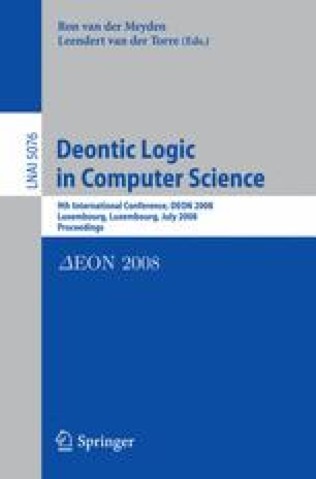
Deontic Logic in Computer Science ; 9th International Conference, DEON 2008, Luxembourg, Luxembourg, July 15-18, 2008. Proceedings
This volume presents the refereed proceedings of the 9th International Conference on Deontic Logic in Computer Science, DEON 2008, held in Luxembourg in July 2008.
