



الصفحة 57
الصفحة 57

EEG signal processing for biomedical applications
Focuses on electroencephalography (EEG) signal processing in biomedical engineering applications. EEG signals are used widely in clinical and research settings to provide cognitive and emotional state information. In addition to capturing complex neural patterns at high speeds, EEG signals are a reliable and non-invasive way of measuring the electrical activity in the brain. By examining various novel analysis and signal processing methods, this collection of papers provides a better understanding of cognitive states and brain activity.
Education for the 21st Century - Impact of ICT and Digital Resources ; IFIP 19th World Computer Congress, TC-3 Education, August 21-24, 2006, Santiago, Chile
The IFIP series publishes state-of-the-art results in the sciences and technologies of information and communication. The scope of the series includes: foundations of computer science; software theory and practice; education; computer applications in technology; communication systems; systems modeling and optimization; information systems; computers and society; computer systems technology; security and protection in information processing systems; artificial intelligence; and human-computer interaction. Proceedings and post-proceedings of referred international conferences in computer science and interdisciplinary fields are featured.

Education and the knowledge society : Information technology supporting human development
Engineering the Knowledge Society (EKS) - Event of the World Summit on the Information Society (WSIS) This book is the result of a joint event of the World Federation of Engineering Organisations (WFEO) and the International Federation for Information Processing (IFIP) held during the World Summit on the Information Society (WSIS) in Geneva, Switzerland, December 11 - 12, 2003. The organisation was in the hands of Mr. Raymond Morel of the Swiss Academy of Engineering Sciences (SATW). Information Technology (or Information and Communication Technology) cannot be seen as a separate entity. Its application should support human development and this application has to be engineered. Education plays a central role in the engineering of Information and Communication Technology (ICT) for human support.
ECSCW 2007 ; Proceedings of the 10th European Conference on Computer-Supported Cooperative Work, Limerick, Ireland, 24-28 September 2007
The volume includes papers addressing novel interaction technologies for CSCW systems, new models and architectures for groupware systems, studies of communication and coordination among mobile actors, studies of cooperative work in complex settings, studies of groupware systems in actual use in real-world settings, and theories and techniques to support the development of cooperative applications. The papers present emerging technologies alongside new methods and approaches to the development of this important class of applications.

ECSCW 2005 ; Proceedings of the ninth European conference on computer-supported cooperative work, 18-22 September 2005, Paris, France
These proceedings contain a collection of papers that reflect the variegated research activities in the field. The volume includes papers addressing novel interaction technologies for CSCW systems, new models and architectures for groupware systems, studies of communication and coordination among mobile actors, studies of cooperative work in complex settings, studies of groupware systems in actual use in real-world settings, and theories and techniques to support the development of cooperative applications. The papers present emerging technologies alongside new methods and approaches to the development of this important class of applications. The work in this volume represents the best of the current research and practice within CSCW. The collection of papers presented here will appeal to researchers and practitioners alike, as they combine an understanding of the nature of work with the possibility offered by new technologies.

ECOOP’ 87 European Conference on Object-Oriented Programming ; Paris, France, June 15-17, 1987. Proceedings
In October 1983 an informal meeting was organized in Le Cap d'Agde with the help of the BIGRE bulletin. Sixty people turned out to hear more than ten presentations on object-oriented programming. More important was their unanimous demand for other, more structured encounters. So, about one year later, the Object group was created by AFCET.

ECOOP 2008 - Object-Oriented Programming ; 22nd European Conference Paphos, Cyprus, July 7-11, 2008 Proceedings
This book constitutes the refereed proceedings of the 22nd European Conference on Object-Oriented Programming, ECOOP 2008, held in Paphos, Cyprus, in July 2008.
ECOOP 2007 – Object-Oriented Programming ; 21th European Conference, Berlin, Germany, July 30 - August 3, 2007, Proceedings
This book contains sections on runtime implementation, empirical studies, programs and predicates, language design, inheritance and derivation, aspects, as well as language about language.

ECOOP 2006 - Object-Oriented Programming ; 20th European Conference, Nantes, France, July 3-7, 2006, Proceedings
This book constitutes the refereed proceedings of the 20th European Conference on Object-Oriented Programming, ECOOP 2006, held in Nantes, France in July 2006.20 revised full papers, together with 3 keynote papers were carefully reviewed and selected.

ECOOP 2005 - object-oriented programming ; 19th European Conference, Glasgow, UK, July 25-29, 2005. Proceedings
The 19th Annual Meeting of the European Conference on Object-Oriented Programming—ECOOP 2005—took place during the last week of July in Glasgow, Scotland, UK. This volume includes the refereed technical papers p- sented at the conference, and two invited papers. It is traditional to preface a volume of proceedings such as this with a note that emphasizes the importance of the conference in its respective ?eld. Although such self-evaluations should always be taken with a large grain of salt, ECOOP is undisputedly the pre- inent conference on object-orientation outside of the United States. In its turn, object-orientationis today’s principaltechnology not only for programming,but also for design, analysisand speci?cation of softwaresystems.

ECOOP 2002 - Object-Oriented Programming ; 16th European Conference Malaga, Spain, June 10-14, 2002 Proceedings
Constitutes the proceedings of the 16th European Conference on Object-Oriented Programming held in Spain in 2002. The 25 papers cover aspect-oriented software development, Java virtual machines, distributed systems, patterns and architectures, languages, optimization and more.
Economics of Identity Theft : Avoidance, Causes and Possible Cures
This book discusses privacy as multi-dimensional, and then pulls forward the economics of privacy in the first few chapters. This book also includes identity-based signatures, spyware, and the placement of biometric security in an economically broken system, which results in a broken biometric system. The final chapters include systematic problems with practical individual strategies for preventing identity theft for any reader of any economic status. In conclusion, four startling previews of the future are written as scenarios.

Economic Analysis of Information System Investment in Banking Industry
Explains in reahty, examines theoretically, and analyzes statistically information system investment in the banking industry with regard to the process of the information technology revolution. This kind of comprehensive research on the banking industry is the first in the world. It could be seen as an application study for Japanese financial deregulation after 1997. However, our project, the Workshop of Information System Investment, is a theoretical research venture, consisting originally, when it began in 1994, of economists and computer scientists. It aimed to measure the effect of com puter hardware and software on the modern economy, based on the microdata of each firm, and to extend the frontiers of economic science. It was, coin- dentally, the time when this project began full-scale operation, in July 1997, that the voluntary closure of Yamaichi Securities was decided. The failure of the Hokkaido Takushoku Bank was disclosed in November of the same year, and the breakdown, temporary nationalization, buying out, and mergers of several banks succeeded one another. Our research therefore suddenly got into the social spotlight on the application stage. Part I is the first history and strategic guidelines of information systems in the banking industry. Part II summarizes the economic analyses of informa tion system investment in the United States, Europe, and Japan. These parts are foundations for the statistical analyses in Part III.
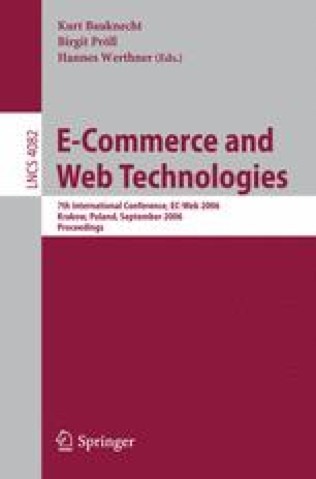
E-Commerce and Web Technologies ; Vol. 4082 ; 7th International Conference, EC-Web 2006, Krakow, Poland, September 5-7, 2006, Proceedings
EC-Web 2006 served as a forum bringing together researchers from academia and practitioners from industry to discuss the current state of the art in e-commerce and Web technologies. Inspiration and new ideas emerged from intensive discussions that took place during the keynote address, the formal sessions and the social events. The conference attracted 88 paper submissions and each paper was reviewed by three Program Committee members. The Program Committee selected 24 papers for presentation and publication (an acceptance and publication rate of 27%).

E-Commerce and Web Technologies ; 9th International Conference, EC-Web 2008 Turin, Italy, September 3-4, 2008 Proceedings
This book constitutes the refereed proceedings of the 9th International Conference on Electronic Commerce and Web Technologies, EC-Web 2008, held in Turin, Italy, in September, 2008 in conjunction with Dexa 2008.

E-Commerce and Web Technologies ; 8th International Conference, EC-Web 2007, Regensburg, Germany, September 3-7, 2007, Proceedings
This book contains sections on recommender systems, business process / design aspects, mobile commerce, security and e-payment, Web services computing / semantic Web, e-negotiation and agent mediated systems, and issues in Web advertising.

E-CARGO and role-based collaboration : Modeling and solving problems in the complex
A model for collaboratively solving complex problems Explains the nature of collaboration, explores an easy-to-follow process of collaboration, and defines a model to solve complex problems in collaboration and complex systems. Written by a noted expert on the topic, the book initiates the study of an effective collaborative system from a novel perspective. The role-based collaboration (RBC) methodology investigates the most important aspects of a variety of collaborative systems including societal-technical systems. The models and algorithms can also be applied across system engineering, production, and management. Contains a set of concepts, models, and algorithms for the analysis, design, implementation, maintenance, and assessment of a complex system Presents computational methods that use roles as a primary underlying mechanism to facilitate collaborative activities including role assignment Explores the RBC methodology that concentrates on the aspects that can be handled by individuals to establish a well-formed team Offers an authoritative book written by a noted expert on the topic

EC2ND 2005 ; Proceedings of the First European Conference on Computer Network Defence
This book contains the proceedings of the First European Conference on Computer Network Defence which took place in December 2005 at the University of Glamorgan in the UK. The theme of the conference is the protection of computer networks; and it provides an opportunity for workers in this area to become better informed about recent research developments as well as to exchange valuable insights and opinions.

E-Business@Print : Internet-based services and processes
The Internet has opened up exciting new opportunities for print media companies, enabling information to be processed for both paper and online output. It also offers new possibilities for print media companies to work increasingly closely with customers and production partners. The author provides a comprehensive overview of the new services that are now available and the new processes that the Internet enables. The reader is systematically guided through the various specialist terms, and numerous examples are used to illustrate possible applications, e.g. online editing systems, Web-based project management tools and online tracking of print jobs.

E-business and telecommunication networks ; 3rd International conference, ICETE 2006, Setúbal, Portugal, August 7-10, 2006. Selected Papers
This book constitutes the best papers of the Third International Conference on E-business and Telecommunication Networks, ICETE 2006, held in Setúbal, Portugal, August 7-10, 2006.
