



الصفحة 5
الصفحة 5

Deep neural networks and data for automated driving : robustness, uncertainty quantification, and insights towards safety
Environment perception for highly automated driving heavily employs deep neural networks, facing many challenges. How much data do we need for training and testing? How to use synthetic data to save labeling costs for training? How do we increase robustness and decrease memory usage? For inevitably poor conditions: How do we know that the network is uncertain about its decisions? Can we understand a bit more about what actually happens inside neural networks? This leads to a very practical problem particularly for DNNs employed in automated driving: What are useful validation techniques and how about safety? This book unites the views from both academia and industry, where computer vision and machine learning meet environment perception for highly automated driving. Naturally, aspects of data, robustness, uncertainty quantification, and, last but not least, safety are at the core of it. This book is unique: In its first part, an extended survey of all the relevant aspects is provided. The second part contains the detailed technical elaboration of the various questions mentioned above.
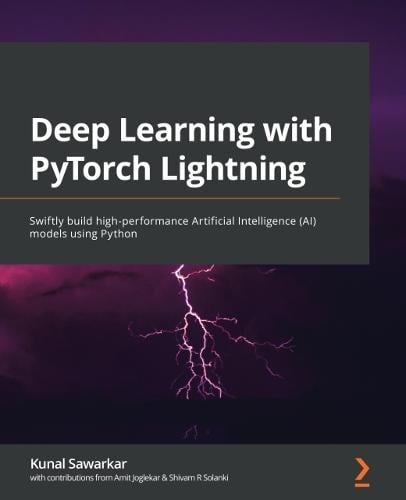
Deep Learning with PyTorch Lightning : Build and train high-performance artificial intelligence and self-supervised models using Python
You’ll learn how to configure PyTorch Lightning on a cloud platform, understand the architectural components, and explore how they are configured to build various industry solutions. You’ll build a neural network architecture, deploy an application from scratch, and see how you can expand it based on your specific needs, beyond what the framework can provide. In the later chapters, you’ll also learn how to implement capabilities to build and train various models like Convolutional Neural Nets (CNN), Natural Language Processing (NLP), Time Series, Self-Supervised Learning, Semi-Supervised Learning, Generative Adversarial Network (GAN) using PyTorch Lightning.

Deep Learning to See : Towards New Foundations of Computer Vision
Topics and features: Presents a curiosity-driven approach, posing questions to stimulate readers to design novel computational models of vision Offers a rethinking of computer vision, arguing for an approach based on vision in nature, versus regarding visual signals as collections of images Provides an interdisciplinary commentary, aiming to unify computer vision, machine learning, human vision, and computational neuroscience Serving to inspire and stimulate critical reflection and discussion, yet requiring no prior advanced technical knowledge, the text can naturally be paired with classic textbooks on computer vision to better frame the current state of the art, open problems, and novel potential solutions.

Deep learning architecture and application
As one of the fastest-growing topics in machine learning, deep learning algorithms have achieved unprecedented success in recent years. Novel paradigms (such as contrastive learning and few-shot learning) in deep learning and rising neural network architectures (e.g., transformer and masked autoencoder) are dramatically changing the field of data-driven algorithms. More importantly, deep learning models are redefining the next generation of industrial applications spanning image recognition, speech processing, language translation, healthcare, and other sciences. For example, recent advances in deep representation learning are allowing us to learn about protein 3D structures, which sheds new light on fundamental medicine and biology along with potentially bringing in billions of dollars (e.g., in the pharmaceutical market).

Deep learning approach for text summarization
Machine learning and deep learning, as we know, have started ruling over almost every field in the computing industry and so, has revolutionized the process of text summarization too. Automatic text summarization is an advancing realm of the natural language processing research in which concise textual summaries are generated from lengthy input documents. Extensive research has been carried out on how automatic summarization can be prosecuted through various extractive and abstractive techniques. In this paper, we address all the approaches to text summarization and present the modus operandi of an Architecture called Encoder Decoder, under the machine learning approach.

Databases, Information Systems, and Peer-to-Peer Computing ; International Workshops, DBISP2P 2005/2006, Trondheim, Norway, August 28-29, 2006, Revised Selected Papers
The P2P paradigm lends itself to constructing large-scale, complex, adaptive, autonomous and heterogeneous database and information systems, endowed with clearly specified and difierential capabilities to negotiate, bargain, coordinate and self-organize the information exchanges in large-scale networks. This vision will have a radical impact on the structure of complex organizations (business, sci- tific or otherwise) and on the emergence and the formation of social communities, and on how the information is organized and processed. The P2P information paradigm naturally encompasses static and wireless connectivity and static and mobile architectures. Wireless connectivity combined with the increasingly small and powerful mobile devices and sensors poses new challenges as well as opp- tunities to the database community. Information becomes ubiquitous, highly distributed and accessible anywhere and at any time over highly dynamic, - stable networks with very severe constraints on the information management and processing capabilities.

Databases, information systems, and peer-to-peer computing ; 2nd international workshop, DBISP2P 2004, Toronto, Canada, August 29-30, 2004, revised selected papers
Peer-to-peer (P2P) paradigm lends itself to constructing large-scale complex, adaptive, - tonomous and heterogeneous database and information systems, endowed with clearly speci?ed and di?erential capabilities to negotiate, bargain, coordinate, and self-organize the information exchanges in large-scale networks. This vision will have a radical impact on the structure of complex organizations (business, scienti?c, or otherwise) and on the emergence and the formation of social c- munities, and on how the information is organized and processed. The P2P information paradigm naturally encompasses static and wireless connectivity, and static and mobile architectures. Wireless connectivity c- bined with the increasingly small and powerful mobile devices and sensors pose new challenges to as well as opportunities for the database community. Inf- mation becomes ubiquitous, highly distributed and accessible anywhere and at any time over highly dynamic, unstable networks with very severe constraints on the information management and processing capabilities.

Data science for economics and finance : Methodologies and applications
The book starts with an introduction on the use of data science technologies in economics and finance and is followed by thirteen chapters showing success stories of the application of specific data science methodologies, touching on particular topics related to novel big data sources and technologies for economic analysis (e.g. social media and news); big data models leveraging on supervised/unsupervised (deep) machine learning; natural language processing to build economic and financial indicators; and forecasting and nowcasting of economic variables through time series analysis.

Data science ; 6th International Conference of Pioneering Computer Scientists, Engineers and Educators, ICPCSEE 2020, Taiyuan, China, September 18-21, 2020, Proceedings, Part II
This two volume set (CCIS 1257 and 1258) constitutes the refereed proceedings of the 6th International Conference of Pioneering Computer Scientists, Engineers and Educators, ICPCSEE 2020 held in Taiyuan, China, in September 2020. The 98 papers presented in these two volumes were carefully reviewed and selected from 392 submissions. The papers are organized in topical sections: database, machine learning, network, graphic images, system, natural language processing, security, algorithm, application, and education.

Data Science ; 6th International Conference of Pioneering Computer Scientists, Engineers and Educators, ICPCSEE 2020, Taiyuan, China, September 18-21, 2020, Proceedings, Part I
This two volume set (CCIS 1257 and 1258) constitutes the refereed proceedings of the 6th International Conference of Pioneering Computer Scientists, Engineers and Educators, ICPCSEE 2020 held in Taiyuan, China, in September 2020. The 98 papers presented in these two volumes were carefully reviewed and selected from 392 submissions. The papers are organized in topical sections: database, machine learning, network, graphic images, system, natural language processing, security, algorithm, application, and education.

Current aopics in artificial intelligence ; 11th Conference of the Spanish Association for Artificial Intelligence, CAEPIA 2005, Santiago de Compostela, Spain, November 16-18, 2005, Revised Selected Papers
This book constitutes the thoroughly refered post-proceedings of the 11th Conference of the Spanish Association for Artificial Intelligence, CAEPIA 2005, held in Santiago de Compostela, Spain in November 2005.

Cooperative Control : A Post-Workshop Vol., 2003 Block Island Workshop on Cooperative Control
This carefully edited book presents how natural groupings such as fish schools, bird flocks, deer herds etc. coordinate themselves and move so flawlessly, often without an apparent leader or any form of centralized control. It shows how the underlying principles of cooperative control may be used for groups of mobile autonomous agents to help enable a large group of autonomous robotic vehicles in the air, on land or sea or underwater, to collectively accomplish useful tasks such as distributed, adaptive scientific data gathering, search and rescue, or reconnaissance.

Control Theory Tutorial : Basic Concepts Illustrated by Software Examples
Introduces the basic principles of control theory in a concise self-study guide. It complements the classic texts by emphasizing the simple conceptual unity of the subject. A novice can quickly see how and why the different parts fit together. The concepts build slowly and naturally one after another, until the reader soon has a view of the whole. Each concept is illustrated by detailed examples and graphics. The full software code for each example is available, providing the basis for experimenting with various assumptions, learning how to write programs for control analysis, and setting the stage for future research projects. The topics focus on robustness, design trade-offs, and optimality. Most of the book develops classical linear theory. The last part of the book considers robustness with respect to nonlinearity and explicitly nonlinear extensions, as well as advanced topics such as adaptive control and model predictive control.

Constraint solving and language processing
Contains selected and thoroughly revised papers plus contributions from invited speakers presented at the First International Workshop on C- straint Solving and Language Processing, held in Roskilde, Denmark, September 1–3, 2004. Constraint Programming and Constraint Solving, in particular Constraint Logic Programming, appear to be a very promising platform, perhaps the most promising present platform, for bringing forward the state of the art in natural language processing, this due to the naturalness in speci?cation and the direct relation to e?cient implementation. Language, in the present context, may - fer to written and spoken language, formal and semiformal language, and even general input data to multimodal and pervasive systems, which can be handled in very much the same ways using constraint programming. The notion of constraints, with slightly differing meanings, apply in the characterization of linguistic and cognitive phenomena, in formalized linguistic m- els as well as in implementation-oriented frameworks. Programming techniques for constraint solving have been, and still are, in a period with rapid devel- ment of new eficient methods and paradigms from which language processing can prompt. A common metaphor for human language processing is one big c- straint solving process in which the differently specified linguistic and cognitive phases take place in parallel and with mutual cooperation, which ?ts quite well with current constraint programming paradigms.

Computing Attitude and Affect in Text : Theory and Applications
Human Language Technology (HLT) and Natural Language Processing (NLP) systems have typically focused on the “factual” aspect of content analysis. Other aspects, including pragmatics, opinion, and style, have received much less attention. However, to achieve an adequate understanding of a text, these aspects cannot be ignored. The chapters in this book address the aspect of subjective opinion, which includes identifying different points of view, identifying different emotive dimensions, and classifying text by opinion. Various conceptual models and computational methods are presented.

Computer Vision Metrics : Survey, Taxonomy, and Analysis
Computer Vision Metrics provides an extensive survey and analysis of over 100 current and historical feature description and machine vision methods, with a detailed taxonomy for local, regional and global features. This book provides necessary background to develop intuition about why interest point detectors and feature descriptors actually work, how they are designed, with observations about tuning the methods for achieving robustness and invariance targets for specific applications. The survey is broader than it is deep, with over 540 references provided to dig deeper. The taxonomy includes search methods, spectra components, descriptor representation, shape, distance functions, accuracy, efficiency, robustness and invariance attributes, and more.

Computer Performance Engineering ; 5th European Performance Engineering Workshop, EPEW 2008, Palma de Mallorca, Spain, September 24-25, 2008. Proceedings
This book constitutes the proceedings of the Fifth European Performance Engineering Workshop, EPEW 2008, held in Palma de Mallorca, Spain, in September 24-25, 2008.

Computer and Information Seciences - ISCIS 2006 ; 21th International Symposium Istanbul, Turkey, Novenber 1-3, 2006, Proceedings
Thesearetheproceedingsofthe21stInternationalSymposiumonComputerand ? Information Sciences (ISCIS 2006) held in Istanbul, Turkey, November 1 – 3, 2006. ISCIS 2006 was organized by the Faculty of Engineering and Natural S- ences of Sabanc?University.

Computer and Information Sciences - ISCIS 2005 ; 20th International Symposium, Istanbul, Turkey, October 26 -- 28, 2005, Proceedings
This book constitutes the refereed proceedings of the 20th International Symposium on Computer and Information Sciences, ISCIS 2005, held in Istanbul, Turkey in October 2005. The 92 revised full papers presented together with 4 invited talks were carefully reviewed and selected from 491 submissions. The papers are organized in topical sections on computer networks, sensor and satellite networks, security and cryptography, performance evaluation, e-commerce and Web services, multiagent systems, machine learning, information retrieval and natural language processing, image and speech processing, algorithms and database systems, as well as theory of computing.

Computer algebra in scientific computing ; Vol. 3718 ; 8th International workshop, CASC 2005, Kalamata, Greece, September 12-16, 2005, Proceedings
This volume contains the proceedings of the CASC 2005 continued a tradition — started in 1998 — of international con-ferences on the latest advances in the application of computer algebra systems(CASs) and methods to the solution of various problems in scientific computing.The methods of scientific computing play an important role in research andengineering applications in the natural and the engineering sciences. The signif-icance and impact of computer algebra methods and computer algebra systemsfor scientific computing has increased considerably in recent times. Nowadays,such general-purpose computer algebra systems as Maple, Magma, Mathematica,MuPAD, Singular, CoCoA and others enable their users to solve the followingthree important tasks within a uniform framework:(a) symbolic manipulation;(b) numerical computation;(c) visualization. The result of this job is reflected in this volume, which contains revised versionsof the accepted papers. The collection of papers included in the proceedingscovers various topics of computer algebra methods, algorithms, and softwareapplied to scientific computing:
