



الصفحة 5
الصفحة 5
Embedded computer systems : Architectures, modeling, and simulation ; Vol. 3553 ; 5th International Workshop, SAMOS 2005, Samos, Greece, July 18-20, Proceedings
The SAMOS workshop is an international gathering of highly quali?ed researchers from academia and industry, sharing in a 3-day lively discussion on the quiet and - spiring northern mountainside of the Mediterranean island of Samos. As a tradition, the workshop features workshop presentations in the morning, while after lunch all kinds of informal discussions and nut-cracking gatherings take place. The workshop is unique in the sense that not only solved research problems are presented and discussed but also (partly) unsolved problems and in-depth topical reviews can be unleashed in the sci- ti?c arena. Consequently, the workshop provides the participants with an environment where collaboration rather than competition is fostered. The earlier workshops, SAMOS I–IV (2001–2004), were composed only of invited presentations. Due to increasing expressions of interest in the workshop, the Program Committee of SAMOS V decided to open the workshop for all submissions. As a result the SAMOS workshop gained an immediate popularity; a total of 114 submitted papers were received for evaluation. The papers came from 24 countries and regions: Austria (1), Belgium (2), Brazil (5), Canada (4), China (12), Cyprus (2), Czech Republic (1), Finland (15), France (6), Germany (8), Greece (5), Hong Kong (2), India (2), Iran (1), Korea (24), The Netherlands (7), Pakistan (1), Poland (2), Spain (2), Sweden (2), T- wan (1), Turkey (2), UK (2), and USA (5). We are grateful to all of the authors who submitted papers to the workshop.

Embedded Computer Systems : Architectures, Modeling, and Simulation ; 8th International Workshop, SAMOS 2008, Samos, Greece, July 21-24, 2008. Proceedings
This book constitutes the refereed proceedings of the 8th International Workshop on Systems, Architectures, Modeling, and Simulation, SAMOS 2008, held in Samos, Greece, in July 2008.
Embedded Computer Systems : Architectures, Modeling, and Simulation ; 7th International Workshop, SAMOS 2007, Samos, Greece, July 16-19, 2007, Proceedings
The book is unique in the sense that not only solved research problems are presented and discussed but also (partly) unsolved pr- lems and in-depth topical reviews can be unleashed in the scientific arena. C- sequently, it provides the participants with an environment where collaboration rather than competition is fostered.
ECSCW 2007 ; Proceedings of the 10th European Conference on Computer-Supported Cooperative Work, Limerick, Ireland, 24-28 September 2007
The volume includes papers addressing novel interaction technologies for CSCW systems, new models and architectures for groupware systems, studies of communication and coordination among mobile actors, studies of cooperative work in complex settings, studies of groupware systems in actual use in real-world settings, and theories and techniques to support the development of cooperative applications. The papers present emerging technologies alongside new methods and approaches to the development of this important class of applications.

ECSCW 2005 ; Proceedings of the ninth European conference on computer-supported cooperative work, 18-22 September 2005, Paris, France
These proceedings contain a collection of papers that reflect the variegated research activities in the field. The volume includes papers addressing novel interaction technologies for CSCW systems, new models and architectures for groupware systems, studies of communication and coordination among mobile actors, studies of cooperative work in complex settings, studies of groupware systems in actual use in real-world settings, and theories and techniques to support the development of cooperative applications. The papers present emerging technologies alongside new methods and approaches to the development of this important class of applications. The work in this volume represents the best of the current research and practice within CSCW. The collection of papers presented here will appeal to researchers and practitioners alike, as they combine an understanding of the nature of work with the possibility offered by new technologies.

ECOOP 2002 - Object-Oriented Programming ; 16th European Conference Malaga, Spain, June 10-14, 2002 Proceedings
Constitutes the proceedings of the 16th European Conference on Object-Oriented Programming held in Spain in 2002. The 25 papers cover aspect-oriented software development, Java virtual machines, distributed systems, patterns and architectures, languages, optimization and more.

Dynamics AX : A guide to microsoft axapta
The world’s leading Axapta 3.0 experts will take you from Axapta novice to pro in this book. This authoritative and comprehensive guide walks you gently through the bulk of what you need to know to productively apply the system in the real worldwith real data, sizing guidelines, deployment architectures, and code. By the book’s end, you will have acquired practical hands-on experience. You’ll be able to get Axapta 3.0 up and running, and identify gaps between the out-of-the-box product and your actual business needs. You’ll also know how to automate real-world business functions.

Domain-driven design with Java, a practitioner's guide : create simple, elegant, and valuable software solutions for complex business problems
Helps you as a developer and architect to put your knowledge to work in order to create elegant software designs that are enjoyable to work with and easy to reason about. You'll begin with an introduction to the concepts of domain-driven design and discover various ways to apply them in real-world scenarios. You'll also appreciate how DDD is extremely relevant when creating cloud native solutions that employ modern techniques such as event-driven microservices and fine-grained architectures. As you advance through the chapters, you'll get acquainted with core DDD's strategic design concepts such as the ubiquitous language, context maps, bounded contexts, and tactical design elements like aggregates and domain models and events. You'll understand how to apply modern, lightweight modeling techniques such as business value canvas, Wardley mapping, domain storytelling, and event storming, while also learning how to test-drive the system to create solutions that exhibit high degrees of internal quality.

Distributed Multimedia Retrieval Strategies for Large Scale Networked Systems
Distributed Multimedia Retrieval Strategies for Large Scale Networked Systems presents an up-to-date research status in the domain of distributed video retrieval. This professional book will include several different techniques that are in place for long duration video retrieval. An experimentally tested technology under the JINI platform, demonstrates a practical working system which serves as a feasibility study, as well as the first step in realizing such a technology.

Distributed Event-Based Systems
Event-based architectures inherently decouple system components. Event-based components are not designed to work with specific other components in a traditional request/reply mode, but separate communication from computation through asynchronous communication mechanisms via a dedicated notification service.
Distributed Applications and Interoperable Systems ; 8th IFIP WG 6.1 International Conference, DAIS 2008, Oslo, Norway, June 4-6, 2008. Proceedings
This volume contains the proceedings of DAIS 2008, the 8th IFIP International Conference on Distributed Applications and Interoperable Systems.
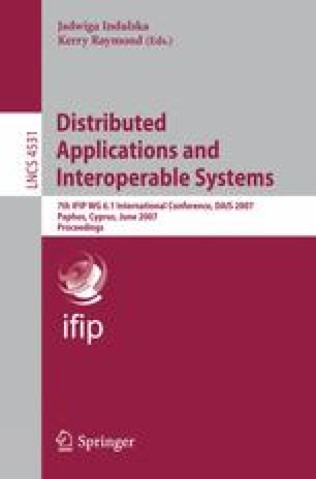
Distributed Applications and Interoperable Systems ; 7th IFIP WG 6.1 International Conference, DAIS 2007, Paphos, Cyprus, June 6-8, 2007, Proccedings
This book presented context-awareness, adaptation, mobility, distributed applications and peer-to-peer computing, all of which relate to the sustainability of distributed applications and integrated systems.

Distributed and Parallel Systems : In Focus : Desktop Grid Computing
In this book contributors investigate parallel and distributed techniques, algorithms, models and applications; present innovative software tools, environments and middleware; focus on various aspects of grid computing; and introduce novel methods for development, deployment, testing and evaluation.

Distributed and parallel computing ; 6th International conference on algorithms and architectures for parallel processing, ICA3PP, Melbourne, Australia, October 2-3, 2005, Proceedings
There are many applications that require parallel and distributed processing to allow complicated engineering, business and research problems to be solved in a reasonable time. Parallel and distributed processing is able to improve company profit, lower costs of design, production, and deployment of new technologies, and create better business environments. The major lesson learned by car and aircraft engineers, drug manufacturers, genome researchers and other specialist is that a computer system is a very powerful tool that is able to help them solving even more complicated problems. That has led computing specialists to new computer system architecture and exploiting parallel computers, clusters of clusters, and distributed systems in the form of grids.

Dissemination of information in communication networks : Broadcasting, gossiping, leader election, and fault-tolerance
Preface Due to the development of hardware technologies (such as VLSI) in the early 1980s, the interest in parallel and distributive computing has been rapidly growingandinthelate1980sthestudyofparallelalgorithmsandarchitectures became one of the main topics in computer science. To bring the topic to educatorsandstudents,severalbooksonparallelcomputingwerewritten. The involvedtextbook“IntroductiontoParallelAlgorithmsandArchitectures”by F. Thomson Leighton in 1992 was one of the milestones in the development of parallel architectures and parallel algorithms. But in the last decade or so the main interest in parallel and distributive computing moved from the design of parallel algorithms and expensive parallel computers to the new distributive reality – the world of interconnected computers that cooperate (often asynchronously) in order to solve di?erent tasks.

Digital twin : Architectures, networks, and applications
Offers comprehensive, self-contained knowledge on digital twin (DT), which is a very promising technology for achieving digital intelligence in the next-generation wireless communications and computing networks. DT is a key technology to connect physical systems and digital spaces in Metaverse. The objectives of this book are to provide the basic concepts of DT, to explore the promising applications of DT integrated with emerging technologies, and to give insights into the possible future directions of DT. For easy understanding, this book also presents several use cases for DT models and applications in different scenarios. The book starts with the basic concepts, models, and network architectures of DT. Then, we present the new opportunities when DT meets edge computing, Blockchain and Artificial Intelligence, and distributed machine learning (e.g., federated learning, multi-agent deep reinforcement learning).

Digital Libraries : Research and Development; 1st International DELOS Conference, Pisa, Italy, February 13-14, 2007, Revised Selected Papers
This book presented similarity search, architectures, personalization, interoperability, evaluation, miscellaneous, preservation, video data management, 3D objects, and peer to peer.

Developing Services for the Wireless Internet
This book is for developers of wireless Internet services. It addresses the technical issues that can get in the way of the production of a successful service: variability of terminals, unstable technology, incomplete testing environment, variable bandwidth and quality of service. Useful techniques and methods when handing these issues are proposed using two case studies: a mobile game and a mobile trading service.

Developing Ambient Intelligence ; Proceedings of the First International Conference on Ambient Intelligence Developments (AmID'06)
As Ambient Intelligence (AmI) ecosystems are rapidly becoming a reality, they raise new research challenges. Unlike predefined static architectures as we know them today, AmI ecosystems are bound to contain a large number of heterogeneous computing, communication infrastructures and devices that will be dynamically assembled. Architectures will be sensitive, adaptive, context-aware and responsive to users‚ needs and habits.Researchers need to both enable their user-friendly application in a growing number of areas while ensuring that these applications remain reliable and secure. Held in Sophia Antipolis (France) from September the 20th to September the 22nd 2006, the first edition of the AmI.d conference tackled the latest research challenges within AmI ecosystems, presented AmI applications as well as security solutions.

Dependable Embedded Systems
This book introduces readers to many new techniques for enhancing and optimizing reliability in embedded systems, which have emerged particularly within the last five years.
