



الصفحة 49
الصفحة 49
JavaScript data structures and algorithms : An Introduction to understanding and implementing core data structure and algorithm fundamentals
Combines clear explanations of data structure and algorithm theory with practical code samples, examples and exercises, all specifically relevant to JavaScript Provides background information on object-oriented programming and native JavaScript concepts to help understand how everything fits together Illustrates how these theoretical computer science concepts ties back to practical applications in software engineering
Java Methods for Financial Engineering : Applications in Finance and Investment
This book is structured around the main theories and models used by practitioners to engineer finance and investment tools. The methods developed and implemented in the text are organized as chapters which cover the core areas.
Java Challenges 100+ : Proven Tasks that Will Prepare You for Anything
Expand your knowledge of Java with this entertaining learning guide, which features 100+ exercises and programming challenges. Java Challenges will prepare you for your next exam or job interview, and covers many practical topics, such as strings, arrays, data structures, recursion, and date and time. The APIs and other material included in this book are Java 17 compatible. You will: Improve your Java knowledge by solving enjoyable but challenging programming puzzles / Solve mathematical problems, recursions, strings, arrays and more / Manage data processing and data structures like lists, sets, maps / Handle advanced recursion as well as binary trees, sorting and searching / Gamify key fundamentals for fun and easier reinforcement
Java : how to program. Late objects : Introducing Jshell
Introduction to Computers, the Internet and Java / Introduction to Java Applications; Input/Output and Operators / Control Statements: Part 1; Assignment, ++ and Operators / Control Statements: Part 2; Logical Operators / Methods / Arrays and ArrayLists / Introduction to Classes and Objects / Classes and Objects: A Deeper Look / Object-Oriented Programming: Inheritance / Object-Oriented Programming: Polymorphism and Interfaces / Exception Handling: A Deeper Look / JavaFX Graphical User Interfaces / JavaFX GUI / Strings, Characters and Regular Expressions / Files, Input/Output Streams, NIO and XML Serialization / Generic Collections / Lambdas and Streams / Recursion / Searching, Sorting and Big O / Generic Classes and Methods: A Deeper Look / Custom Generic Data Structures / JavaFX Graphics and Multimedia / Concurrency / Accessing Databases with JDBC / Introduction to JShell: Java 9's REPL for Interactive Java
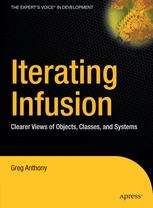
Iterating Infusion : Clearer Views of Objects, Classes, and Systems
Iterating Infusion presents comprehensive tools for you to best manage and work with object orientation. These include simplified fundamental concepts, popular language comparisons, advanced designing strategies, a broad usage progression, thorough design notations (interaction algebra), and data-oriented (fundamentally-OO) languages. The title, Iterating Infusion, alludes to the fact that any system has multiple, coexisting functional levels and that new levels—both lower and higher—are continually added to the same functional area. The practical effect is to bring processes into focus, always clarifying the vague. The extreme form of this is when separate but compatible technologies are brought together to create advancements; these can be baby-steps or great leaps, with varying amounts of effort. In more general terms, the same thing in a different context can take on much more power. And actually, this phenomenon is at the heart of object-oriented software.

IT Security Controls : A Guide to Corporate Standards and Frameworks
Gives an overview of the major standards and frameworks, and a proposed architecture to meet them. The book identifies and describes the necessary controls and processes that must be implemented in order to secure your organization's infrastructure. The book proposes a comprehensive approach to the implementation of IT security controls with an easily understandable graphic implementation proposal to comply with the most relevant market standards (ISO 27001, NIST, PCI-DSS, and COBIT) and a significant number of regulatory frameworks from central banks across the World (European Union, Switzerland, UK, Singapore, Hong Kong, India, Qatar, Kuwait, Saudi Arabia, Oman, etc.). You will learn: Understand corporate IT security controls, including governance, policies, procedures, and security awareness Know cybersecurity and risk assessment techniques such as penetration testing, red teaming, compliance scans, firewall assurance, and vulnerability scans Understand technical IT security controls for unmanaged and managed devices, and perimeter controls Implement security testing tools such as steganography, vulnerability scanners, session hijacking, intrusion detection, and more

ISSE/SECURE 2007 securing electronic business processes : Highlights of the information security solutions Europe/SECURE 2007 Conference
Presents the most interesting talks given at ISSE/SECURE 2007 - the forum for the interdisciplinary discussion of how to adequately secure electronic business processes. Adequate information security is one of the basic requirements of all electronic business processes. It is crucial for effective solutions that the possibilities offered by security technology can be integrated with the commercial requirements of the applications.
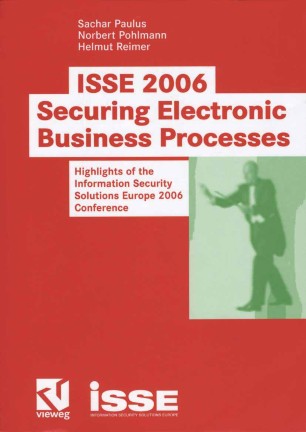
ISSE 2006 — Securing Electronic Busines Processes : Highlights of the Information Security Solutions Europe 2006 Conference
Presents the most interesting talks given at ISSE 2006 - the forum for the interdisciplinary discussion of how to adequately secure electronic business processes. The topics include: Smart Token and e-ID-Card Developments and their Application - Secure Computing and how it will change the way we trust computers - Risk Management and how to quantify security threats - Awareness raising, Data Protection and how we secure corporate information. Adequate information security is one of the basic requirements of all electronic business processes. It is crucial for effective solutions that the possibilities offered by security technology can be integrated with the commercial requirements of the applications. The reader may expect state-of-the-art: best papers of the Conference ISSE 2006.

Computation and Logic in the Real World ; 3rd Conference on Computability in Europe, CiE 2007, Siena, Italy, June 18-23, 2007, Proceedings
This volume, Computation and Logic in the Real World, is the proceedings of the third in a series of conferences of CiE Computability in Europe, (CiE) is an informal network working on computability theory including its foundations, technical development, and applications. It performed with discrete or continuous data by all kinds of algorithms, programs, and machines. The sources of new ideas and methods include practical developments in areas such as neural networks, quantum computation, natural computation, molecular computation, computational learning.
Computable Models of the Law : Languages, Dialogues, Games, Ontologies
This book originate from a workshop held at the European University Institute of Florence, Italy, in December 2006. The workshop was devoted to the discussion of the different ways of understanding and explaining contemporary law, for the purpose of building computable models of it -- especially models enabling the development of computer applications for the legal domain.
Complexity of Constraints : An Overview of Current Research Themes
This state-of-the-art survey contains the papers that were invited by the organizers after conclusion of an International Dagstuhl-Seminar on Complexity of Constraints, held in Dagstuhl Castle, Germany, in October 2006.

Complex, Intelligent, and Software Intensive Systems ; Proceedings of the 13th International Conference on Complex, Intelligent, and Software Intensive Systems (CISIS-2019)
This book presents scientific interactions between the three interwoven and challenging areas of research and development of future ICT-enabled applications: software, complex systems and intelligent systems.
Comparative genomics ; Vol.4205 ; RECOMB 2006 International Workshop, RECOMB-CG 2006, Montreal, Canada, September 24-26, 2006, Proceedings
The papers address a broad variety of aspects and components of the field of comparative genomics, ranging from new quantitative discoveries about genome structure and process to theorems on the complexity of computational problems inspired by genome comparison.
Comparative genomics ; Vol. 3388 : RECOMB 2004 International Workshop, RCG 2004, Bertinoro, Italy, October 16-19, 2004, Revised Selected Papers
This papers investigates the problem of conservation of combinatorial structures in genome rearrangement scenarios. We give a characterization of a class of scenarios that conserve all common intervals, called commuting scenarios, and a characterization of permutations for which commuting scenarios exist. We show that measuring conservation of common intervals can be useful tool in assessing the quality of rearrangement scenarios, by investigating in detail three specific scenarios involving the mouse, rat and human X chromosomes.
Comparative genomics ; RECOMB 2007, International Workshop, RECOMB-CG 2007, San Diego, CA, USA, September 16-18, 2007, Proceedings
This book provides an evolutionary conceptual framework for comparative genomics, with the ultimate objective of understanding the loss and gain of genes during evolution, the interactions among gene products, and the relationship between genotype, phenotype and the environment. The many examples in the book have been carefully chosen from primary research literature based on two criteria: their biological insight and their pedagogical merit. The phylogeny-based comparative methods, involving both continuous and discrete variables, often represent a stumbling block for many students entering the field of comparative genomics. They are numerically illustrated and explained in great detail.

Comparative genomics ; International Workshop, RECOMB-CG 2008, Paris, France, October 13-15, 2008. Proceedings
This book constitutes the refereed proceedings of the 6th RECOMB Comparative Genomics Satellite Workshop, RECOMB-CG 2008, held in Paris, France, in October 2008.

Comparative Evaluation of XML Information Retrieval Systems ; 5th International Workshop of the Initiative for the Evaluation of XML Retrieval, INEX 2006 Dagstuhl Castle, Germany, December 17-20, 2006 Revised and Selected Papers
This book covered methodology and seven additional tracks on ad-hoc, natural language processing, heterogeneous collection, multimedia, interactive, use case, as well as document mining.
Communications and Multimedia Security ; Vol.4237 ; 10th IFIP TC-6 TC 11 International Conference, CMS 2006, Heraklion Crete, Greece, October 19-21, 2006, Proceedings
Scientists, managers, and politicians all over the world havedesignedandarecurrently implementing systematicapproachesto network and information security, most of which are underlined by the principle: there is much more room for improvement and research. Along the lines of encouraging and catalyzing research in the area of c- munications and multimedia security, it is our great pleasure to present the proceedings of the 10th IFIP TC-6 TC-11 Conference on Communications and MultimediaSecurity(CMS2006), we sought a balanced program containing presentations on various aspects of secure c- munication and multimedia systems.

Communicating sequential processes : The first 25 years : Symposium on the Occasion of 25 Years of CSP, London, UK, July 7-8, 2004. Revised Invited Papers
This volume, like the symposium CSP25 which gave rise to it, commemorates the semi-jubilee of Communicating Sequential Processes. 1 Tony Hoare’s paper “Communicating Sequential Processes” is today widely regarded as one of the most in?uential papers in computer science. To comm- orate it, an event was organized under the auspices of BCS-FACS (the British Computer Society’s Formal Aspects of Computing Science specialist group). CSP25 was one of a series of such events organized to highlight the use of formal methods, emphasize their relevance to modern computing and promote their wider application.
Classification and Modeling with Linguistic Information Granules : Advanced Approaches to Linguistic Data Mining
Many approaches have already been proposed for classification and modeling in the literature. These approaches are usually based on mathematical mod els. Computer systems can easily handle mathematical models even when they are complicated and nonlinear (e.g., neural networks). On the other hand, it is not always easy for human users to intuitively understand mathe matical models even when they are simple and linear. This is because human information processing is based mainly on linguistic knowledge while com puter systems are designed to handle symbolic and numerical information. A large part of our daily communication is based on words. We learn from various media such as books, newspapers, magazines, TV, and the Inter net through words. We also communicate with others through words. While words play a central role in human information processing, linguistic models are not often used in the fields of classification and modeling. If there is no goal other than the maximization of accuracy in classification and modeling, mathematical models may always be preferred to linguistic models. On the other hand, linguistic models may be chosen if emphasis is placed on interpretability.
