



الصفحة 47
الصفحة 47

Agile processes in software engineering and extreme programming ; 9th International Conference, XP 2008, Limerick, Ireland, June 10-14, 2008. Proceedings
Constitutes the refereed proceedings of the 9th International Conference on Agile Processes in Software Engineering and eXtreme Programming, XP 2008, held in Limerick, Ireland, in June 2008.
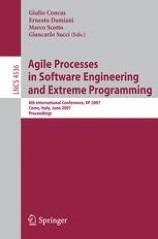
Agile processes in software engineering and extreme programming ; 8th International Conference, XP 2007, Como, Italy, June 18-22, 2007, Proceedings
Oorganized in topical sections on managing agile processes, extending agile methodologies, teaching and introducing agile methodologies, methods and tools, empirical studies, and methodology issue.

Agile Processes in Software Engineering and Extreme Programming ; 23rd International Conference on agile software development, XP 2022, Copenhagen, Denmark, June 13–17, 2022, Proceedings
Constitutes the proceedings of the 23rd International Conference on Agile Software Development, XP 2022, which was held in Copenhagen, Denmark, in June 2022. XP is the premier agile software development conference combining research and practice. It is a unique forum where agile researchers, practitioners, thought leaders, coaches, and trainers get together to present and discuss their most recent innovations, research results, experiences, concerns, challenges, and trends. XP conferences provide an informal environment to learn and trigger discussions and welcome both people new to agile and seasoned agile practitioners.

Agile Processes in Software Engineering and Extreme Programming ; 22nd International Conference on agile software development, XP 2021, Virtual Event, June 14–18, 2021, Proceedings
Constitutes the proceedings of the 22nd International Conference on Agile Software Development, XP 2021, which was held virtually during June 14-18, 2021. XP is the premier agile software development conference combining research and practice. It is a unique forum where agile researchers, practitioners, thought leaders, coaches, and trainers get together to present and discuss their most recent innovations, research results, experiences, concerns, challenges, and trends. XP conferences provide an informal environment to learn and trigger discussions and welcome both people new to agile and seasoned agile practitioners. This year’s conference was held with the theme “Agile Turns Twenty While the World Goes Online”.

Agile processes in software engineering and extreme programming ; 21st International Conference on agile software development, XP 2020, Copenhagen, Denmark, June 8–12, 2020, Proceedings
This book constitutes the proceedings of the 21st International Conference on Agile Software Development, XP 2020, which was planned to be held during June 8-12, 2020, at the IT University of Copenhagen, Denmark. However, due to the COVID-19 pandemic the conference was postponed until an undetermined date.

Agile processes in software engineering and extreme programming ; 20th International Conference, XP 2019, Montréal, QC, Canada, May 21–25, 2019, Proceedings
XP is the premier agile software development conference combining research and practice. It is a hybrid forum where agile researchers, academics, practitioners, thought leaders, coaches, and trainers get together to present and discuss their most recent innovations, research results, experiences, concerns, challenges, and trends. Following this history, for both researchers and seasoned practitioners XP 2019 provided an informal environment to network, share, and discover trends in Agile for the next 20 years.This volume presented agile adoption, agile practices; large-scale agile; agility beyond IT, and the future of agile.

Agile processes in software engineering and extreme programming ; 19th International Conference, XP 2018, Porto, Portugal, May 21–25, 2018, Proceedings
This open access book constitutes the proceedings of the 19th International Conference on Agile Software Development, XP 2018, held in Porto, Portugal, in May 2018. XP is the premier agile software development conference combining research and practice, and XP 2018 provided a playful and informal environment to learn and trigger discussions around its main theme – make, inspect, adapt. The 21 papers presented in this volume were carefully reviewed and selected from 62 submissions. They were organized in topical sections named: agile requirements; agile testing; agile transformation; scaling agile; human-centric agile; and continuous experimentation.

Agile processes in software engineering and extreme programming ; 18th International Conference, XP 2017, Cologne, Germany, May 22-26, 2017, Proceedings
The volume constitutes the proceedings of the 18th International Conference on Agile Software Development, XP 2017, held in Cologne, Germany, in May 2017.The 14 full and 6 short papers presented in this volume were carefully reviewed and selected from 46 submissions. They were organized in topical sections named: improving agile processes; agile in organization; and safety critical software. In addition, the volume contains 3 doctoral symposium papers

Agile processes in software engineering and extreme programming ; XP 2020 Workshops, Copenhagen, Denmark, June 8–12, 2020, Revised Selected Papers
This book constitutes the 6 research workshops, the Agile Education and Training Track, the Doctoral Symposium, as well as a panel presented at XP 2020, the 21st International Conference on Agile Software Development, which was held during June 8-12, 2020.
Agile processes in software engineering and extreme programming : XP 2022 workshops, Copenhagen, Denmark, June 13-17, 2022 and XP 2023 workshops, Amsterdam, the Netherlands, June 13-16, 2023 : revised selected papers
Book constitutes papers from the research workshops presented at XP 2022 and XP 2023, respectively the 23rd and 24th International Conferences on Agile Software Development, held on June 13-17, 2022 at the IT University of Copenhagen, Denmark and June 13-16, 2023 in Amsterdam, Netherlands.

Agent-oriented software engineering VIII ; 8th International Workshop, AOSE 2007, Honolulu, HI, USA, May 14, 2007, Revised Selected Papers
This volume constitutes the thoroughly refereed proceedings of the 8th International Workshop on Agent-Oriented Software Engineering, AOSE 2007, held in Honolulu, Hawaii in May 2007 as part of AAMAS 2007.
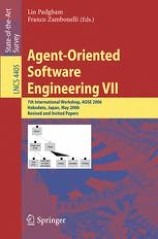
Agent-oriented software engineering VII ; 7th International Workshop, AOSE 2006, Hakodate, Japan, May 8, 2006, Revised and Invited Papers
Software architectures that contain many dynamically interacting components, each with their own thread of control, and engaging in complex coordination protocols, are difficult to correctly and efficiently engineer. Agent-oriented modelling techniques are important for supporting the design and development of such applications.The book is organized in topical sections on modelling and design of agent systems, modelling open agent systems, formal reasoning about designs, as well as testing, debugging and evolvability.

Agent-oriented software engineering VI ; 6th International Workshop, AOSE 2005, Utrecht, The Netherlands, July 25, 2005. Revised and Invited Papers
This book represents the thoroughly refereed post-proceedings of the 6th International Workshop on Agent-Oriented Software Engineering, AOSE 2005, held in Utrecht, The Netherlands, in July 2005 as part of AAMAS 2005. The 18 revised full papers were carefully selected from 35 submissions during two rounds of reviewing and improvement. The papers are organized in topical sections on modeling tools, analysis and validation tools, multiagent systems design, implementation tools, and experiences and comparative evaluations.

Agent-oriented software engineering V ; 5th International workshop, AOSE 2004, New York, NY, USA, July 2004, revised selected papers
The explosive growth of application areas such as electronic commerce, ent- prise resource planning and mobile computing has profoundly and irreversibly changed our views on software systems. Nowadays, software is to be based on open architectures that continuously change and evolve to accommodate new components and meet new requirements. Software must also operate on di?- ent platforms, without recompilation, and with minimal assumptions about its operating environment and its users. Furthermore, software must be robust and ¨ autonomous, capable of serving a naive user with a minimum of overhead and interference. Agent concepts hold great promise for responding to the new realities of software systems. They o?er higher-level abstractions and mechanisms which address issues such as knowledge representation and reasoning, communication, coordination, cooperation among heterogeneous and autonomous parties, p- ception, commitments, goals, beliefs, and intentions, all of which need conceptual modelling. On the one hand, the concrete implementation of these concepts can lead to advanced functionalities.

Agent-oriented information systems IV ; 8th International bi-conference workshop, AOIS 2006, Hakodate, Japan, May 9, 2006 and Luxembourg, Luxembourg, June 6, 2006, Revised Selected Papers
In AOIS, we focus on the application of agent technology in information systems development and explore the potential for facilitating the increased usage of agent technology in the creation of information systems in the widest sense.
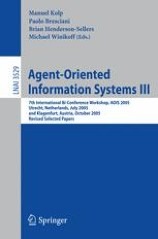
Agent-oriented information systems III ; 7th International bi-conference workshop, AOIS 2005, Utrecht, The Netherlands, July 26, 2005, and Klagenfurt, Austria, October 27, 2005, Revised Selected Papers
In 2005, two AOIS workshops were held internationally. The first was affiliated with the AAMAS 2005 meeting in July in Utrecht in The Netherlands and chaired by Henderson-Sellers and Winikoff and the second with ER 2005 in November in Klagenfurt in Austria and chaired by Kolp and Bresciani. The best papers from these meetings were identified and authors invited to revise and possibly extend their papers in the light of reviewers’ comments and feedback at the workshop. We have grouped these papers loosely under four headings: Agent behavior, communications and reasoning; Methodologies and ontologies; Agent-oriented software engineering; and Applications.

Agent-mediated electronic commerce VI ; Theories for and engineering of distributed mechanisms and systems, AAMAS 2004 Workshop, Amec 2004, New York, NY, USA, July 19, 2004, revised selected papers
The design of intelligent trading agents, mechanisms, and systems has receivedgrowing atttention in the agents and multiagent systems communities in aneffort to address the increasing costs of search, transaction, and coordinationwhich follows from the increasing number of Internet-enabled distibuted elec-tronic markets. Furthermore, new technologies and supporting business modelsare resulting in a growing volume of open and horizontally integrated markets fortrading of an increasingly diverse set of goods and services. However, growth oftechnologies for such markets requires innovative solutions to a diverse set of ex-isting and novel technical problems which we are only beginning to understand.Specifically, distributed markets present not only traditional
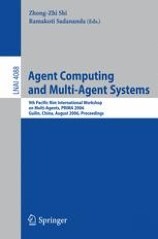
Agent Computing and Multi-Agent Systems ; 9th Pacific Rim International Workshop on Multi-Agents, PRIMA 2006, Guilin, China, August 7-8, 2006, Proceedings
PRIMA is a series of workshops on agent computing and multi-agent systems, integrating the activities in Asia and Pacific Rim countries. Agent computing and multi-agent systems are computational systems in which several autonomous or se- autonomous agents interact with each other or work together to perform some set of tasks or satisfy some set of goals. These systems may involve computational agents that are homogeneous or heterogeneous, they may involve activities on the part of agents having common or distinct goals, and they may involve participation on the part of humans and intelligent agents. The aim of PRIMA 2006 was to bring together Asian and Pacific Rim researchers and developers from academia and industry to report on the latest technical advances or domain applications and to discuss and explore scientific and practical problems as raised by the participants. PRIMA 2006 received 203 submitted papers.
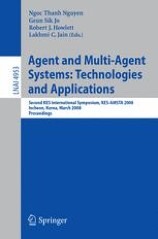
Agent and Multi-Agent Systems : Technologies and Applications ; 2nd KES International Symposium, KES-AMSTA 2008, Incheon, Korea, March 26-28, 2008. Proceedings
The KES-AMSTA Symposium Series is a sub-series of the KES Conference Series. The aim of the symposium was to provide an international forum for scientific research into the technologies and applications of agent and multi-agent systems.

Agent and multi-agent systems : Technologies and applications ; 1st KES International Symposium, KES-AMSTA 2007, Wroclaw, Poland, May 31-June 1, 2007, Proceedings
The aim of the symposium was to provide an international forum for scientific - search in the technologies and applications of agent and multi-agent systems. Agents and multi-agent systems are related to the modern software which has long been r- ognized as a promising technology for constructing autonomous, complex and intel- gent systems. A key development in the field of agent and multi-agent systems has been the specification of agent communication languages and formalization of - tologies. Agent communication languages are intended to provide standard decla- tive mechanisms for agents to communicate knowledge and make requests of each other, whereas ontologies are intended for conceptualization of the knowledge - main.
