



الصفحة 45
الصفحة 45
Foundations of information and knowledge systems ; 5th International Symposium, FoIKS 2008, Pisa, Italy, February 11-15, 2008. Proceedings
This book constitutes the refereed proceedings of the 5th International Symposium on Foundations of Information and Knowledge Systems, FoIKS 2008 held in Pisa, Italy, in February 2008. The 13 revised full papers presented together with 9 revised short papers and 3 invited lectures were carefully selected during two rounds of reviewing and improvement from from 79 submissions. The papers deal with any foundational aspect of information and knowledge systems, including submissions from researchers working in fields such as discrete mathematics, logic and algebra, model theory, information theory, complexity theory, algorithmics and computation, geometry, analysis, statistics and optimisation who are interested in applying their ideas, theories and methods to research on information and knowledge systems.

Foundations of information and knowledge systems ; 4th International Symposium, FoIKS 2006, Budapest, Hungary, February 14-17, 2006, Proceedings
This book constitutes the refereed proceedings of the 4th International Symposium on Foundations of Information and Knowledge Systems, held in February 2006. The 14 revised full papers presented together with three revised short papers and one invited paper were carefully reviewed and selected from 54 submissions. Among the topics covered are the theoretical foundations of information and knowledge systems, as well as mathematical fields such as discrete mathematics, combinatorics, logics and finite model theory, and applications thereof for research on database and knowledge base theory.

Foundations of Genetic Algorithms ; 9th International Workshop, FOGA 2007, Mexico City, Mexico, January 8-11, 2007, Revised Selected Papers
Readers will find here a fascinating text that is the thoroughly refereed post-proceedings of the 9th Workshop on the Foundations of Genetic Algorithms, FOGA 2007, held in Mexico City in January 2007.

Foundations of genetic algorithms ; 8th International Workshop, FOGA 2005, Aizu-Wakamatsu City, Japan, January 5-9, 2005, Revised Selected Papers
The8thWorkshopontheFoundationsofGeneticAlgorithms,FOGA-8,washeld at the University of Aizu in Aizu-Wakamatsu City, Japan, January 5–9, 2005. This series of workshops was initiated in 1990 to encourage further research on the theoretical aspects of genetic algorithms, and the workshops have been held biennially ever since. The papers presented at these workshops are revised, edited and published as volumes during the year following each workshop. This series of (now eight) volumes provides an outstanding source of reference for the theoretical work in this ?eld. At the same time this series of volumes provides a clear picture of how the theoretical research has grown and matured along with the ?eld to encompass many evolutionary computation paradigms including evolution strategies (ES), evolutionary programming (EP), and genetic programming (GP), as well as the continuing growthininteractionswith other ?elds suchas mathematics,physics, and biology.

Foundations of generic optimization : Vol.1 : A combinatorial approach to epistasis
This is a comprehensive overview of the basics of fuzzy control, which also brings together some recent research results in soft computing, in particular fuzzy logic using genetic algorithms and neural networks. This book offers researchers not only a solid background but also a snapshot of the current state of the art in this field.

Foundations of fuzzy logic and soft computing ; 12th International Fuzzy Systems Association World Congress, IFSA 2007, Cancun, Mexico, Junw 18-21, 2007, Proceedings
This book comprises a selection of papers from IFSA 2007 on new methods and theories that contribute to the foundations of fuzzy logic and soft computing. methodologies. Soft computing consists of several computing paradigms which can be used to produce powerful intelligent systems for solving real-world problems.

Foundations of Data Mining and Knowledge Discovery
This volume presents the results of investigations into the foundations of the discipline, and represents the state-of-the-art for much of the current research. This book will prove extremely valuable and fruitful for data mining researchers, no matter whether they would like to uncover the fundamental principles behind data mining, or apply the theories to practical applications.
Foundations of Computer Security
Foundations of Computer Security provides a succinct, yet authoritative introduction to the underlying theory, history, vocabulary, and concepts that drive this pivotal area of computer science. With its user-friendly approach and clarity of style, the text conveys—in simple terms—the core principles and developments underlying computer security in its many ramifications in the rapidly evolving computing arena. Following its opening framework laid out in a broad preface and introductory chapter, the book features chapters dedicated to a wide array of security-related subtopics: physical security, viruses and worms, malware and spyware, privacy and trust, and cryptography.
Foundations of augmented cognition ; 3rd International Conference, FAC 2007, Held as Part of HCI International 2007, Beijing, China, July 22-27, 2007, Proceedings
These papers address the latest research and development efforts and highlight the human aspects of design and use of computing systems. This volume contains papers in the thematic area of Augmented Cognition.

Foundations of 3D Graphics Programming : Using JOGL and Java3D ; 2nd ed.
This thoroughly updated and enhanced second edition of Foundations of 3D Graphics Programming is an innovative shortcut to graphics theory and programming using JOGL, a new vehicle of 3D graphics programming in Java. This revised edition of the successful, reader-friendly text covers all graphics basics and several advanced topics, as well as some basic concepts in Java programming for those who currently are C/C++ programmers. Specifically, it provides all the core aspects of OpenGL programming in Java using JOGL, along with concisely presented computer graphics theories. In addition, it uses a top-down approach to lead the reader into programming and applications up-front. The content about theory provides a high-level understanding of all basic graphics, and of using JOGL instead of implementing a graphics system. Explanations are integrated with the sample programs, which are specifically designed for learning and accompanying this book.
Foundation of semantic web technologies
Concentrates on Semantic Web technologies standardized by the World Wide Web Consortium: RDF and SPARQL enable data exchange and querying, RDFS and OWL provide expressive ontology modeling, and RIF supports rule-based modeling. The text also describes methods for specifying, querying, and reasoning with ontological information. In addition, it explores topics that are clearly beyond foundations, such as tools, applications, and engineering aspects.
Foundation models for natural language processing : pre-trained language models integrating media
Covers basic natural language processing models, pre-trained language models BERT, GPT, and sequence-to-sequence converters, as well as the concepts of self-attention and context-sensitive embedding. Various approaches to improving these models are then discussed, such as expanding the pre-training parameters, increasing the length of input texts, or incorporating additional knowledge. An overview of the best performing models is then provided for about twenty application areas, e.g., question answering, translation, story generation, dialogue systems, image generation from text, etc. For each application area, the strengths and weaknesses of existing models are discussed, and an overview of further developments is provided. In addition, links to freely available code are provided. The concluding chapter summarizes the economic opportunities, risk mitigation, and potential developments of AI.

Foundation Mathematics for Computer Science : A Visual Approach
In this second edition of Foundation Mathematics for Computer Science, John Vince has reviewed and edited the original book and written new chapters on combinatorics, probability, modular arithmetic and complex numbers. These subjects complement the existing chapters on number systems, algebra, logic, trigonometry, coordinate systems, determinants, vectors, matrices, geometric matrix transforms, differential and integral calculus. During this journey, the author touches upon more esoteric topics such as quaternions, octonions, Grassmann algebra, Barrycentric coordinates, transfinite sets and prime numbers.

Foundation Form Creation with Adobe LiveCycle Designer ES
Form creation is key to information processing and forms workflow is a key concept within Adobe LiveCycle Enterprise Suite. Adobe LiveCycle Forms ES is a stand-alone product that also comes bundled with Adobe LiveCycle Enterprise Suite. This is the first and only book about this new product specifically created for the design, creation, and processing of dynamically interactive forms. Foundation Form Creation with Adobe LiveCycle Designer ES is written for users of all abilities, with introductory material for beginners and advanced techniques for more experienced users. It discusses both the best-practices of designing forms that work and the specifics of implementing them efficiently for data collection—the full life cycle of working with forms.
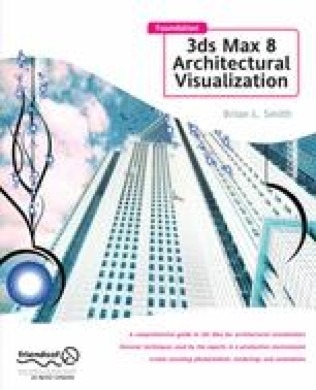
Foundation 3ds Max 8 Architectural Visualization
Welcome to the world of 3D architectural visualizations using the most powerful and versatile 3D software package on the planet: 3ds Max. In just the last few years, the visualization industry has arguably become the fastest-growing 3D industry, and may soon overtake all others in total number of users. Just as the use of computer-aided design became the norm for nearly all architectural, engineering, and construction firms in the 1990s, 3D visualizations have become standard practice today. This book takes you through the challenge of learning one of the most complex computer programs ever created, by way of easy-to-follow tutorials and instruction. It specifically focuses on those parts of the program you need to know to produce stunning architectural visualizations.
Form-oriented analysis : A new methodology to model form-based applications
Form-based applications range from simple web shops to complex enterprise resource planning systems. Draheim and Weber adapt well-established basic modeling techniques in a novel way to achieve a modeling framework optimized for this broad application domain. They introduce new modeling artifacts, such as page diagrams and form storyboards, and separate dialogue patterns to allow for reuse. In their implementation they have developed new constructs such as typed server pages, and tools for forward and reverse engineering of presentation layers. The methodology is explained using an online bookshop as a running example in which the user can experience the modeling concepts in action. The combination of theoretical achievements and hands-on practical advice and tools makes this book a reference work for both researchers in the areas of software architectures and submit-response style user interfaces, and professionals designing and developing such applications. More information and additional material is also available online.
Formal Techniques for Networked and Distributed Systems - FORTE 2008 ; 28th IFIP WG 6.1 International Conference Tokyo, Japan, June 10-13, 2008 Proceedings
This book constitutes the refereed proceedings of the 28th IFIP WG 6.1 International Conference on Formal Techniques for Networked and Distributed Systems, FORTE 2008, held in Tokyo, Japan, in June 2008 co-located with TestCom/FATES 2008.The 19 revised full papers and 1 revised short paper presented together with 1 invited talk were carefully reviewed and selected from 44 submissions. The papers cover new approaches, concepts and experience in the application of formal methods for the specification and verification of distributed systems and applications.
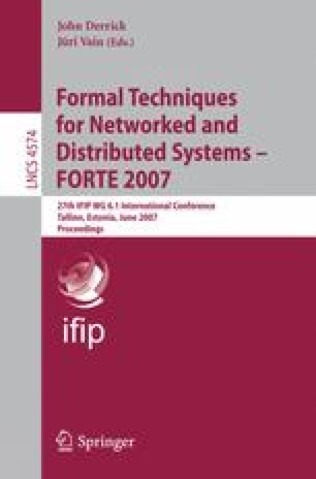
Formal Techniques for Networked and Distributed Systems – FORTE 2007 ; 27th IFIP WG 6.1 International Conference, Tallinn, Estonia, June 27-29, 2007, Proceedings
These proceedings contain papers from the 27th FORTE conference. FORTE (Formal Techniques for Networked and Distributed Systems) is the joint int- national annual conference combining the former PSTV (Protocol Speci?cation Testing and Veri?cation) and former FORTE (Formal Description Techniques for Distributed Systems and Communication Protocols) conferences.
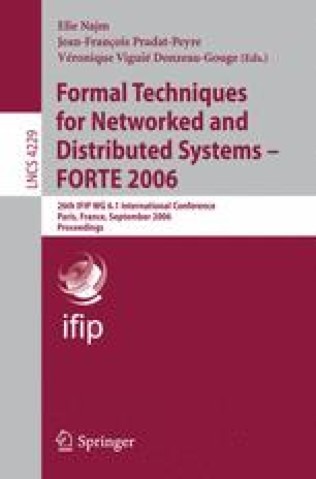
Formal Techniques for Networked and Distributed Systems - FORTE 2006 ; 26th IFIP WG 6.1 International Conference, Paris, France, September 26-29, 2006, Proceedings
This book constitutes the refereed proceedings of the 26th IFIP WG 6.1 International Conference on Formal Techniques for Networked and Distributed Systems, FORTE 2006, held in Paris, France, in September 2006. The 26 revised full papers and 4 short papers presented together with 3 invited lectures were carefully reviewed and selected from 177 submissions. The papers focus on the construction of middleware and services using formalised and verified approaches.
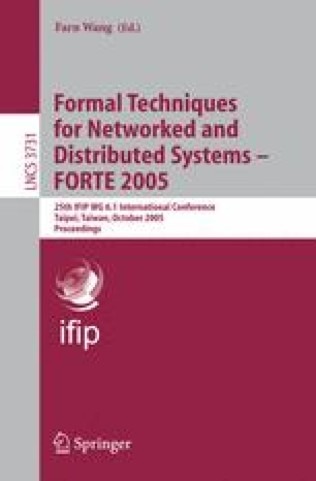
Formal techniques for networked and distributed systems - FORTE 2005 ; 25th IFIP WG 6.1 International Conference, Taipei, Taiwan, October 2-5, 2005, Proceedings
FORTE (Formal Techniques for Networked and Distributed Systems) 2005 was sp- sored by Working Group 6.1, Technical Committee 6 (TC6) of the International Fed- ation for InformationProcessing (IFIP).The conferenceseries started in 1981underthe name PSTV (ProtocolSpeci?cation, Testing, and Veri?cation).In 1988,a second series under the name FORTE was started. Both series merged to FORTE/PSTV in 1996. The conference name was changed to FORTE in 2001. During its 24-year history, many important contributions have been reported in the conference series. The last ?ve me- ings of FORTE were held in Pisa (Italy), Cheju Island (Korea), Houston (USA), Berlin (Germany), and Madrid (Spain). The 25th FORTE was held from Sunday to Wednesday, October 2–5, 2005 on the beautiful campus of the National Taiwan University (NTU), Taipei, Taiwan, ROC.
