



الصفحة 4
الصفحة 4
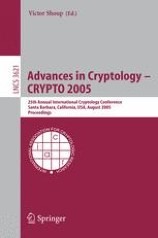
Advances in cryptology - CRYPTO 2005 ; 25th Annual International cryptology conference, Santa Barbara, California, USA, August 14-18, 2005, Proceedings
Constitutes the refereed proceedings of the 25th Annual International Cryptology Conference, CRYPTO 2005, held in Santa Barbara, California, USA in August 2005. this book includ topics : Coding and Information Theory / Cryptology / Computer Communication Networks / Operating Systems / Discrete Mathematics in Computer Science / Computers and Society"
Advances in cryptology – ASIACRYPT 2007 ; 13th International conference on the theory and application of cryptology and information security, Kuching, Malaysia, December 2-6, 2007, Proceedings
The book are organized in topical sections on number theory and elliptic curve, protocol, hash function design, group/broadcast cryptography, mac and implementation, multiparty computation, block ciphers, foundation, public key encryption, and cryptanalysi.
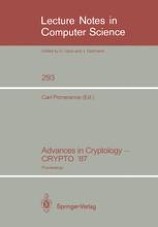
Advances in cryptology - CRYPTO -87 ; Conference on the theory and applications of cryptographic techniques : Proceedings
Zero-knowledge interactive proofsystems are a new technique which can be used as a cryptographic tool for designing provably secure protocols. Goldwasser, Micali, and Rackoff originally suggested this technique for controlling the knowledge released in an interactive proof of membership in a language, and for classification of languages. In this approach, knowledge is defined in terms of complexity to convey knowledge if it gives a computational advantage to the receiver, theory, and a message is said for example by giving him the result of an intractable computation. The formal model of interacting machines is described in. A proof-system (for a language L) is an interactive protocol by which one user, the prover, attempts to convince another user, the verifier, that a given input x is in L. We assume that the verifier is a probabilistic machine which is limited to expected polynomial-time computation, while the prover is an unlimited probabilistic machine.
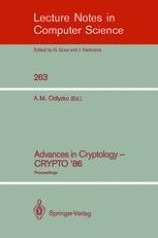
Advances in cryptology - CRYPTO -86 ; Conference on the theory and applications of cryptographic techniques : Proceedings
This book is the proceedings of CRYPTO 86, one in a series of annual conferences devoted to cryptologic research. They have all been held at the University of California at Santa Barbara. The first conference in this series, CRYPTO 81, organized by A. Gersho, did not have a formal proceedings. The proceedings of the following four conferences in this series have been published as: Advances in Cryptology: Proceedings of Crypto 82, D. Chaum, R. L. Rivest, and A. T. Sherman, eds., Plenum, 1983. Advances in Cryptology: Proceedings of Crypto 83, D. Chaum, ed., Plenum, 1984. Advances in Cryptology: Proceedings of CRYPTO 84, G. R. Blakley and D. Chaum, eds., Lecture Notes in Computer Science #196, Springer, 1985. Advances in Cryptology - CRYPTO '85 Proceedings, H. C. Williams, ed., Lecture Notes in Computer Science #218, Springer, 1986. A parallel series of conferences is held annually in Europe. The first of these had its proceedings published as Cryptography: Proceedings, Burg Feuerstein 1982, T. Beth, ed., Lecture Notes in Computer Science #149, Springer, 1983.
Advanced encryption standard - AES ; 4th International Conference, AES 2004, Bonn, Germany, May 10-12, 2004, Revised Selected and Invited Papers
This volume comprises the proceedings of the 4th Conference on Advanced En-cryption Standard, ‘AES — State of the Crypto Analysis,’ which was held inBonn, Germany, 2004.The conference followed a series of events organized by the US National In-stitute of Standards and Technology (NIST) in order to hold an internationalcompetition to decide on an algorithm to serve as the Advanced EncryptionStandard (AES). In 1998, at the first AES conference (AES 1), 15 different algo-rithms were presented, discussed, reviewed and verified. After a further conferencedevoted to verification, testing and examination of the candidate algorithms inorder to prove their performance and security, one winning algorithm remained.The encryption scheme Rijndael, designed by the Belgian cryptographers JoanDaemen and Vincent Rijmen, was selected in 2000 to become the successor tothe famous DES (Data Encryption Standard) and it is now the Advanced En-cryption Standard.
