



الصفحة 4
الصفحة 4

Languages and Compilers for Parallel Computing ; 18th International Workshop, LCPC 2005, Hawthorne, NY, USA, October 20-22, 2005, Revised Selected Papers
This book constitutes the thoroughly refereed post-proceedings of the 18th International Workshop on Languages and Compilers for Parallel Computing, LCPC 2005, held in Hawthorne, NY, USA in October 2005. The 26 revised full papers and eight short papers presented were carefully selected during two rounds of reviewing and improvement.

Languages and Compilers for High Performance Computing ; 17th International Workshop, LCPC 2004, West Lafayette, IN, USA, September 22-24, 2004, Revised Selected Papers
Cetus is a compiler infrastructure for the source-to-source transformation of programs. Since its creation nearly three years ago, it has grown to over 12,000 lines of Java code, been made available publically on the web, and become a basis for several research projects. We discuss our experience using Cetus for a selection of these research projects. The focus of this paper is not the projects themselves, but rather how Cetus made these projects possible, how the needs of these projects influenced the development of Cetus, and the solutions we applied to problems we encountered with the infrastructure. We believe the research community can benefit from such a discussion, as shown by the strong interest in the mini-workshop on compiler research infrastructures where some of this information was first presented.

Language and Automata Theory and Applications ; 2nd International Conference, LATA 2008, Tarragona, Spain, March 13-19, 2008. Revised Papers
This book constitutes the refereed proceedings of the Second International Conference on Language and Automata Theory and Applications, LATA 2008, held in Tarragona, Spain, in March 2008.The 40 revised full papers presented were carefully reviewed and selected from 134 submissions. The papers deal with the various issues related to automata theory and formal languages
Java 17 Recipes : A Problem-Solution Approach
Quickly find solutions to dozens of common programming problems encountered while building Java applications, with recipes presented in the popular problem-solution format. Look up the programming problem that you want to resolve. Read the solution. Apply the solution directly in your own code. Problem solved! covers of some of the newest features, APIs, and more such as pattern matching for switch, Restore Always-Strict-Floating-Point-Semantics, enhanced pseudo-random number generators, the vector API, sealed classes, and enhancements in the use of String. Source code for all recipes is available in a dedicated GitHub repository. This must-have reference belongs in your library. You will learn : Look up solutions to everyday problems involving Java SE 17 LTS and other recent releases / Develop Java SE applications using the latest in Java SE technology / Incorporate Java major features introduced in versions 17, 16, and 15 into your code

Java 17 Quick Syntax Reference : A Pocket Guide to the Java SE Language, APIs, and Library
Packed with useful information and is a must-have for any Java programmer. You will: Run a Java file with a single command / Learn what a switch expression is and how to use it / Use pattern matching / Code with Java modules / Create text blocks to handle multiline strings / Learn what sealed classes are and how to use these and more
Component-based software engineering ; 11th International Symposium, CBSE 2008, Karlsruhe, Germany, October 14-17, 2008. Proceedings
This book constitutes the refereed proceedings of the 11th International ACM SIGSOFT Symposium on Component-Based Software Engineering, CBSE 2008, held in Karlsruhe, Germany in October 2008.
Compilers : Principles, techniques, and tools
This introduction to compilers is the direct descendant of the well-known book by Aho and Ullman, Principles of Compiler Design. The authors present updated coverage of compilers based on research and techniques that have been developed in the field over the past few years. The book provides a thorough introduction to compiler design and covers topics such as context-free grammars, fine state machines, and syntax-directed translation.
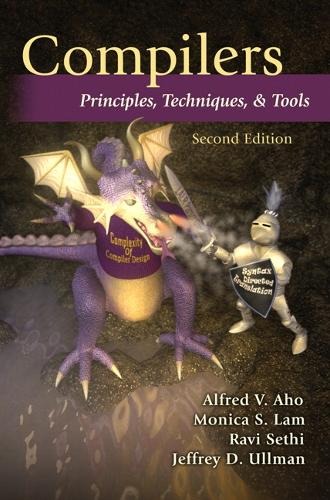
Compilers : Principles, techniques & tools
This introduction to compilers is the direct descendant of the well-known book by Aho and Ullman, Principles of Compiler Design. The authors present updated coverage of compilers based on research and techniques that have been developed in the field over the past few years. The book provides a thorough introduction to compiler design and covers topics such as context-free grammars, fine state machines, and syntax-directed translation.
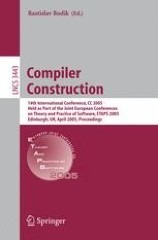
Compiler construction ; Vol. 3443 : 14th International Conference, CC 2005, Held as Part of the Joint European Conferences on Theory and Practice of Software, ETAPS 2005, Edinburgh, UK, April 4-8, 2005. Proceedings
"This book constitutes the refereed proceedings of 14th International Conference, CC 2005, Held as Part of the Joint European Conferences on Theory and Practice of Software, ETAPS 2005, including Topics Programming Languages, Compilers, Interpreters Logics and Meanings of Programs / Mathematical Logic and Formal Languages / Software Engineering / Artificial Intelligence"
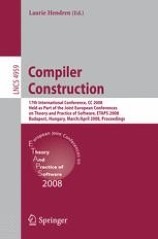
Compiler construction ; 17th International Conference, CC 2008, Held as Part of the Joint European Conferences on Theory and Practice of Software, ETAPS 2008, Budapest, Hungary, March 29 - April 6, 2008. Proceedings
This book constitutes the proceedings of the 17th International Conference on Compiler Construction, CC 2008. It covers analysis and transformations, compiling for parallel architectures, runtime techniques and tools, analyses, and atomicity and transactions.
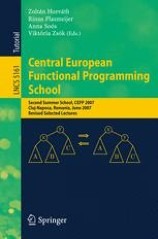
Central European Functional Programming School : 2nd Summer School, CEFP 2007, Cluj-Napoca, Romania, June 23-30, 2007, Revised Selected Lectures
This volume presents texts from selected lectures given by leading researchers at the Second Central European Functional Programming School, CEFP 2007, held in Cluj-Napoca, Romania, in June 2007.

C# 10 Quick Syntax Reference : A Pocket Guide to the Language, APIs, and Library
Reviews the essential C# 10 and earlier syntax, not previously covered, in a well-organized format that can be used as a handy reference. Specifically, unions, generic attributes, CallerArgumentExpression, params span, Records, Init only setters, Top-level statements, Pattern matching enhancements, Native sized integers, Function pointers and more. You will: Employ nullable reference types / Work with ranges and indices / Apply recursive patterns to your applications / Use switch expressions

Beginning PyQt : A hands-on approach to GUI programming with PyQt6
Learn GUI application development from the ground up by building simple projects that teach the fundamentals of using PyQt6. This 2nd edition includes updated code, programs, and new chapters to get you started using the newest version. Taking a practical approach, each chapter will gradually teach more advanced and diverse concepts to aid you in designing and customizing interesting and professional applications. Using this knowledge, you’ll be able to build a photo editor, games, a text editor, a working web browser, and an assortment of other GUIs. In the end, this book will guide you through the process of creating UIs to help you bring your own ideas to life. Find out what you need to begin making your own applications with PyQt! You will: Develop cross-platform UIs with PyQt and Python / Use PyQt’s many widgets and apply them by building real applications / Build larger applications through a step-by-step approach and break the code into smaller chunks for deeper understanding / Work with more complex applications in PyQt, covering SQL databases, multithreading, web browsers, and more / Create modern-looking UIs with Qt Quick and QtQml using the latest version of PyQt
Beginning IntelliJ IDEA : Integrated development environment for Java programming
Shows you how to leverage IntelliJ’s tools to develop clean, efficient Java applications. The last portion of the book focuses on application testing and deployment, and language- and framework- specific guidelines. After reading this book and working through its freely available source code, you'll be up to speed with this powerful IDE for today's Java development. You will: Use IntelliJ IDEA to build Java applications / Set up your IDE and project / Work with source code / Extend your Java application to data science and other kinds of applications / Test and deploy your application and much more
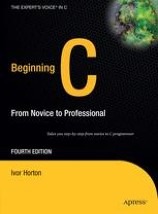
Beginning C : From novice to professional
With Beginning C: From Novice to Professional, Fourth Edition, you'll come to understand the fundamentals of the C language and learn how to program. All you need is this book and any one of the widely available free or commercial C or C++ compilers, and you'll soon be writing real C programs. You'll learn C from the first principles.
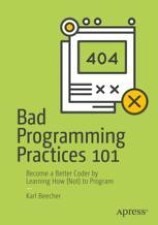
Bad programming practices 101 : Become a better coder by learning how (Not) to program
Takes a humorous slant on the programming practice manual by reversing the usual approach: under the pretence of teaching you how to become the world’s worst programmer who generally causes chaos, the book teaches you how to avoid the kind of bad habits that introduce bugs or cause code contributions to be rejected.
Automatic program development : A tribute to Robert Paige
This work, a tribute to renowned researcher Robert Paige, is a collection of revised papers published in his honor in the Higher-Order and Symbolic Computation Journal in 2003 and 2005. The book also includes some papers by members of the IFIP Working Group 2.1 of which Bob was an active member.
Automated technology for verification and analysis ; 6th International Symposium, ATVA 2008, Seoul, Korea, October 20-23, 2008. Proceedings
This book constitutes the refereed proceedings of the 6th International Symposium on Automated Technology for Verification and Analysis, ATVA 2008, held in Seoul, Korea, in October 2008.
Architecture of computing systems ; 34th International Conference, ARCS 2021, Virtual Event, June 7–8, 2021, Proceedings
This book constitutes the proceedings of the 34th International Conference on Architecture of Computing Systems, ARCS 2021, held virtually in July 2021. The 12 full papers in this volume were carefully reviewed and selected from 24 submissions. 2 workshop papers (VEFRE) are also included. ARCS has always been a conference attracting leading-edge research outcomes in Computer Architecture and Operating Systems, including a wide spectrum of topics ranging from fully integrated, self-powered embedded systems up to high-performance computing systems. It also provides a platform covering newly emerging and cross-cutting topics, such as autonomous and ubiquitous systems, reconfigurable computing and acceleration, neural networks and artificial intelligence. The selected papers cover a variety of topics from the ARCS core domains, including heterogeneous computing, memory optimizations, and organic computing.
Algebraic Methodology and Software Technology ; 12th International Conference, AMAST 2008 Urbana, IL, USA, July 28-31, 2008 Proceedings
This book constitutes the refereed proceedings of the 12th International Conference on Algebraic Methodology and Software Technology, AMAST 2008, held in Urbana, IL, USA, in July 2008.
