



الصفحة 3
الصفحة 3

Deep learning methods for converting speech to text = تقنيات التعلم العميق في تحويل الصوت إلى نص
Aims to design and develop a system capable of extracting audio content from films and audio recordings and converting it into text using deep learning techniques. This is done by analyzing audio patterns, extracting sounds and words from the video, and then converting them into written text. Deep learning, a branch of artificial intelligence, is used to accomplish this task. The study also includes comparing different deep learning techniques to determine their effectiveness in this context.
COTS-Based software systems ; 4th International Conference, ICCBSS 2005, Bilbao, Spain, February 7-11, 2005, Proceedings
The theme “Build and Conquer” : software development is an engineering discipline, and not an artistic expression. Once we are ready to “build” our software systems using pieces previously builtin (similar to any other technology manufacturer), we will be able to “conquer” the software engineering process. If we take a look at other engineering disciplines such as car manufacturing, house appliances or aeronautics, we see that the final products are built through the integration of multiprovider commercial components. These components are successfully integrated and constitute an important part of the final product. Most software-related organizations still build software from scratch, omitting thousands of ready-built commercially available software components that could be used very effectively during the development phase. This year ICCBSS moves to Europe for the first time since the first conference took place in Orlando, FL, USA in 2002. The conference scope has enlarged over the years to include the Open Source community and Web Services technologies. so many of the characteristics of COTS are also applied to Open Source and Web Services.

Constraint solving and language processing
Contains selected and thoroughly revised papers plus contributions from invited speakers presented at the First International Workshop on C- straint Solving and Language Processing, held in Roskilde, Denmark, September 1–3, 2004. Constraint Programming and Constraint Solving, in particular Constraint Logic Programming, appear to be a very promising platform, perhaps the most promising present platform, for bringing forward the state of the art in natural language processing, this due to the naturalness in speci?cation and the direct relation to e?cient implementation. Language, in the present context, may - fer to written and spoken language, formal and semiformal language, and even general input data to multimodal and pervasive systems, which can be handled in very much the same ways using constraint programming. The notion of constraints, with slightly differing meanings, apply in the characterization of linguistic and cognitive phenomena, in formalized linguistic m- els as well as in implementation-oriented frameworks. Programming techniques for constraint solving have been, and still are, in a period with rapid devel- ment of new eficient methods and paradigms from which language processing can prompt. A common metaphor for human language processing is one big c- straint solving process in which the differently specified linguistic and cognitive phases take place in parallel and with mutual cooperation, which ?ts quite well with current constraint programming paradigms.

Computing Characterizations of Drugs for Ion Channels and Receptors Using Markov Models
Flow of ions through voltage gated channels can be represented theoretically using stochastic differential equations where the gating mechanism is represented by a Markov model. The flow through a channel can be manipulated using various drugs, and the effect of a given drug can be reflected by changing the Markov model. These lecture notes provide an accessible introduction to the mathematical methods needed to deal with these models. They emphasize the use of numerical methods and provide sufficient details for the reader to implement the models and thereby study the effect of various drugs. Examples in the text include stochastic calcium release from internal storage systems in cells, as well as stochastic models of the transmembrane potential. Well known Markov models are studied and a systematic approach to including the effect of mutations is presented.

Computer-Aided Design of User Interfaces V ; Proceedings of the 6th International Conference on Computer-Aided Design of User Interfaces CADUI '06 (6-8 June 2006, Bucharest, Romania)
Today, the development life cycle of 3D User Interfaces (UIs) mostly remains an art more than a principled-based approach. Several methods [1,3,7,8,9,10,11,15,17,18,19] have been introduced to decompose this life cycle into steps and sub-steps, but these methods rarely provide the design knowledge that should be typically used for achieving each step. In addition, the development life cycle is more focusing directly on the programming - sues than on the design and analysis phases. This is sometimes reinforced by the fact that available tools for 3D UIs are toolkits, interface builders, r- dering engines, etc. When there is such a development life cycle defined, it is typically structured into the following set of activities: 1. The conceptual phase is characterized by the identification of the content and interaction requests. The meta-author discusses with the interface designer to take advantage of the current interaction technology. The int- face designer receives information about the content. The result of this phase is the production of UI schemes (e. g. , written sentences, visual schemes on paper) for defining classes of interactive experiences (e. g. , class Guided tour). Conceptual schemes are produced both for the final users and the authors. The meta-author has a deep knowledge of the c- tent domain and didactic skills too. He/she communicates with the final user too, in order to focus on didactic aspects of interaction. 2.

Computer vision for biomedical image applications
The purpose of this book is to submit the workshop, “Computer Vision for Biomedical Image Applications: Current Techniques and Future Trends” (CVBIA), is to examine the diverse applications of computer vision to biomedical image applications, considering both current methods and promising new trends. An additional goal is to provide the opportunity for direct interactions between (1) prominent senior researchers and young scientists, including students, postdoctoral associates and junior faculty; (2) local researchers and international leaders in biomedical image analysis; and (3) computer scientists and medical practitioners. Our CVBIA workshop had two novel characteristics: each contributed paper was authored primarily by a young scientist, and the workshop attracted an unusually large number of well-respected invited speakers (and their papers).

Computer Processing of Oriental Languages. Beyond the Orient : The Research Challenges Ahead ; 21st International Conference, ICCPOL 2006, Singapore, December 17-19, 2006, Proceedings
This book constitutes the thoroughly refereed proceedings of the 21st International Conference on Computer Processing of Oriental Languages, ICCPOL 2006.The papers are organized in topical sections on information retrieval, document classification, questions and answers, summarization, machine translation, word segmentation, chunking, abbreviation expansion, writing-system issues, parsing, semantics, and lexical resources.

Computer organization and architecture : Designing for performance ; 11th ed.
For graduate and undergraduate courses in computer science, computer engineering, and electrical engineering. Comprehensively covers processor and computer design fundamentals Computer Organization and Architecture, 11th Edition is about the structure and function of computers. Its purpose is to present, as clearly and completely as possible, the nature and characteristics of modern-day computer systems.

Computer organization and architecture : Designing for performance ; 10th ed.
For graduate and undergraduate courses in computer science, computer engineering, and electrical engineering. Comprehensively covers processor and computer design fundamentals Computer Organization and Architecture, 11th Edition is about the structure and function of computers. Its purpose is to present, as clearly and completely as possible, the nature and characteristics of modern-day computer systems.

Computer Mathematics ; 8th Asian Symposium, ASCM 2007, Singapore, December 15-17, 2007. Revised and Invited Papers
This book constitutes thoroughly refereed post-conference proceedings of the 8th Asian Symposium on Computer Mathematics, ASCM 2007, held in Singapore in December 2007.

Computer Analysis of Images and Patterns ; 12th International Conference, CAIP 2007, Vienna, Austria, August 27-29, 2007, Proceedings
This volume covers motion detection and tracking, medical imaging, biometrics, color, curves and surfaces beyond two dimensions, reading characters, words and lines, image segmentation, shape, image registration and matching, signal decomposition and invariants, and features and classification.

Computational Electronic Circuits : Simulation and Analysis with MATLAB®
This textbook teaches in one, coherent presentation the three distinct topics of analysis of electronic circuits, mathematical numerical algorithms and coding in a software such as MATLAB®. By combining the capabilities of circuit simulators and mathematical software, the author teaches key concepts of circuit analysis and algorithms, using a modern approach. The DC, Transient, AC, Noise and behavioral analyses are implemented in MATLAB to study the complete characteristics of a variety of electronic circuits, such as amplifiers, rectifiers, hysteresis circuits, harmonic traps and passes, polyphaser filters, directional couplers, electro-static discharge and piezoelectric crystals. This book teaches basic and advanced circuit analysis, by incorporating algorithms and simulations that teach readers how to develop their own simulators and fully characterize and design electronic circuits.

CMOS Current-Mode Circuits for Data Communications
Addresses the analysis and design principles of CMOS current mode circuits and their applications for data communications. The analytical methods and design principles are based on the characteristics of MOS devices applied to current CMOS technologies. Major topics include: design techniques for current mode circuits, electrical signaling for high speed data links, current-mode transmitters and receivers, switching noise and grounding of mixed mode circuits, a comparison of voltage-mode with current-mode circuits, ESD protection, and additional related topics. Examples are given of CMOS technologies from leading semiconductor companies and analyzed using the latest computer-aided design tools by leading design companies. CMOS Current-Mode Circuits for Data Communications is a valuable reference for circuit design engineers and hardware system engineers.
Materials for Information Technology : Devices, Interconnects and Packaging
The Engineering Materials and Processes series focuses on all forms of materials and the processes used to synthesise and formulate them as they relate to the various engineering disciplines.

Matching Properties of Deep Sub-Micron MOS Transistors
Matching Properties of Deep Sub-Micron MOS Transistors examines this interesting phenomenon. Microscopic fluctuations cause stochastic parameter fluctuations that affect the accuracy of the MOSFET. For analog circuits this determines the trade-off between speed, power, accuracy and yield.
Machine Learning for Cyber Physical Systems : Selected papers from the International Conference ML4CPS 2018
Presents new approaches to Machine Learning for Cyber Physical Systems, experiences and visions. Cyber Physical Systems are characterized by their ability to adapt and to learn: They analyze their environment and, based on observations, they learn patterns, correlations and predictive models. Typical applications are condition monitoring, predictive maintenance, image processing and diagnosis. Machine Learning is the key technology for these developments.
Machine learning for brain disorders
Organized into five parts. Part One presents the fundamentals of ML. Part Two looks at the main types of data used to characterize brain disorders, including clinical assessments, neuroimaging, electro- and magnetoencephalography, genetics and omics data, electronic health records, mobile devices, connected objects and sensors. Part Three covers the core methodologies of ML in brain disorders and the latest techniques used to study them. Part Four is dedicated to validation and datasets, and Part Five discusses applications of ML to various neurological and psychiatric disorders.

Logical aspects of computational linguistics ; 4th International Conference, LACL 2001, Le Croisic, France, June 27-29, 2001, Proceedings
Structural Equations in Language Learning.- On the Distinction between Model-Theoretic and Generative-Enumerative Syntactic Frameworks.- Contributed Papers.- A Formal Definition of Bottom-Up Embedded Push-Down Automata and Their Tabulation Technique.- An Algebraic Approach to French Sentence Structure.- Deductive Parsing of Visual Languages.- Lambek Grammars Based on Pregroups.- An Algebraic Analysis of Clitic Pronouns in Italian.- Consistent Identification in the Limit of Any of the Classes k-Valued Is NP-hard.- Polarized Non-projective Dependency Grammars.- On Mixing Deduction and Substitution in Lambek Categorial Grammars.- A Framework for the Hyperintensional Semantics of Natural Language with Two Implementations.- A Characterization of Minimalist Languages.- of Speech Tagging from a Logical Point of View.- Transforming Linear Context-Free Rewriting Systems into Minimalist Grammars.- Recognizing Head Movement.- Combinators for Paraconsistent Attitudes.- Combining Syntax and Pragmatic Knowledge for the Understanding of Spontaneous Spoken Sentences.- Atomicity of Some Categorially Polyvalent Modifiers.

Logic Based Program Synthesis and Transformation ; Vol. 3573 : 14th International Symposium, LOPSTR 2004, Verona, Italy, August 26-28, 2004, Revised Selected Papers
In this work, we devise an analysis that searches for semantically equivalent code fragments within a given logic program. The presence of duplicated code (or functionality) is a primary indication that the design of the program can be improved by performing a so-called refactoring transformation. Within the framework of our analysis, we formally characterize three situations of duplicated functionality and their associated refactorings: the extraction of a duplicated goal into a new predicate, the removal of equivalent predicates and the generalization of two predicates into a higher-order predicate. The resulting analysis detects in a completely automatic way what program fragments are suitable candidates for the considered refactoring transformations.
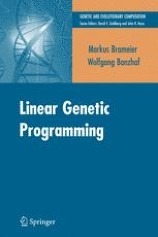
Linear Genetic Programming
Linear Genetic Programming examines the evolution of imperative computer programs written as linear sequences of instructions. In contrast to functional expressions or syntax trees used in traditional Genetic Programming (GP), Linear Genetic Programming (LGP) employs a linear program structure as genetic material whose primary characteristics are exploited to achieve acceleration of both execution time and evolutionary progress.
