



الصفحة 27
الصفحة 27

AI*IA 2005 : Advances in artificial intelligence ; 9th congress of the Italian Association for Artificial Intelligence Milan, Italy, September 21-23, 2005, Proceedings
This volume collects the papers selected for presentation at the IX Congress of the Italian Association for Arti?cial Intelligence (AI*IA), 2005 On the one hand this congress continues the tradition of AI*IA in organizing its biannual s- enti?c meeting from 1989; on the other hand, this edition is a landmark in the involvement of the international community of arti?cial intelligence (AI), directly involving a broad number of experts from several countries in the P- gramCommittee. Moreover,the peculiar nature of scienti?c researchin arti?cial intelligence (which is intrinsically international) and several consolidated int- national collaborations in projects and mobility programs allowed the collection and selection of papers from many di?erent countries, all around the world, enlarging the visibility of the Italian contribution within this research ?eld. Arti?cial intelligence is today a growing complex set of conceptual, theor- ical, methodological, and technological frameworks, o?ering innovative com- tational solutions in the design and development of computer-based systems. Within this perspective, researchers working in this area must tackle a broad range of knowledge about methods, results, and solutions coming from di?erent classical areas of this discipline. The congress was designed as a forum allowing researchers to present and discuss specialized results as general contributions to AI growth.

AI and UX : Why artificial intelligence needs user experience
Great effort has been put forth to continuously make AI “smarter.” But, will smarter always equal more successful AI? It is not just about getting a product to market, but about getting the product into a user’s hands in a form that will be embraced. This demands examining the product from the perspective of the user. Authors Gavin Lew and Robert Schumacher have written AI and UX to examine just how product managers and designers can best strike this balance. From exploring the history of the parallel journeys of AI and UX, to investigating past product examples and failures, to practical expert knowledge on how to best execute a positive user experience, AI and UX examines all angles of how AI can best be developed within a UX framework.

AI 2008 : Advances in artificial intelligence ; 21st Australasian Joint Conference on Artificial Intelligence Auckland, New Zealand, December 1-5, 2008. Proceedings
This book constitutes the refereed proceedings of the 21th Australasian Joint Conference on Artificial Intelligence, AI 2008, held in Auckland, New Zealand, in December 2008.
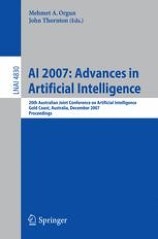
AI 2007: Advances in artificial intelligence ; 20th Australian Joint Conference on Artificial Intelligence, Gold Coast, Australia, December 2-6, 2007, Proceedings
The book is organized in topical sections on machine learning, neural networks, evolutionary computing, constraint satisfaction, satisfiability, automated reasoning, knowledge discovery, robotics, social intelligence, ontologies and semanti.

AI 2006 : Advances in artificial intelligence ; 19th Australian Joint Conference on Artificial Intelligence, Hobart, Australia, December 4-8, 2006, Proceedings
This volume contains the proceedings of the 19th Australian Joint Conference on Artificial Intelligence (AI 2006) held at Hobart, Australia. AI 2006 received a record number of submissions, a total of 689 submissions from 35 countries. The papers in this volume give an indication of recent advances in artificial int- ligence. The topics covered include Machine Learning, Robotics, AI Applications, Planning, Agents, Data Mining and Knowledge Discovery, Cognition and User Interface, Vision and Image Processing, Information Retrieval and Search, AI in the Web, Knowledge Representation, Knowledge-Based Systems, and Neural Networks.

AI 2004 : Advances in artificial intelligence ; 17th Australian Joint conference on artificial intelligence, Cairns, Australia, December 4-6, 2004, proceedings
AI 2004 was the seventeenth in the series of annual Australian artificial intelli-gence conferences. This conference is the major forum for artificial intelligenceresearch in Australia. It has consistently attracted strong international partic-ipation. This year more than two thirds of the submissions were from outsideAustralia.The current volume is based on the proceedings of AI 2004. AI 2004 was collo-cated with Complex 2004, the 7th Asia-Pacific Conference on Complex Systems,with the aim of promoting cross-fertilization and collaboration in areas of com-plex and intelligent systems

Agent-oriented software engineering VI ; 6th International Workshop, AOSE 2005, Utrecht, The Netherlands, July 25, 2005. Revised and Invited Papers
This book represents the thoroughly refereed post-proceedings of the 6th International Workshop on Agent-Oriented Software Engineering, AOSE 2005, held in Utrecht, The Netherlands, in July 2005 as part of AAMAS 2005. The 18 revised full papers were carefully selected from 35 submissions during two rounds of reviewing and improvement. The papers are organized in topical sections on modeling tools, analysis and validation tools, multiagent systems design, implementation tools, and experiences and comparative evaluations.

Agent-oriented software engineering V ; 5th International workshop, AOSE 2004, New York, NY, USA, July 2004, revised selected papers
The explosive growth of application areas such as electronic commerce, ent- prise resource planning and mobile computing has profoundly and irreversibly changed our views on software systems. Nowadays, software is to be based on open architectures that continuously change and evolve to accommodate new components and meet new requirements. Software must also operate on di?- ent platforms, without recompilation, and with minimal assumptions about its operating environment and its users. Furthermore, software must be robust and ¨ autonomous, capable of serving a naive user with a minimum of overhead and interference. Agent concepts hold great promise for responding to the new realities of software systems. They o?er higher-level abstractions and mechanisms which address issues such as knowledge representation and reasoning, communication, coordination, cooperation among heterogeneous and autonomous parties, p- ception, commitments, goals, beliefs, and intentions, all of which need conceptual modelling. On the one hand, the concrete implementation of these concepts can lead to advanced functionalities.

Agent-oriented information systems II ; 6th International bi-conference workshop, AOIS 2004, Riga, Latvia, June 8, 2004 and New York, NY, USA, July 20, 2004, revised selected papers
Information systems have become the backbone of all kinds of organizations - day. In almost every sector – manufacturing, education, health care, government and businesses large and small – information systems are relied upon for - eryday work, communication, information gathering and decision-making. Yet, the in?exibilities in current technologies and methods have also resulted in poor performance, incompatibilities and obstacles to change. As many organizations are reinventing themselves to meet the challenges of global competition and e-commerce, there is increasing pressure to develop and deploy new technologies that are ?exible, robust and responsive to rapid and unexpected change. Agent concepts hold great promise for responding to the new realities of - formation systems. They o?er higher-level abstractions and mechanisms which address issues such as knowledge representation and reasoning, communication, coordination, cooperation among heterogeneous and autonomous parties, p- ception, commitments, goals, beliefs, intentions, etc., all of which need conc- tual modelling. On the one hand, the concrete implementation of these concepts can lead to advanced functionalities.

Agent Technology and e-Health
Multi-agent systems are one of the most exciting research areas in Artificial Intelligence. This book reports on the results achieved in this area, discusses the benefits (and drawbacks) that agent-based systems may bring to medical domains and society.

Agent Intelligence Through Data Mining
AGENT INTELLIGENCE THROUGH DATA MINING offers a self-contained overview of a relatively young but important area of research: the intersection of agent technology and data mining. This intersection leads to considerable advancements in the area of information technologies, drawing the increasing attention of both research and industrial communities. It can take two forms: a) the more mundane use of intelligent agents for improved data mining and; b) the use of data mining for smarter, more efficient agents. The second approach is the main focus of this volume. this book presents a methodology for developing multi-agent systems, describes available open-source tools to support this process, and demonstrates the application of the methodology on three different cases. AGENT INTELLIGENCE THROUGH DATA MINING is designed for a professional audience composed of researchers and practitioners in industry.

Agent and Multi-Agent Systems : Technologies and Applications ; 2nd KES International Symposium, KES-AMSTA 2008, Incheon, Korea, March 26-28, 2008. Proceedings
The KES-AMSTA Symposium Series is a sub-series of the KES Conference Series. The aim of the symposium was to provide an international forum for scientific research into the technologies and applications of agent and multi-agent systems.

Agent and multi-agent systems : Technologies and applications ; 1st KES International Symposium, KES-AMSTA 2007, Wroclaw, Poland, May 31-June 1, 2007, Proceedings
The aim of the symposium was to provide an international forum for scientific - search in the technologies and applications of agent and multi-agent systems. Agents and multi-agent systems are related to the modern software which has long been r- ognized as a promising technology for constructing autonomous, complex and intel- gent systems. A key development in the field of agent and multi-agent systems has been the specification of agent communication languages and formalization of - tologies. Agent communication languages are intended to provide standard decla- tive mechanisms for agents to communicate knowledge and make requests of each other, whereas ontologies are intended for conceptualization of the knowledge - main.

Advances in web mining and web usage analysis ; 8th International workshop on knowledge discovery on the web, WebKDD 2006 Philadelphia, USA, August 20, 2006 Revised Papers
The discipline of data mining delivers methodologies and tools for the an- ysis of large data volumes and the extraction of comprehensible and non-trivial insights from them. Web mining, a much younger discipline, concentrates on the analysisofdata pertinentto the Web.Web mining methods areappliedonusage data and Web site content; they strive to improve our understanding of how the Web is used, to enhance usability and to promote mutual satisfaction between e-business venues and their potential customers.Many ofthe infancy problems in Web mining have been solvedby now, but the tremendous potential for new and improved uses, as well as misuses, of the Web are leading to new challenges.

Advances in web mining and web usage analysis ; 7th International workshop on knowledge discovery on the web, WEBKDD 2005, Chicago, IL, USA, August 21, 2005, Revised Papers
Thisbookcontainsthepostworkshopproceedingsofthe7thInternationalWo- shop on Knowledge Discovery from the Web, WEBKDD 2005. The WEBKDD workshop series takes place as part of the ACM SIGKDD International Conf- ence on Knowledge Discovery and Data Mining (KDD) since 1999. The discipline of data mining delivers methodologies and tools for the an- ysis of large data volumes and the extraction of comprehensible and non-trivial insights from them. Web mining, a much younger discipline, concentrates on the analysisofdata pertinentto theWeb.Web mining methods areappliedonusage data and Web site content; they strive to improve our understanding of how the Web is used, to enhance usability and to promote mutual satisfaction between e-business venues and their potential customers. In the last years, the interest for the Web as medium for communication, interaction and business has led to new challenges and to intensive, dedicated research. Many of the infancy problems in Web mining have now been solved but the tremendous potential for new and improved uses, as well as misuses, of the Web are leading to new challenges.

Advances in web mining and web usage analysis ; 6th International workshop on knowledge discovery on the web, WEBKDD 2004, Seattle, WA, USA, August 22-25, 2004, Revised Selected Papers
The Webisaliveenvironmentthatmanagesanddrivesawidespectrumofapp- cations in which a user may interact with a company, a governmental authority, a non-governmental organization or other non-pro?t institution or other users. User preferences and expectations, together with usage patterns, form the basis for personalized, user-friendly and business-optimal services. Key Web business metrics enabled by proper data capture and processing are essential to run an e?ective business or service. Enabling technologies include data mining, sc- able warehousing and preprocessing, sequence discovery, real time processing, document classi?cation, user modeling and quality evaluation models for them. Recipient technologies required for user pro?ling and usage patterns include recommendation systems, Web analytics applications, and application servers, coupled with content management systems and fraud detectors.

Advances in web intelligence ; 1st International symposium, ISVC 2005, Lake Tahoe, NV, USA, December 5-7, 2005, proceedings
In recent years the Internet has become a source of data and information of indisputable importance and has immensely gained in acceptance and popularity. The World Wide Web (WWW or Web, for short), frequently named “the nervous system of the infor- tion society,” offers numerous valuable services leaving no doubt about the signi?cance of the Web in our daily activities at work and at home. Consequently, we have a clear aspiration to meet the obvious need for effective use of its potential by making - provements in both the methods and the technology applied. Among the new research directions observable in Web-related applications, intelligent methods from within the broadly perceived topic of soft computing occupy an important place. AWIC, the “Atlantic Web Intelligence Conferences” are intended to be a forum for exchange of new ideas and novel practical solutions in this new and exciting ?eld.

Advances in web and network technologies, and information management ; APWeb/WAIM 2007 International Workshops : DBMAN 2007, WebETrends 2007, PAIS 2007 and ASWAN 2007, Huang Shan, China, June 16-18, 2007, Proceedings
With the increasing ubiquity of personal computing devices, such as mobile phones and PDAs, and the increasing deployment of sensor networks, new distributed applications are developed over networked databases posing interesting challenges. It aimed to bring together researchers in different fields related to database management and application over networks and to provide a forum where researchers and practitioners could share and exchange their knowledge and experience.

Advances in spatial and temporal databases ; 7th International symposium, SSTD 2001, Redondo Beach, CA, USA, July 12-15, 2001 Proceedings
The Seventh International Symposium on Spatial and Temporal Databases (SSTD 2001), held in Redondo Beach, CA, USA, July 12{15, 2001, brought together leading researchers and developers in the area of spatial, temporal, and spatio-temporal databases to discuss the state of the art in spatial and temporal data management and applications, and to understand the challenges and - search directions in the advancing area of data management for moving objects. The symposium served as a forum for disseminating research in spatial and temporal data management, and for maximizing the interchange of knowledge among researchers from the established spatial and temporal database com- nities. The exchange of research ideas and results not only contributes to the academic arena, but also bene ts the user and commercial communities.

Advances in neural networks - ISNN 2008 ; 5th International symposium on neural networks, ISNN 2008, Beijing, China, September 24-28, 2008, Proceedings, Part II
The two volume set LNCS 5263/5264 constitutes the refereed proceedings of the 5th International Symposium on Neural Networks, ISNN 2008, held in Beijing, China in September 2008.
