



الصفحة 27
الصفحة 27
Foundations of software science and computation structures ; 25th International conference, FOSSACS 2022, Held as Part of the European joint conferences on theory and practice of software, ETAPS 2022, Munich, Germany, April 2–7, 2022, proceedings
This book constitutes the proceedings of the 25th International Conference on Foundations of Software Science and Computational Structures, FOSSACS 2022, which was held during April 4-6, 2022, in Munich, Germany, as part of the European Joint Conferences on Theory and Practice of Software, ETAPS 2022. They deal with research on theories and methods to support the analysis, integration, synthesis, transformation, and verification of programs and software systems.
Foundations of software science and computation structures ; 24th International conference, FOSSACS 2021, Held as Part of the European joint conferences on theory and practice of software, ETAPS 2021, Luxembourg City, Luxembourg, March 27 – April 1, 2021, proceedings
This book constitutes the proceedings of the 24th International Conference on Foundations of Software Science and Computational Structures, FOSSACS 2021, which was held during March 27 until April 1, 2021, as part of the European Joint Conferences on Theory and Practice of Software, ETAPS 2021. The conference was planned to take place in Luxembourg and changed to an online format due to the COVID-19 pandemic.

Foundations of software science and computation structures ; 23rd International conference, FOSSACS 2020, Held as part of the European joint conferences on theory and practice of software, ETAPS 2020, Dublin, Ireland, April 25–30, 2020, proceedings
This book constitutes the proceedings of the 23rd International Conference on Foundations of Software Science and Computational Structures, FOSSACS 2020, which took place in Dublin, Ireland, in April 2020, and was held as Part of the European Joint Conferences on Theory and Practice of Software, ETAPS 2020.
Foundations of software science and computation structures ; 22nd International conference, FOSSACS 2019, Held as part of the European joint conferences on theory and practice of software, ETAPS 2019, Prague, Czech Republic, April 6–11, 2019, proceedings
This book constitutes the proceedings of the 22nd International Conference on Foundations of Software Science and Computational Structures, FOSSACS 2019, which took place in Prague, Czech Republic, in April 2019, held as part of the European Joint Conference on Theory and Practice of Software, ETAPS 2019. The 29 papers presented in this volume were carefully reviewed and selected from 85 submissions. They deal with foundational research with a clear significance for software science.

Foundations of software science and computation structures ; 21st International conference, FOSSACS 2018, Held as part of the European joint conferences on theory and practice of software, ETAPS 2018, Thessaloniki, Greece, April 14–20, 2018. proceedings
Contains the papers presented at the 21st International Conference on Foundations of Software Science and Computation Structures (FoSSaCS 2018), which was held April 16–19, 2018, in Thessaloniki, Greece. The conference is dedicated to foundational research with a clear significance for software science and brings together research on theories and methods to support the analysis, integration, synthesis,transformation, and verification of programs and software systems.
Foundations of software science and computation structures ; 11th International conference, FOSSACS 2008, Held as part of the joint European conferences on theory and practice of software, ETAPS 2008, Budapest, Hungary, March 29 - April 6, 2008. proceedings
The fve main conferences received 571 submissions, 147 of which were accepted, giving an overall acceptance rate of less than 26%, with each conference below 27%.Congratulations there foretoall the authorswhomadeittothe fnalprogramme! I hope that most of the other authors will still have found a way of participating in this exciting event, and that you will all continue submitting to ETAPS and contributing to make of it the best conference in the area. The events that comprise ETAPS address various aspects of the system velopment process, including specifcation, design, implementation, analysis and improvement

Foundations of Security Analysis and Design IV ; FOSAD 2006/2007 Turtorial Lectures
This book presents thoroughly revised versions of eight tutorial lectures given by leading researchers during two International Schools on Foundations of Security Analysis and Design, FOSAD 2006/2007, held in Bertinoro, Italy, in September 2006 and September 2007.
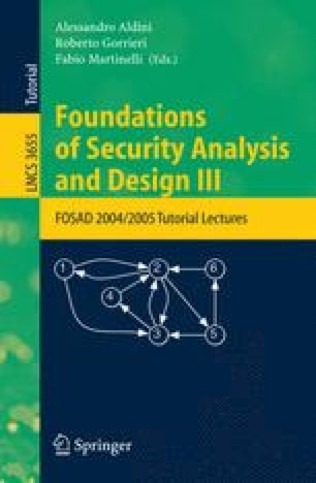
Foundations of security analysis and design III : FOSAD 2004/2005 tutorial lectures
The increasing relevance of security to real-life applications, such as electronic commerce and Internet banking, is attested by the fast-growing number of - search groups, events, conferences, and summer schools that address the study of foundations for the analysis and the design of security aspects. The “Int- national School on Foundations of Security Analysis and Design” (FOSAD, see http://www.sti.uniurb.it/events/fosad/)has been one of the foremost events - tablishedwiththegoalofdisseminatingknowledgeinthiscriticalarea,especially for young researchers approaching the ?eld and graduate students coming from less-favoured and non-leading countries. The FOSAD school is held annually at the Residential Centre of Bertinoro (http://www.ceub.it/), in the fascinating setting of a former convent and ep- copal fortress that has been transformed into a modern conference facility with computing services and Internet access. Since the ?rst school, in 2000, FOSAD hasattractedmorethan250participantsand50lecturersfromallovertheworld.
Foundations of Security : What Every Programmer Needs to Know
Foundations of Security: What Every Programmer Needs to Know teaches new and current software professionals state-of-the-art software security design principles, methodology, and concrete programming techniques they need to build secure software systems.
Foundations of Multi-Paradigm Modelling for Cyber-Physical Systems
This book coherently gathers well-founded information on the fundamentals of and formalisms for modelling cyber-physical systems (CPS). Highlighting the cross-disciplinary nature of CPS modelling, it also serves as a bridge for anyone entering CPS from related areas of computer science or engineering.
Foundations of Intelligent Systems ; Vol. 4203 ; 16th International Symposium, ISMIS 2006, Bari, Italy, September 27-29, 2006, Proceedings
This book constitutes the refereed proceedings of the 16th International Symposium on Methodologies for Intelligent Systems, ISMIS 2006. The book presents 81 revised papers together with 3 invited papers. Topical sections include active media human-computer interaction, computational intelligence, intelligent agent technology, intelligent information retrieval, intelligent information systems, knowledge representation and integration, knowledge discovery and data mining, logic for AI and logic programming, machine learning, text mining, and Web intelligence.
Foundations of Intelligent Systems ; Vol. 3488 ; 15th International Symposium ISMIS 2005, Saratoga Springs, NY, USA, May 25-28, 2005, Proceedings
This volume contains the papers selected for presentation at the 15th International S- posiumonMethodologiesforIntelligentSystems, ISMIS2005, heldinSaratogaSprings, NewYork,25-28May,2005. ThesymposiumwasorganizedbySUNYatAlbany. Itwas sponsored by the Army Research Of?ce and by several units of the University at Albany including its Division for Research, College of Arts and Sciences, Department of C- puter Science, and Institute for Informatics, Logics, and Security Studies (formerly the Institute for Programming and Logics). The Program Committee selected the following major areas for ISMIS 2005: intelligent information systems, knowledge discovery and data mining, knowledge - formation and integration, knowledge representation, logic for arti?cial intelligence, soft computing, Web intelligence, Web services, and papers dealing with applications of intelligent systems in complex/novel domains. The contributed papers were selected from almost 200 full draft papers by the Program Committee members.
Foundations of Intelligent Systems ; 17th International Symposium, ISMIS 2008 Toronto, Canada, May 20-23, 2008 Proceedings
This book constitutes the refereed proceedings of the 17th International Symposium on Methodologies for Intelligent Systems, ISMIS 2008, held in Toronto, Canada, in May 2008.The 68 revised papers presented together with 3 plenary talks were carefully reviewed and selected from over 100 submissions. The papers are organized in topical sections on knowledge discovery and data mining: foundations, advances, mining changes and actional patterns; logic for artificial intelligence, autonomic and evolutionary computation, soft computing, databases and data warehouses, digital library, intelligent information retrieval.
Foundations of Intelligent Systems ; 13th International Symposium, ISMIS 2002, Lyon, France, June 27-29, 2002. Proceedings
This volume contains the papers selected for presentation at the 13th International Symposium on Methodologies for Intelligent Systems ISMIS 2002, held in Lyon, France, 27-29 June, 2002. The symposium was organized by the UniversitØ ClaudThe program committee selected the following major areas for ISMIS 2002: Intelligent Multimedia, Intelligent Information Retrieval, Intelligent Information Systems, Knowledge Representation and Integration, Learning and Knowledge Discovery, Logic for Artificial Intelligence, Methodologies (modeling, design, validation, performance evaluation), and Soft Computing.
Foundations of information and knowledge systems ; 5th International Symposium, FoIKS 2008, Pisa, Italy, February 11-15, 2008. Proceedings
This book constitutes the refereed proceedings of the 5th International Symposium on Foundations of Information and Knowledge Systems, FoIKS 2008 held in Pisa, Italy, in February 2008. The 13 revised full papers presented together with 9 revised short papers and 3 invited lectures were carefully selected during two rounds of reviewing and improvement from from 79 submissions. The papers deal with any foundational aspect of information and knowledge systems, including submissions from researchers working in fields such as discrete mathematics, logic and algebra, model theory, information theory, complexity theory, algorithmics and computation, geometry, analysis, statistics and optimisation who are interested in applying their ideas, theories and methods to research on information and knowledge systems.

Foundations of generic optimization : Vol.1 : A combinatorial approach to epistasis
This is a comprehensive overview of the basics of fuzzy control, which also brings together some recent research results in soft computing, in particular fuzzy logic using genetic algorithms and neural networks. This book offers researchers not only a solid background but also a snapshot of the current state of the art in this field.

Foundations of Data Mining and Knowledge Discovery
This volume presents the results of investigations into the foundations of the discipline, and represents the state-of-the-art for much of the current research. This book will prove extremely valuable and fruitful for data mining researchers, no matter whether they would like to uncover the fundamental principles behind data mining, or apply the theories to practical applications.
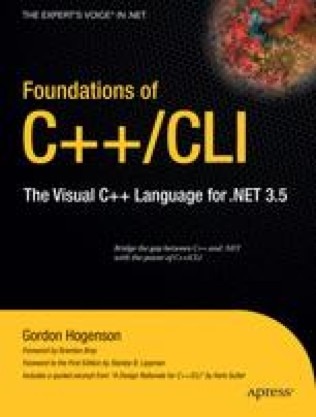
Foundations of C++/CLI : The Visual C++ Language for .NET 3.5
Foundations of C++/CLI: The Visual C++ Language for .NET 3.5 introduces C++/CLI, Microsoft's extensions to the C++ syntax that allow you to target the common language runtime, the key to the heart of the .NET Framework 3.5. This book gives you a small, fast–paced primer that will kick–start your journey into the world of C++/CLI. In 13 no–fluff chapters, Microsoft insiders take readers into the core of the C++/CLI language and explain both how the language elements work and how Microsoft intends them to be used. This book is a beginner's guide, but it assumes a familiarity with programming basics. And it concentrates on explaining the aspects of C++/CLI that make it the most powerful and fun language of the .NET Framework. As such, this book is ideal if you're thinking of migrating to C++/CLI from another language.
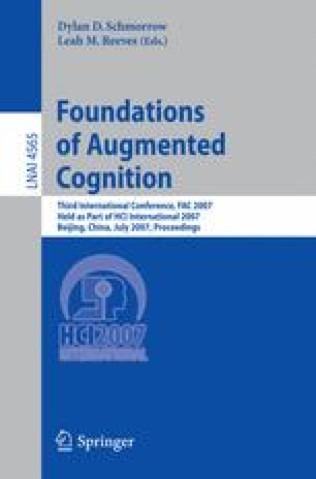
Foundations of augmented cognition ; 3rd International Conference, FAC 2007, Held as Part of HCI International 2007, Beijing, China, July 22-27, 2007, Proceedings
These papers address the latest research and development efforts and highlight the human aspects of design and use of computing systems. This volume contains papers in the thematic area of Augmented Cognition.
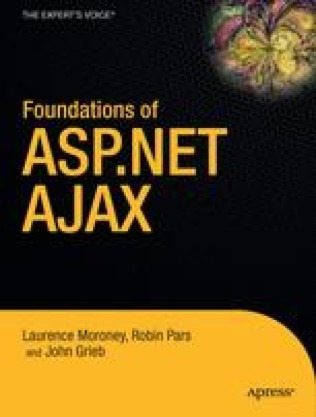
Foundations of ASP.NET AJAX
Foundations of ASP.NET AJAX gives you a detailed grounding in how ASP.NET AJAX works. It takes you swiftly through the basic principles of Ajax, then deep into the heart of the technology, where every namespace is discussed and every function considered. By the end of the book, you'll know all the essentials to confidently produce cutting-edge ASP.NET AJAX applications swiftly and professionally.
