



الصفحة 21
الصفحة 21
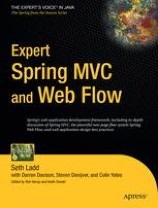
Expert Spring MVC and Web Flow
Expert Spring MVC and Web Flow provides in-depth coverage of Spring MVC and Spring Web Flow, two highly customizable and powerful web frameworks brought to you by the developers and community of the Spring Framework. Spring MVC is a modern web application framework built upon the Spring Framework, and Spring Web Flow is a new project that compliments Spring MVC for building reusable web controller modules that encapsulate rich page navigation rules. Along with detailed analysis of the code and functionality, plus the first-published coverage of Spring Web Flow, this book includes numerous tips and tricks to help you get the most out of Spring MVC, Spring Web Flow, and web development in general.
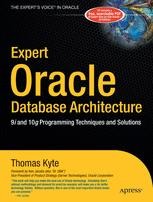
Expert Oracle Database Architecture : 9i and 10g Programming Techniques and Solutions
This is a defining book on the Oracle database for any developer or database administrator who works with Oracle-driven database applications. Tom Kyte has a simple philosophy: you can treat Oracle as a black box and just stick data into it or you can understand how it works and exploit it as a powerful computing environment. If you choose the latter, then you will find that there are few information management problems that you cannot solve quickly and elegantly. Expert Oracle Database Architecture is the first of a three-book series that completely explores and defines the Oracle database. It covers all of the most important Oracle architecture features, including: Files, memory structures and processes / Locking and latching / Transactions, concurrency and multi-versioning / Tables and Indexes / Datatypes / Partitioning and parallelism Each feature is taught in a proof-by-example manner, not only discussing what it is, but also how it works, how to implement software using it, and the common pitfalls associated with it.

Expert F#
Expert F# is about practical programming in a beautiful language that puts the power and elegance of functional programming into the hands of .NET developers. In combination with .NET, F# achieves unrivaled levels of programmer productivity and program clarity. This books serves as: The authoritative guide to F# by the designer of F#. A comprehensive reference of F# concepts, syntax, and features. A treasury of expert F# techniques for practical, real–world programming.
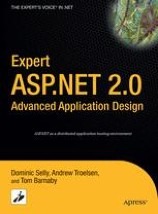
Expert ASP.NET 2.0 Advanced Application Design
Expert ASP.NET 2.0 Advanced Application Design will help you derive maximum performance and reliability from the distributed applications you create with ASP.NET 2.0. The book first looks at some of the non-functional requirements that impact the design of a distributed application. It then relates them to the servers and services available in the .NET 2.0 Framework. ASP.NET 2.0 is the central process for use in distributed .NET applications, and the book closely examines the ASP.NET 2.0 Framework and its hosting environment, Internet Information Server (IIS). The book looks at how ASP.NET 2.0 is used by different packages within .NET (like Web Services), and explores how it can be extended to meet your own custom requirements.

Expert .NET Delivery Using NAnt and CruiseControl.NET
This book is a guide to the implementation of good processes in a .NET environment. Author Marc Holmes focuses on actual implementation, and details patterns and anti-patterns to watch out for. He also provides a practical and in-depth look at NAnt and CruiseControl.NET, and solutions to common problem scenarios.

E-Voting and Identity ; 1st International Conference, VOTE-ID 2007, Bochum, Germany, October 4-5, 2007, Revised Selected Papers
Voting and identity have a very delicate relationship. Only a few processes - pendso much on an identity management respecting the fine line between reliable identification and reliable non-identifiability each at its part during the process. And only a few processes may change their outer appearance so much with the advent of new IT as voting and identity management do. So it was no surprise in FIDIS, the interdisciplinary Network of Excellence working on the Future of Identity in the Information Society

Evolving Connectionist Systems : The Knowledge Engineering Approach
Evolving Connectionist Systems is aimed at all those interested in developing and using intelligent computational models and systems to solve challenging real world problems in computer science, engineering, bioinformatics and neuroinformatics. The book challenges scientists and practitioners with open questions about future creation of new information models inspired by Nature. This edition includes new methods for adaptive, knowledge-based learning, such as online incremental feature selection, spiking neural networks, transductive neuro-fuzzy inference, adaptive data and model integration, cellular automata and artificial life systems, particle swarm optimisation, ensembles of evolving systems, and quantum inspired neural networks. New applications to gene and protein interaction modelling, brain data analysis and brain model creation, computational neuro-genetic modelling, adaptive speech, image and multimodal recognition, language modelling, adaptive robotics, modelling dynamic financial and socio-economic systems, and ecological modelling, are covered. An important new feature of the book is the attempt to connect different structural and functional levels of a complex, intelligent system, looking for inspiration from functional relationships in natural systems, such as the genetic and the brain activity.

Evolutionary Synthesis of Pattern Recognition Systems
Evolutionary Synthesis of Pattern Recognition Systems presents novel effective approaches based on evolutionary computational techniques, such as genetic programming (GP), linear genetic programming (LGP), coevolutionary genetic programming (CGP) and genetic algorithms (GA) to automate the synthesis and analysis of object detection and recognition systems. The book’s concepts, principles, and methodologies will enable readers to automatically build robust and flexible systems—in a systematic manner—that can provide human-competitive performance and reduce the cost of designing and maintaining these systems. Its content covers all key aspects of object recognition: object detection, feature selection, feature discovery, object recognition, domain knowledge. Basic knowledge of programming and data structures, and some calculus, is presupposed.ing the book’s novel ideas

Evolutionary Computer Music
The evolutionary computation approach to music is an exciting new development for composers and musicologists alike. For composers, it provides an innovative and natural means for generating musical ideas from a specifiable set of primitive components and processes. For musicologists, these techniques are used to model the cultural transmission and change of a population's body of musical ideas over time. In both cases, musical evolution can be guided by a variety of constraints and tendencies built into the system, such as realistic psychological factors that influence the way music is expressed, experienced, learned, stored, modified, and passed on among individuals. This book discusses not only the applications of evolutionary computation to music, but also the tools needed to create and study such systems. These tools are drawn in part from research into the origins and evolution of biological organisms, ecologies, and cultural systems on the one hand, and from computer simulation methodologies on the other. They can be combined to create surrogate artificial worlds populated by interacting simulated organisms in which complex musical experiments can be performed that would otherwise be impossible.

Evaluation of text summaries based on linear optimization of content metrics
Covers both theoretical contributions and practical applications in security system design by applying the Internet of Things (IoT) and CI. It further explains the application of IoT in the design of modern security systems and how IoT blended with computational intel- ligence can make any security system improved and realizable. Key features: Focuses on the computational intelligence techniques of security system design Covers applications and algorithms of discussed computational intelligence techniques Includes convergence-based and enterprise integrated security systems with their applications Explains emerging laws, policies, and tools affecting the landscape of cyber security Discusses application of sensors toward the design of security systems This book will be useful for graduate students and researchers in electrical, computer engineering, security system design and engineering

Euro-Par 2020 : Parallel Processing ; 26th International Conference on Parallel and Distributed Computing, Warsaw, Poland, August 24–28, 2020, Proceedings
This book constitutes the proceedings of the 26th International Conference on Parallel and Distributed Computing, Euro-Par 2020, held in Warsaw, Poland, in August 2020. The conference was held virtually due to the coronavirus pandemic. The 39 full papers presented in this volume were carefully reviewed and selected from 158 submissions. They deal with parallel and distributed computing in general, focusing on support tools and environments; performance and power modeling, prediction and evaluation; scheduling and load balancing; high performance architectures and compilers; data management, analytics and machine learning; cluster, cloud and edge computing; theory and algorithms for parallel and distributed processing; parallel and distributed programming, interfaces, and languages; multicore and manycore parallelism; parallel numerical methods and applications; and accelerator computing.

Euro-Par 2019 : Parallel Processing Workshops ; Euro-Par 2019 International Workshops, Göttingen, Germany, August 26–30, 2019, Revised Selected Papers
Euro-Par is an annual, international conference in Europe, covering all aspects of parallel and distributed processing. These range from theory to practice, from small to the largest parallel and distributed systems and infrastructures, from fundamental computational problems to full-edged applications, from architecture, compiler, language and interface design and implementation to tools, support infrastructures, and application performance aspects.

Euro-Par 2008 - Parallel Processing ; 14th International Euro-Par Conference, Las Palmas de Gran Canaria, Spain, August 26-29, 2008. Proceedings
This book constitutes the refereed proceedings of the 14th International Conference on Parallel Computing, Euro-Par 2008, held in Las Palmas de Gran Canaria, Spain, in August 2008.The 86 revised papers presented were carefully reviewed and selected from 264 submissions. The papers are organized in topical sections on support tools and environments; performance prediction and evaluation; scheduling and load balancing; high performance architectures and compilers; parallel and distributed databases; grid and cluster computing; peer-to-peer computing; distributed systems and algorithms; parallel and distributed programming.
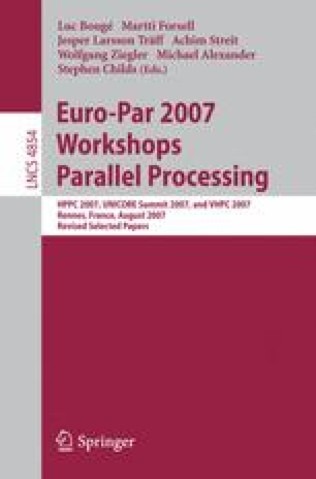
Euro-Par 2007 Workshops : Parallel Processing ; HPPC 2007, UNICORE Summit 2007, and VHPC 2007, Rennes, France, August 28-31, 2007, Revised Selected Papers
Parallel and distributed processing , although within the focus of computer science research for along time ,is gainingmore and more importance in awidespectrum of applications. These proceedings aim to demonstrate the use of parallel and distributed processing concepts in diferent application felds, and attempt to spark interest in novel research directions to advance the embracing model of high-performance computing research in general. The objective of these workshops is to specifcally address researchers c- ing from university, industry and governmental research organizations and application-oriented companies, in order to close the gap between purely sentifc research and the applicability of the research ideas to real-life problems.

Euro-Par 2007 Parallel Processing ; 13th International Euro-Par Conference, Rennes, France, August 28-31, 2007, Proceedings
This book covering support tools and environments; performance prediction and evaluation; scheduling and load balancing; compilers for high performance; parallel and distributed databases; grid and cluster computing; peer-to-peer computing; distributed systems and algorithms; parallel and distributed programming; parallel numerical algorithms; distributed and high-performance multimedia; theory and algorithms for parallel computation; high performance networks; mobile and ubiquitous computing.

Euro-Par 2006 Parallel Processing ; CoreGRID 2006, UNICORE Summit 2006, Petascale Computational Biology and Bioinformatics, Dresden, Germany, August 29-September 1, 2006, Revised Selected Papers
This book contiants Petascale Computational Biology and Bioinformatics.

Euro-Par 2006 Parallel Processing ; 12th International Euro-Par Conference, Dresden, Germany, August 28-September 1, 2006, Proceedings
This book constitutes the refereed proceedings of the 12th International Conference on Parallel Computing, Euro-Par 2006. parallel and distributed databases, data mining and knowledge discovery; grid and cluster computing: models, middleware and architectures; parallel computer architecure and instruction-level parallelism.
Euro-Par 2005 Parallel Processing ; 11th International Euro-Par Conference, Lisbon, Portugal, August 30 - September 2, 2005, Proceedings
This book constitutes the refereed proceedings of the 11th International Conference on Parallel Computing, Euro-Par 2005, held in Lisbon, Portugal, in August/September 2005. The 120 revised papers presented together with 4 invited papers were carefully reviewed and selected from 388 submissions. The papers are organized in topical sections on support tools and environments, performance prediction and evaluation, scheduling and load balancing, compilers for high performance, parallel and distributed databases, data mining and knowledge discovery, grid and cluster computing: models, middleware and architectures, parallel computer architecture and instruction distributed systems and algorithms, parallel programming: models, methods, and languages, parallel numerical algorithms.

EUNICE 2005: Networks and Applications Towards a Ubiquitously Connected World ; IFIP International Workshop on Networked Applications, Colmenarejo, Madrid/Spain, 6-8 July, 2005
The IFIP series publishes state-of-the-art results in the sciences and technologies of information and communication. The scope of the series includes: foundations of computer science; software theory and practice; education; computer applications in technology; communication systems; systems modeling and optimization; information systems; computers and society; computer systems technology; security and protection in information processing systems; artificial intelligence; and human-computer interaction. Proceedings and post-proceedings of referred international conferences in computer science and interdisciplinary fields are featured. These results often precede journal publication and represent the most current research. The principal aim of the IFIP series is to encourage education and the dissemination and exchange of information about all aspects of computing.

E-Training Practices for Professional Organizations
E-Training Practices for Professional Organizations is an essential reference for anyone interested in the integration of e-business, e-work and e-learning processes. The book collects, for the first time, the proceedings from the 2003 IFIP eTrain Conference held in Pori, Finland. The text serves as a multi-disciplinary resource for information on the research, development and applications of all topics related to e-Learning. The first half of the book discusses theories, paradigms and their applications in academia and industry. The last half of the book examines learning environments, design issues and collaboration among the corporate, governmental and academic sectors. With academic and professional contributors, E-Training Practices for Professional Organizations reflects the multi-faceted and exciting nature of e-training studies. This volume presents the balanced view of past developments and current research necessary to truly reach the potential of this burgeoning field.
