



الصفحة 2
الصفحة 2

Database Theory – ICDT 2007 ; 11th International Conference, Barcelona, Spain, January 10-12, 2007, Proceedings
The papers are organized in topical sections on information integration and peer to peer, axiomatizations for XML, expressive power of query languages, incompleteness, inconsistency, and uncertainty, XML schemas and typechecking, stream processing and sequential query processing, ranking, XML update and query, as well as query containment.

Database theory - ICDT 2005 ; 10th international conference, Edinburgh, UK, January 5-7, 2005, Proceedings
This volume collects the papers presented at the 10th International Conference on Database Theory, ICDT 2005, held during January 5–7, 2005, in Edinburgh, UK. ICDT (http://alpha.luc.ac.be/~lucp1080/icdt/) has now a long tra- tion of international conferences, providing a biennial scienti?c forum for the communication of high-quality and innovative research results on theoretical - pects of all forms of database systems and database technology. The conference usually takes place in Europe, and has been held in Rome (1986), Bruges (1988), Paris (1990), Berlin (1992), Prague (1995), Delphi (1997), Jerusalem (1999), London (2001), and Siena (2003) so far. ICDT has merged with the Sym- sium on Mathematical Fundamentals of Database Systems (MFDBS), initiated in Dresden in 1987, and continued in Visegrad in 1989 and Rostock in 1991. ICDT had a two-stage submission process. First, 103 abstracts were subm- ted, which were followed a week later by 84 paper submissions. From these 84 submissions, the ICDT Program Committee selected 24 papers for presentation at the conference. Most of these papers were “extended abstracts” and preli- nary reports on work in progress. It is anticipated that most of these papers will appear in a more polished form in scienti?c journals.

Database systems for advanced applications ; Vol. 3453 ; 10th international conference, DASFAA 2005, Beijing, China, April 17-20, 2005, Proceedings
Data Stream Mining and Resource Adaptive Computation.- Purpose Based Access Control for Privacy Protection in Database Systems.- Complex Networks and Network Data Mining.- Bioinformatics.- Indexing DNA Sequences Using q-Grams.- PADS: Protein Structure Alignment Using Directional Shape Signatures.- LinkageTracker: A Discriminative Pattern Tracking Approach to Linkage Disequilibrium Mapping.- Watermarking and Encryption.- Query Optimization in Encrypted Database Systems.- Watermarking Spatial Trajectory Database.- Effective Approaches for Watermarking XML Data.- XML Query Processing.- A Unifying Framework for Merging and Evaluating XML Information.- Efficient Evaluation of Partial Match Queries for XML Documents Using Information Retrieval Techniques.- PathStack: A Holistic Path Join Algorithm for Path Query with Not-Predicates on XML Data.- XML Coding and Metadata Management.- An Improved Prefix Labeling Scheme: A Binary String Approach for Dynamic Ordered XML.- Efficiently Coding and Indexing XML Document.- XQuery-Based TV-Anytime Metadata Management.- Data Mining.- Effective Database Transformation and Efficient Support Computation for Mining Sequential Patterns.

Database Programming Languages ; 8th International Workshop, DBPL 2001, Frascati, Italy, September 8-10, 2001. Revised Papers
The papers here are organized in topical sections on semistructured data OL AP and data mining systems, schema integration, and index concurrency XML spatial databases user languages and rules.

Database Programming Languages ; 11th International Symposium, DBPL 2007, Vienna, Austria, September 23-24, 2007, Revised Selected Papers
This volume contains works at the intersection of database and programming language research.It also cover algorithms, XML query languages, inconsistency handling, data provenance, emerging data models, and type checking.

Database Programming Languages ; 10th international symposium, DBPL 2005, Trondheim, Norway, August 28-29, 2005, revised selected papers
Constitutes the refereed post-proceedings of the 10th International Workshop on Database Programming Languages, DBPL 2005. This book presents papers organized in topical sections on XML languages, XML and P2P data integration, XML query languages, types and XML, grammars, automata, and tree, as well as dependencies and constraints.
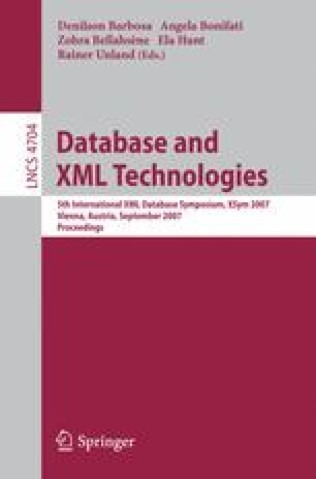
Database and XMLTechnologies ; 5th International XML Database Symposium, XSym 2007, Vienna, Austria, September 23-24, 2007, Proceedings
This book discuss the use of and synergy between databases and XML. It provided theory and practice of XML data management and its applications. This volume also contains current research in XPath and XQuery processing, XML Updates, Temporal XML and Constraints.

Database and XML Technologies ; Vol. 4156 ; 4th International XML Database Symposium, XSym 2006, Seoul, Korea, September 10-11, 2006, Proceedings
The theme of the XML Database Symposium (XSym) is the convergence of database technology with XML technology. Since the first International XML Symposium in 2003, XSym has continued to provide a forum for academics, practitioners, users and vendors to discuss the use of and synergy between advanced XML technologies. XSym 2006 received 32 full paper submissions. Each submitted paper underwent a rigorous review by independent referees. These proceedings represent a collection of eight excellent research papers. Their focus is on building XML repositories and covers the following topics: XML query processing, caching, indexing and navigation support, structural matching, temporal XML, and XML updates.

Database and XML Technologies ; Vol. 3671 ; 3rd international XML database symposium, XSym 2005, Trondheim, Norway, August 28-29, 2005, Proceedings
Constitutes the proceedings of the Third International XML Database Symposium, XSym 2005, held in Trondheim, Norway in August 2005. The 15 papers are organized in sections on indexing support for the evaluation of XPath and XQuery; benchmarks and algorithms for XQuery and XPath evaluation; algorithms for constraint satisfaction checking, and more.

Database : Enterprise, skills and innovation; 22nd British national conference on databases, BNCOD 22, Sunderland, UK, July 5-7, 2005, Proceedings
The British National Conference on Databases (BNCOD) was established in 1980 as a forum for research into the theory and practice of databases. The original conference in the series took place at the University of Aberdeen. To be precise, this conference was in fact entitled ICOD which stood for International Conference on Databases. It was the intention, when the series began, that an ICOD would take place every two years, whilst a BNCOD would run in the years in between. As the record shows ICOD was only held in 1980 and 1983. The more junior conference has managed to acquire a lifetime much longer than that of its senior relative! If truth wereknown,however,BNCOD has,overthe years,growninto ICOD and although the conference is still titled “British National,” it is, in fact, an international conference that takes place on a yearly basis. Proof of this can be obtained simply by looking at the table of contents of these proceeding which clearlyshowthatthe majorityofpaperspresentedatthis year’sconferencecame from contributors whose a?liations are outside the UK. Despitetherangeofpapersono?er,BNCODstillretainsitsuniquelyBritish ?avor. The Programme Committee is drawn from UK academics and the c- ference is always held at a British university (or in earlier years a polytechnic!).

Data science on the Google cloud platform : Implementing end-to-end real-time data pipelines : From ingest to machine learning
Learn how easy it is to apply sophisticated statistical and machine learning methods to real-world problems when you build using Google Cloud Platform (GCP). This hands-on guide shows data engineers and data scientists how to implement an end-to-end data pipeline with cloud native tools on GCP. You'll work through a sample business decision by employing a variety of data science approaches. Follow along by building a data pipeline in your own project on GCP, and discover how to solve data science problems in a transformative and more collaborative way. Employ best practices in building highly scalable data and ML pipelines on Google Cloud Automate and schedule data ingest using Cloud Run Create and populate a dashboard in Data Studio Build a real-time analytics pipeline using Pub/Sub, Dataflow, and BigQuery Conduct interactive data exploration with BigQuery Create a Bayesian model with Spark on Cloud Dataproc Forecast time series and do anomaly detection with BigQuery ML Aggregate within time windows with Dataflow Train explainable machine learning models with Vertex AI Operationalize ML with Vertex AI Pipelines

Data Mining for Biomedical Applications ; PAKDD 2006 Workshop, BioDM 2006, Singapore, April 9, 2006, Proceedings
This book constitutes the refereed proceedings of the International Workshop on Data Mining for Biomedical Applications, BioDM 2006, held in Singapore in conjunction with the 10th Pacific-Asia Conference on Knowledge Discovery and Data Mining (PAKDD 2006). The 14 revised full papers presented together with 1 keynote talks were carefully reviewed and selected from 35 submissions. The papers are organized in topical sections on protein-protein interactions, database and search, bio data clustering, and in-silico diagnosis.

Data Management in Grids ; 1st VLDB Workshop, DMG 2005, Trondheim, Norway, September 2-3, 2005, Revised Selected Papers
This book constitutes the thoroughly refereed post-proceedings of the First International Workshop on Data Management in Grids, DMG 2005, held in Trondheim, Norway in September 2005 in conjunction with VLDB 2005. papers address all current research activities in relation to data management in dynamic, heterogeneous and cross-organizational environments, i.e. grids. They show unique expertise in the management of very large, widely distributed databases.

Data Management in Grid and Peer-to-Peer Systems ; 1st International Conference, Globe 2008, Turin, Italy, September 3, 2008. Proceedings
This book constitutes the refereed proceedings of the First International Conference on Data Management in Grid and Peer-to-Peer Systems, Globe 2008, held in Turin, Italy, in September 2008.

Data and applications security XXI ; 21st Annual IFIP WG 11.3 Working Conference on data and applications security, Redondo Beach, CA, USA, July 8-11, 2007, Proceedings
This book presented secure query evaluation, location-based security/mobile security, distributed security issues, cryptographic-based security, temporal access control and usage control, as well as system security issues.

Current trends in database technology - EDBT 2006 ; EDBT 2006 Workshop PhD, DataX, IIDB, IIHA, ICSNW, QLQP, PIM, PaRMa, and Reactivity on the Web, Munich, Germany, March 26-31, 2006, Revised Selected Papers
This book constitutes the thoroughly refereed joint post-proceedings of nine workshops held as part of the 10th International Conference on Extending Database Technology, EDBT 2006, held in Munich, Germany in March 2006. The 70 revised full papers presented were selected from numerous submissions during two rounds of reviewing and revision.

Constraint-Based Mining and Inductive Databases ; European Workshop on Inductive Databases and Constraint Based Mining, Hinterzarten, Germany, March 11-13, 2004, Revised Selected Papers
The interconnected ideas of inductive databases and constraint-based mining are appealing and have the potential to radically change the theory and practice of data mining and knowledge discovery.

Conceptual Modeling - ER 2006 ; 25th International Conference on Conceptual Modeling, Tucson, AZ, USA, November 6-9, 2006, Proceedings
The International Conference on Conceptual Modeling provides the premiere - rum for presenting and discussing current research and applications in which the - jor emphasis is on conceptual modeling. Topics of interest span the entire spectrum of conceptual modeling including research and practice in areas such as theories of c- cepts and ontologies underlying conceptual modeling, methods and tools for devel- ing and communicating conceptual models, and techniques for transforming conc- tual models into effective implementations.
Conceptual Modeling - ER 2005
Conceptual modeling is fundamental to any domain where one must cope with complex real-world situations and systems because it fosters communication - tween technology experts and those who would bene?t from the application of those technologies. Conceptual modeling is the key mechanism for und- standing and representing the domains of information system and database - gineering but also increasingly for other domains including the new “virtual” e-environmentsandtheinformationsystemsthatsupportthem.Theimportance of conceptual modeling in software engineering is evidenced by recent interest in “model-drivenarchitecture”and“extremenon-programming”.Conceptualm- eling also plays a prominent rolein various technical disciplines and in the social sciences. The Annual International Conference on Conceptual Modeling (referred to as the ER Conference) provides a central forum for presenting and discussing current research and applications in which conceptual modeling is the major emphasis.
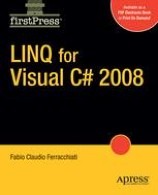
LINQ for Visual C# 2008
Every C# programmer needs to learn about LINQ (Language–Integrated Query), Microsoft's breakthrough technology for simplifying and unifying data access from any data source. With LINQ, you can write more elegant and flexible code—not just to access databases and files, but to manipulate data structures and XML. This book is a short, yet comprehensive guide to the major features of LINQ and the significant enhancements introduced with .NET 3.5. There is no better source for getting a head–start on the future of these technologies than this book.
