



الصفحة 2
الصفحة 2
Multi-body Dynamic Modeling of Multi-legged Robots
This book describes the development of an integrated approach for generating the path and gait of realistic hexapod robotic systems. It discusses in detail locomation with straight-ahead, crab and turning motion capabilities in varying terrains, like sloping surfaces, staircases, and various user-defined rough terrains. It also presents computer simulations and validation using Virtual Prototyping (VP) tools and real-world experiments.

Multiagent System Technologies ; Vol. 3550 : 3rd German Conference, MATES 2005, Koblenz, Germany, September 11-13, 2005, Proceedings
After two successful MATES conferences in Erfurt 2003 and 2004, the 3rd G- man conference on Multi-agent System Technologies (MATES 2005) took place in Koblenz, Germany, in September 2005, and was co-located with the 28th German Conference on Arti?cial Intelligence (KI 2005). Building onotheragent-related events in Germany in the past, and organized by the GI German Special Interest Group on Distributed Arti?cial Intelligence, the MATES conference series aims at promoting the theory and applications of agents and multiagent systems. In corporating the 9th International Workshopon Cooperative Information Agents (CIA 2005), the topics of interest for MATES 2005 also covered the ?elds of intelligent information agents and systems for the Internet and the (Semantic) Web. As in recent years, MATES 2005 provided a distinguished, lively and int- disciplinary forum for researchers, users, and developers of agent technology, to present and discuss the latest advances of research and development in the area of autonomous agents and multiagent systems. Accordingly, the topics of MATES 2005 covered the whole range from the theory to applications of age- and multiagent technology. The technical program included a total of 24 sci- ti?c talks, and demonstrations of selected running agent systems, and both the MATES 2005 Best Paper and the CIA 2005 System Innovation awards.

Motion-Free Super-Resolution
With the explosion of Internet technology and graphics engines, digital images are now everywhere. Image capturing tools are all pervading - in our pockets to inside a satellite. And although imaging applications demand an availability to high resolution images, such images are not picture perfect and may be lacking sufficient details. This requires that these images be super-resolved for improved details. How to achieve this is what constitutes research in the area of image super-resolution. Motion-Free Super-Resolution explores new technology for image super-resolution - applying cues other than the motion cue in super-resolving a scene. This book will serve as an essential reference for both academecians and practicing engineers in the area of image processing and computer vision, as well as providing a basis for ongoing research in this field.

Motion in Games ; 1st International Workshop, MIG 2008, Utrecht, The Netherlands, June 14-17, 2008. Revised Papers
This book constitutes the thoroughly refereed post-workshop proceedings of the First International Workshop on Motion in Games, held in Utrecht, The Netherlands, during June 14-17, 2008, in collaboration with the NLGD Festival of Games.The 24 revised papers presented during the workshop cover topics on crowd simulation; virtual humans; motion synthesis; interfaces; navigation and steering; and facial and behavioral animation.

Modeling Communication with Robots and Virtual Humans ; Second ZiF Research Group International Workshop on Embodied Communication in Humans and Machines, Bielefeld, Germany, April 5-8, 2006, Revised Selected Papers
The 17 articles in this state-of-the-art survey address artificial intelligence research on communicative agents and also provide an interdisciplinary perspective from linguistics, behavioral research, theoretical biology, philosophy, communication psychology, and computational neuroscience. The topics include studies on human multimodal communication; the modeling of feedback signals, facial expression, eye contact, and deception; the recognition and comprehension of hand gestures and head movements; communication interfaces for humanoid robots; the evolution of cognition and language; emotion and social appraisal in nonverbal communication; dialogue models and methodologies; theory of mind and intentionality; complex systems, dynamic field theory, and connectionist modeling.

Model-Driven Software Development
Abstraction is the most basic principle of software engineering. Abstractions are provided by models. Modeling and model transformation constitute the core of model-driven development. Models can be refined and finally be transformed into a technical implementation, i.e., a software system. The aim of this book is to give an overview of the state of the art in model-driven software development. Achievements are considered from a conceptual point of view in the first part, while the second part describes technical advances and infrastructures. Finally, the third part summarizes experiences gained in actual projects employing model-driven development. Beydeda, Book and Gruhn put together the results from leading researchers in this area, both from industry and academia. The result is a collection of papers which gives both researchers and graduate students a comprehensive overview of current research issues and industrial forefront practice, as promoted by OMG’s MDA initiative.
Model-Driven Development of Reliable Automotive Services ; 2nd Automotive Software Workshop, ASWSD 2006, San Diego, CA, USA, March 15-17, 2006, Revised Selected Papers
This book constitutes the thoroughly refereed post-workshop proceedings of the Second Automotive Software Workshop, ASWSD 2006, held in San Diego, CA, USA in March 2006.The 11 revised full papers presented were carefully reviewed and selected from 18 lectures held at the workshop, that brought together experts from industry and academia, working on highly complex, distributed, reactive software systems related to the automotive domain. The papers are organized in topical sections on modeling techniques and infrastructures, model transformations, quality assurance, real-time control, as well as services and components.
Model-Based Engineering of Collaborative Embedded Systems : Extensions of the SPES Methodology
This book presents the results of the "Collaborative Embedded Systems" (CrESt) project, aimed at adapting and complementing the methodology underlying modeling techniques developed to cope with the challenges of the dynamic structures of collaborative embedded systems (CESs) based on the SPES development methodology.

Mobile World : Past, Present and Future
Key reading for all those involved with the future of mobile communications, this book is a valuable resource, particularly for advanced undergraduate and postgraduate students on Mobile Technology courses, practitioners, and researchers working in mobile communications, CSCW and HCI. This volume is a sequel to Brown et al: Wireless World: Social and Interactional Aspects of the Mobile Age, also in the CSCW series. "This book presents a rich insight into how and why the mobile has become so important in today’s society. It explores the strong emotional attachment that people have to these devices, and argues that it is people and not the technology that developers must put at the heart of future mobile offerings. A valuable book for industry and academics alike."

Mining Complex Data ; ECML/PKDD 2007 Third International Workshop, MCD 2007, Warsaw, Poland, September 17-21, 2007, Revised Selected Papers
This book constitutes the refereed proceedings of the Third International Workshop on Mining Complex Data, MCD 2007, held in Warsaw, Poland, in September 2007, co-located with ECML and PKDD 2007.The 20 revised full papers presented were carefully reviewed and selected; they present original results on knowledge discovery from complex data. In contrast to the typical tabular data, complex data can consist of heterogenous data types, can come from different sources, or live in high dimensional spaces. All these specificities call for new data mining strategies.

Medical Image Computing and Computer-Assisted Intervention - MICCAI 2008 ; 11th International Conference, New York, NY, USA, September 6-10, 2008, Proceedings, Part II
The program committee carefully selected 258 revised papers from numerous submissions for presentation in two volumes, based on rigorous peer reviews. The first volume includes 127 papers related to medical image computing, segmentation, shape and statistics analysis, modeling, motion tracking and compensation, as well as registration. The second volume contains 131 contributions related to robotics and interventions, statistical analysis, segmentation, intervention, modeling, and registration.
Medical Image Computing and Computer-Assisted Intervention - MICCAI 2008 ; 11th International Conference, New York, NY, USA, September 6-10, 2008, Proceedings, Part I
The program committee carefully selected 258 revised papers from numerous submissions for presentation in two volumes, based on rigorous peer reviews. The first volume includes 127 papers related to medical image computing, segmentation, shape and statistics analysis, modeling, motion tracking and compensation, as well as registration. The second volume contains 131 contributions related to robotics and interventions, statistical analysis, segmentation, intervention, modeling, and registration.

Measure, Integration & Real Analysis
This book welcomes students into the fundamental theory of measure, integration, and real analysis. Focusing on an accessible approach, Axler lays the foundations for further study by promoting a deep understanding of key results.

Mathematics of Program Construction ; 8th International Conference, MPC 2006, Kuressaare, Estonia, July 3-5, 2006, Proceedings
This volume contains the proceedings of the 8th International Conference on Mathematics of ProgramConstruction, MPC 2006,held at Kuressaare, Estonia, July 3-5, 2006, colocated with the 11th International Conference on Algebraic Methodology and Software Technology, AMAST 2006, July 5-8, 2006. TheMPCconferencesaimtopromotethedevelopmentofmathematicalpr- ciples and techniques that are demonstrably useful and usable in the process of constructing computer programs. Topics of interest range from algorithmics to support for program construction in programming languages and systems.
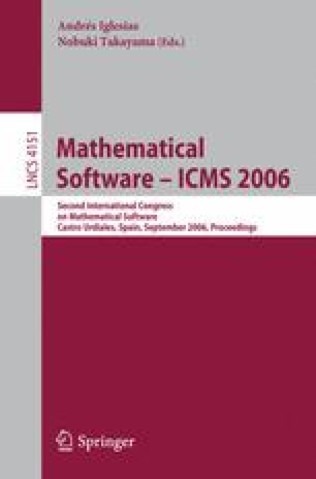
Mathematical Software - ICMS 2006 ; 2nd International Congress on Mathematical Software, Castro Urdiales, Spain, September 1-3, 2006, Proceedings
This volume contains the outstanding collection of invited papers and refereed papers selected for the Second International Congress on Mathematical Software, ICMS 2006, held in Castro Urdiales, Spain, September 1-3, 2006. This congress was devoted to all aspects of mathematical software, whose appearance is — in our opinion — one of the most important events in mathematics. Mathematical software systems are used to construct examples, to prove theorems, and to find new mathematical phenomena. Conversely, mathematical research often motivates developments of new algorithms and new systems. Beyond mathematics, mathematical software systems are becoming indispensable tools in many branches of science and technology.

Mathematical Morphology : 40 Years On ; Proceedings of the 7th International Symposium on Mathematical Morphology, April 18-20, 2005
Mathematical Morphology is a speciality in Image Processing and Analysis, which considers images as geometrical objects, to be analyzed through their interactions with other geometrical objects. It relies on several branches of mathematics, such as discrete geometry, topology, lattice theory, partial differential equations, integral geometry and geometrical probability. It has produced fast and efficient algorithms for computer analysis of images, and has found applications in bio-medical imaging, materials science, geoscience, remote sensing, quality control, document processing and data analysis. This book contains the 43 papers presented at the 7th International Symposium on Mathematical Morphology, held in Paris on April 18-20, 2005. It gives a lively state of the art of current research topics in this field. It also marks a milestone, the 40 years of uninterrupted development of this ever-expanding domain.

IoT-enabled Smart Healthcare Systems, Services and Applications
In IoT-Enabled Smart Healthcare Systems, Services and Applications, an accomplished team of researchers delivers an insightful and comprehensive exploration of the roles played by cutting-edge technologies in modern healthcare delivery. The distinguished editors have included resources from a diverse array of learned experts in the field that combine to create a broad examination of a rapidly developing field.

Introduction to Scientific Visualization
Scientific visualization is recognised as important for understanding data, whether measured, sensed remotely or calculated. Introduction to Scientific Visualization is aimed at readers who are new to the subject, either students taking an advanced option at undergraduate level or postgraduates wishing to visualize some specific data.

Introduction to development engineering
Introduces the emerging field of development engineering and its constituent theories, methods, and applications. It is both an instructional text for students and a resource for researchers and practitioners involved in the design and scaling of technologies for low-resource communities. The scope is broad, ranging from the development of mobile applications for low-literacy users to hardware and software solutions for providing electricity and water in remote environments. It is also highly interdisciplinary, drawing on methods and theories from the social sciences as well as engineering and the natural sciences.

Interactive drink machine company - (IDM company)
This project is a continuation of our previous project for a hot drink machine by adding the capability for electronic payment and developing the company's management system and making the hot drink machine linkable with the company's server via the Internet and more interactive with the customer through the development of this project according to several aspects. On the software level: An integrated system that allows recording customer requests and executed operations, in addition to information about users, including their personal information, current balance, and executed requests. On the level of employees, their personal information, their work tasks and the operations carried out by them (Receipt and delivery of materials and servicing of machines).
