



الصفحة 2
الصفحة 2
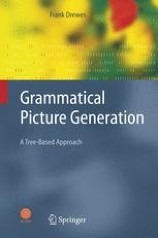
Grammatical Picture Generation : A Tree-Based Approach
The book presents important types of picture generators, using a tree-based approach to stress their common algorithmic basis, the treatment influenced by the theory of computation, and the theory of formal languages in particular. It guides the reader through the basics of the tree-based approach on to dedicated chapters on line-drawing languages, collage grammars, iterated function systems, grid picture languages, languages of fractals, and languages of coloured collages, while presenting results about (un)decidable, NP-complete, or efficiently solvable problems, normal forms, hierarchies of language classes, and related phenomena.
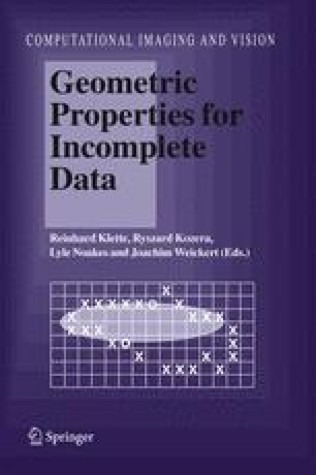
Geometric Properties for Incomplete Data
Computer vision and image analysis require interdisciplinary collaboration between mathematics and engineering. This book addresses the area of high-accuracy measurements of length, curvature, motion parameters and other geometrical quantities from acquired image data. It is a common problem that these measurements are incomplete or noisy, such that considerable efforts are necessary to regularise the data, to fill in missing information, and to judge the accuracy and reliability of these results. This monograph brings together contributions from researchers in computer vision, engineering and mathematics who are working in this area.

Fuzzy database modeling with XML
Fuzzy Database Modeling with XML aims to provide a single record of current research and practical applications in the fuzzy databases. This volume is the outgrowth of research the author has conducted in recent years. Fuzzy Database Modeling with XML introduces state of the art information to the database research, while at the same time serving the information technology professional faced with a non-traditional application that defeats conventional approaches. The research on fuzzy conceptual models and fuzzy object-oriented databases is receiving increasing attention, in addition to fuzzy relational database models. With rapid advances in network and internet techniques as well, the databases have been applied under the environment of distributed information systems. It is essential in this case to integrate multiple fuzzy database systems. Since databases are commonly employed to store and manipulate XML data, additional requirements are necessary to model fuzzy information with XML. Second, this book maps fuzzy XML model to the fuzzy databases. Very few efforts at investigating these issues have thus far occurred.

Fundamentals of multimedia ; 3rd ed.
Addresses real issues commonly faced in the workplace. The essential concepts are explained in a practical way to enable students to apply their existing skills to address problems in multimedia. Fully revised and updated, this new edition now includes coverage of such topics as 3D TV, social networks, high-efficiency video compression and conferencing, wireless and mobile networks, and their attendant technologies.
Fundamentals of multimedia ; 2nd ed.
Addresses real issues commonly faced in the workplace. The essential concepts are explained in a practical way to enable students to apply their existing skills to address problems in multimedia. Fully revised and updated, this new edition now includes coverage of such topics as 3D TV, social networks, high-efficiency video compression and conferencing, wireless and mobile networks, and their attendant technologies.

From Opinion Mining to Financial Argument Mining
Financial opinion mining is a branch of traditional opinion mining and sentiment analysis which shares the basic notions of traditional approaches and adds its own domain-specific characteristics. In Sect. 1.1, we start with a common definition of general opinion mining after which we briefly overview traditional research directions.

Foundations of Qt Development
Foundations of Qt Development is based on Qt 4.2, and is aimed at C++ programmers who want to become proficient using this excellent toolkit to create graphical applications that can be ported to all major platforms. The book is focused on teaching you to write your own code in addition to using existing code. Common areas of confusion are identified, addressed, and answered.
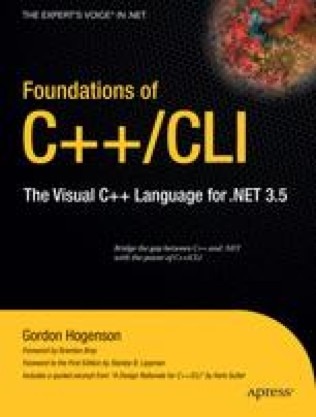
Foundations of C++/CLI : The Visual C++ Language for .NET 3.5
Foundations of C++/CLI: The Visual C++ Language for .NET 3.5 introduces C++/CLI, Microsoft's extensions to the C++ syntax that allow you to target the common language runtime, the key to the heart of the .NET Framework 3.5. This book gives you a small, fast–paced primer that will kick–start your journey into the world of C++/CLI. In 13 no–fluff chapters, Microsoft insiders take readers into the core of the C++/CLI language and explain both how the language elements work and how Microsoft intends them to be used. This book is a beginner's guide, but it assumes a familiarity with programming basics. And it concentrates on explaining the aspects of C++/CLI that make it the most powerful and fun language of the .NET Framework. As such, this book is ideal if you're thinking of migrating to C++/CLI from another language.
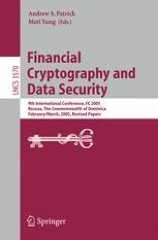
Financial cryptography and data security Vol. 3570 ; 9th International Conference, FC 2005, Roseau, The Commonwealth Of Dominica, February 28 - March 3, 2005, Revised Papers
The 9th International Conference on Financial Cryptography and Data Security (FC 2005) was held in the Commonwealth of Dominica from February 28 to March 3, 2005. This conference, organized by the International Financial Cryptography Association (IFCA), continues to be the premier international forum for research, exploration, and debate regarding security in the context of finance and commerce. The conference title and scope was expanded this year to cover all aspects of securing transactions and systems. The goal is to build an interdisciplinary meeting, bringing together cryptographers, data-security specialists, business and economy researchers, as well as economists, IT professionals, implementers, and policy makers. We think that this goal was met this year. The conference received 90 submissions and 24 papers were accepted, 22 in the Research track and 2 in the Systems and Applications track. In addition, the conference featured two distinguished invited speakers, Bezalel Gavish and Lynne Coventry, and two interesting panel sessions, one on phishing and the other on economics and information security. Also, for the first time, some of the papers that were judged to be very strong but did not make the final program were selected for special invitation to our Works in Progress (Rump) Session that took place on Wednesday evening.
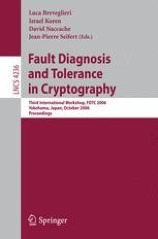
Fault Diagnosis and Tolerance in Cryptography ; 3rd International Workshop, FDTC 2006, Yokohama, Japan, October 10, 2006, Proceedings
The sophistication of the underlying cryptographic algorithms, the high complexity of the implementations, and the easy access and low cost of cryptographic devices resulted in increased concerns regarding the reliability and security of crypto-devices. The effectiveness of side channel attacks on cryptographic devices, like timing and power-based attacks, has been known for some time. Several recent investigations have demonstrated the need to develop methodologies and techniques for designing robust cryptographic systems (both hardware and software) to protect them against both accidental faults and maliciously injected faults with the purpose of extracting the secret key. This trend has been particularly motivated by the fact that the equipment needed to carry out a successful side channel attack based on fault injection is easily accessible at a relatively low cost (for example, laser beam technology), and that the skills needed to use it are quite common.
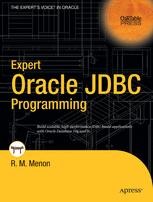
Expert Oracle JDBC Programming
JDBC is the most commonly used API in Java to access and manipulate data in a database. Oracle is one of the most popular and scalable databases in the world. This book is a must-have for any developer building an application that employs JDBC on Oracle database. Unlike other JDBC books, this book has been written to complement not rehash the contents of Oracle JDBC documentation and the JDBC specification. The book teaches you not just how to write JDBC code, but how to write effective JDBC code in a step-by-step fashion. This book does not assume any prior knowledge of JDBC, though it does assume basic knowledge of SQL and PL/SQL. It covers JDBC with a focus on writing high-performing, scalable and secure applications for Oracle 10g and 9i.
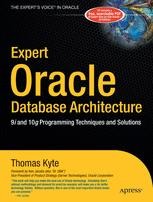
Expert Oracle Database Architecture : 9i and 10g Programming Techniques and Solutions
This is a defining book on the Oracle database for any developer or database administrator who works with Oracle-driven database applications. Tom Kyte has a simple philosophy: you can treat Oracle as a black box and just stick data into it or you can understand how it works and exploit it as a powerful computing environment. If you choose the latter, then you will find that there are few information management problems that you cannot solve quickly and elegantly. Expert Oracle Database Architecture is the first of a three-book series that completely explores and defines the Oracle database. It covers all of the most important Oracle architecture features, including: Files, memory structures and processes / Locking and latching / Transactions, concurrency and multi-versioning / Tables and Indexes / Datatypes / Partitioning and parallelism Each feature is taught in a proof-by-example manner, not only discussing what it is, but also how it works, how to implement software using it, and the common pitfalls associated with it.
Expert C++/CLI : .NET for Visual C++ Programmers
C++/CLI is Microsofts latest extension to C++ that targets the heart of .NET 2.0, the common language runtime. Expert Visual C++/CLI is written by visual C++ MVP Marcus Heege, who examines the core of the C++/CLI language. He explains both how the language elements work and how Microsoft intends them to be used.
Expert .NET Delivery Using NAnt and CruiseControl.NET
This book is a guide to the implementation of good processes in a .NET environment. Author Marc Holmes focuses on actual implementation, and details patterns and anti-patterns to watch out for. He also provides a practical and in-depth look at NAnt and CruiseControl.NET, and solutions to common problem scenarios.

Excel 2007 : Beyond the Manual
Excel 2007: Beyond the Manual will introduce those who are already familiar with Excel basics to more advanced features, like consolidation, what-if analysis, PivotTables, sorting and filtering, and some commonly used functions.
Error-Correction Coding and Decoding : Bounds, Codes, Decoders, Analysis and Applications
This book discusses both the theory and practical applications of self-correcting data, commonly known as error-correcting codes. The applications included demonstrate the importance of these codes in a wide range of everyday technologies, from smartphones to secure communications and transactions. Written in a readily understandable style,This book is a valuable resource for anyone interested in error-correcting codes and their applications, ranging from non-experts to professionals at the forefront of research in their field.

English proofreader
Using Natural Language Processing via Deep Learning, we will attempt to implement a context-sensitive spelling error correction system focused on casual text messaging. For example, usual autocorrect systems will not correct a sentence like “An apple is better than a banana” as this is a syntactically correct sentence. However, a correction should be made here to the word “then” and the sentence should be, “An apple is better than a banana.” These types of mistakes are common in people texting and can be found for example in people learning English as a second language. Natural Language Processing can be summarized as combining the utilization of computation to understand the concepts of natural language and speech.

Engineering self-organising systems Vol. 3910 ; 3rd International Workshop, ESOA 2005, Utrecht, The Netherlands, July 25, 2005, Revised Selected Papers
This book contains recent work from a broad range of areas with the common theme of utilising self-organisation productively. As distributed information infrastructures continue to spread (such as the Internet, wireless and mobile systems), new challenges have arisen demanding robust and scalable solutions. In these new challenging environments the - signers and engineers of global applications and services can seldom rely on centralised control or management, high reliability of devices, or secure en- ronments. At the other end of the scale, ad-hoc sensor networks and ubiquitous computing devices are making it possible to embed millions of smart computing agents into the local environment.
Engineering human computer interaction and interactive systems ; Joint Working Conferences EHCI-DSVIS 2004, Hamburg, Germany, July 11-13, 2004, Revised Selected Papers
As its name suggests, the EHCI-DSVIS conference has been a special event, merging two different, although overlapping, research communities: EHCI (Engineering for Human-Computer Interaction) is a conference organized by the IFIP 2.7/13.4 working group, started in 1974 and held every three years since 1989. The group’s activity is the scientific investigation of the relationships among the human factors in computing and software engineering. DSVIS (Design, Specification and Verification of Interactive Systems) is an annual conference started in 1994, and dedicated to the use of formal methods for the design of interactive systems. Of course these two research domains have a lot in common, and are informed by each other’s results.

Embedded Java Security : Security for Mobile Devices
Whereas Java brings functionality and versatility to the world of mobile devices, at the same time it also introduces new security threats. The rapid growth of the number of mobile devices that support Java makes this a pressing issue. Embedded Java Security carefully examines the security aspects of Java and offers a security evaluation for the Java platform. After explaining background material on the architecture of embedded platforms and relating to its role in security, the book deconstructs the security model into its main components: It explains each component and relates it to the aim of securing the applications and the device. Toward this end, several implementations of the Java platform are examined and tested to relate the model to its actual implementation on devices. The security holes found are further used to clarify security issues and point out common errors. Finally, the book provides an evaluation of embedded Java security that includes security models and security tests performed on real-life implementations.
