



الصفحة 2
الصفحة 2

Introduction to Algorithms
Combines rigor and comprehensiveness. It covers a broad range of algorithms in depth, yet makes their design and analysis accessible to all levels of readers, with self-contained chapters and algorithms in pseudocode. Since the publication of the first edition, Introduction to Algorithms has become the leading algorithms text in universities worldwide as well as the standard reference for professionals. This fourth edition has been updated throughout.

Introducing Blockchain with Java : Program, Implement, and Extend Blockchains with Java
Includes numerous exercises and test questions to help you solidify what you have learned as you progress through the book, and provides ideas on expanding the codebase to make it your own. You will have access to a fully-functioning repository with Java code. You will have the knowledge necessary to program your own blockchains with Java and you will have a completed project for your portfolio. You will: Know the most important theoretical concepts of the blockchain / Code the blockchain in Java / Create a user interface with JavaFX / Implement SQLite DB using JDBC Driver / Create a P2P multi-threaded app / Create your own cryptocurrency app with full functionality / Implement blockchain technology on a P2P network from scratch using Java, JavaFX, and SQL

Intelligent Document Retrieval : Exploiting Markup Structure
Collections of digital documents can nowadays be found everywhere in institutions, universities or companies. Examples are Web sites or intranets. But searching them for information can still be painful. Searches often return either large numbers of matches or no suitable matches at all. Such document collections can vary a lot in size and how much structure they carry. What they have in common is that they typically do have some structure and that they cover a limited range of topics. The second point is significantly different from the Web in general. The type of search system that we propose in this book can suggest ways of refining or relaxing the query to assist a user in the search process. In order to suggest sensible query modifications we would need to know what the documents are about. Explicit knowledge about the document collection encoded in some electronic form is what we need. However, typically such knowledge is not available. So we construct it automatically.

Intelleger = انتليجر
The project management system is a web application designed to assist software managers in efficiently managing their projects, including websites, mobile apps, and other software initiatives. Utilizing artificial intelligence, the application streamlines project creation and management processes, offering significant benefits in terms of organization and accuracy. Managers can create projects by inputting essential details such as the name, scope, deadline, and tasks. The system generates AI-based functional and non-functional requirements tailored to the project scope using gpt2 model on Pure dataset. Managers can then review and edit these requirements as needed before finalizing the project. The application facilitates comprehensive task management by allowing managers to assign tasks to developers, edit task details, and ensure task deadlines align with project deadlines. Developers can log their start and end times automatically when they begin and complete tasks, providing accurate time tracking and performance analysis.also they can use code generation model to generate their task’s code using codebert model on concode and codesearchnet dataset Real-time notifications keep both managers and developers informed of task assignments, completions, and other critical updates.
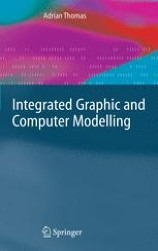
Integrated Graphic and Computer Modelling
Full colour throughout, the book explores programming language developments from machine code to more natural language forms, and the basic display operations and commands needed to create effective computer graphic systems. As the visual presentation of real and virtual environments becomes more and more the norm in application systems, a clear understanding of the theory that underpins these techniques is required of all students and practitioners studying and working on large computer systems.

Inside deep learning : Math, algorithms, models
Journey through the theory and practice of modern deep learning, and apply innovative techniques to solve everyday data problems. In Inside Deep Learning, you will learn how to: Implement deep learning with PyTorch Select the right deep learning components Train and evaluate a deep learning model Fine tune deep learning models to maximize performance Understand deep learning terminology Adapt existing PyTorch code to solve new problems Inside Deep Learning is an accessible guide to implementing deep learning with the PyTorch framework. It demystifies complex deep learning concepts and teaches you to understand the vocabulary of deep learning so you can keep pace in a rapidly evolving field. No detail is skipped--you'll dive into math, theory, and practical applications. Everything is clearly explained in plain English.

Information Systems Security ; Vol. 4332 ; 2nd International Conference, ICISS 2006, Kolkata, India, December 19-21, 2006, Proceedings
This book constitutes the refereed proceedings of the Second International Conference on Information Systems Security, ICISS 2006, held in Kolkata, India in December 2006. The 20 revised full papers and five short papers presented together with four invited papers and three ongoing project summaries were carefully reviewed and selected from 79 submissions. The papers discuss in depth the current state of the research and practice in information systems security.

Information Systems Security ; Vol. 3803 : 1st International conference, ICISS 2005, Kolkata, India, December 19-21, 2005, Proceedings
The 1st InternationalConference on Information Systems Security (ICISS 2005) was held December 19–21, 2005 at Jadavpur University, Kolkata, India. The objectives of the conference were to discuss in depth the current state of the research and practice in information systems security, enable participants to bene?tfrompersonalcontactwithotherresearchersandexpandtheirknowledge, and disseminate the research results. This volumecontains 4 invitedpapers,19refereedpapersthat werepresented at the conference, and 5 ongoing project summaries. The refereed papers, which were selected from the 72 submissions, were rigorouslyreviewed by the Program Committee members. The volume provides researcherswith a broad perspective of recent developments in information systems security. A special note of than...

Information security, practice and experience ; 3rd International Conference, ISPEC 2007, Hong Kong, China, May 7-9, 2007, Proceedings
ISPEC is an annual conference that brings together researchers and practitioners to provide a con?uence of new information security technologies, their applications and their integration with IT systems in various vertical s- tors. In 2005 and 2006,the ?rst and second conferences were held successfully in Singapore and Hangzhou, China, respectively.

Information security practice and experience ; 4th International Conference, ISPEC 2008 Sydney, Australia, April 21-23, 2008 Proceedings
The 4 th Information Security Practice and Experience Conference (ISPEC2008) was held at Crowne Plaza, Darling Harbour, Sydney, Australia, during April 21-23, 2008. The previous three conferences were held in Singapore in 2005, Hangzhou, China in 2006 and Hong Kong, China in 2007. As with the previous three conference proceedings, the proceedings of ISPEC 2008 were published in the LNCS series by Springer. The conference received 95 submissions, out of which the Program Committee selected 29 papers for presentation at the conference. These papers are included in the proceedings. The accepted papers cover a range of topics in mathem- ics, computer science and security applications.

Information security applications ; 8th International Workshop, WISA 2007, Jeju Island, Korea, August 27-29, 2007, Revised Selected Papers
Complete with Springer's trademark online files and updates, this fascinating text constitutes the refereed proceedings of the 8th International Workshop on Information Security Applications, WISA 2007, held in Jeju Island, Korea, in August 2007.

Information security and privacy ; 6th Australasian Conference, ACISP 2001, Sydney, Australia, July 11-13, 2001. Proceedings
A Few Thoughts on E-Commerce.- New CBC-MAC Forgery Attacks.- Cryptanalysis of a Public Key Cryptosystem Proposed at ACISP 2000.- Improved Cryptanalysis of the Self-Shrinking Generator.- Attacks Based on Small Factors in Various Group Structures.- On Classifying Conference Key Distribution Protocols.- Pseudorandomness of MISTY-Type Transformations and the Block Cipher KASUMI.- New Public-Key Cryptosystem Using Divisor Class Groups.- First Implementation of Cryptographic Protocols Based on Algebraic Number Fields.- Practical Key Recovery Schemes.- Non-deterministic Processors.- Personal Secure Booting.- Evaluation of Tamper-Resistant Software Deviating from Structured Programming Rules.- A Strategy for MLS Workflow.- Condition-Driven Integration of Security Services.- SKETHIC: Secure Kernel Extension against Trojan Horses with Informat ion-Carrying Codes.- Secure and Private Distribution of Online Video and Some Related Cryptographic Issues.- Private Information Retrieval Based on the Subgroup Membership Problem.

Information security and cryptology ; Vol. 3822 ; 1st SKLOIS Conference, CISC 2005, Beijing, China, December 15-17, 2005, Proceedings
The first SKLOIS Conference on Information Security and Cryptography(CISC 2005) was organized by the State Key Laboratory of Information Security of the Chinese Academy of Sciences. It was held in Beijing, China, December 15-17, 2005 and was sponsored by the Institute of Software, the Chinese Academy of Sciences, the Graduate School of the Chinese Academy of Sciences and the National Science Foundation of China. The conference proceedings, represe- ing invited and contributed papers, are published in this volume of Springer’s Lecture Notes in Computer Science (LNCS) series. The area of research covered by CISC has been gaining importance in recent years, and a lot of fundamental, experimental and applied work has been done, advancing the state of the art. The program of CISC 2005 covered numerous ?elds of research within the general scope of the conference.

Information Security and Cryptology - ICISC 2007 ; 10th International Conference, Seoul, Korea, November 29-30, 2007, Proceedings
This book constitutes the refereed proceedings of the 10th International Conference on Information Security and Cryptology, ICISC 2007, held in Seoul, Korea, November 29-30, 2007.

Information Security and Cryptology - ICISC 2004 ; 7th International Conference, Seoul, Korea, December 2-3, 2004, Revised Selected Papers
The 7th International Conference on Information Security and Cryptology was organized by the Korea Institute of Information Security and Cryptology (KIISC) and was sponsored by the Ministry of Information and Communi- tion of Korea. The conference received 194 submissions, and the Program Committee - lected 34 of these for presentation. The conference program included two invited lectures.MikeReiterspokeon“Securityby,andfor,ConvergedMobileDevices.” And Frank Stajano spoke on “Security for Ubiquitous Computing.” We would like to ?rst thank the many researchers from all over the world who subm- ted their work to this conference. An electronic submission process was ava- able. The submission review process had two phases. In the ?rst phase, Program Committeememberscompiledreports(assisteda...

Information Security ; Vol. 4176 ; 9th International Conference; ISC 2006, Samos Island, Greece, August 30 - September 2, 2006, Proceedings
th This volume contains the papers presented at the 9 Information Security Conference (ISC 2006) held on Samos Island, Greece, during August 30 – September 2, 2006. The Conference was organized by the University of the Aegean, Greece. ISC was first initiated as a workshop, ISW in Japan in 1997, ISW 1999 in Mal- sia, ISW 2000 in Australia and then changed to the current name ISC when it was held in Spain in 2001 (ISC 2001). The latest conferences were held in Brazil (ISC 2002), UK (ISC 2003), USA (ISC 2004), and Singapore (ISC 2005). ISC 2006 provided an international forum for sharing original research results and application experiences among specialists in fundamental and applied problems of - formation security. In response to the Call for Papers, 188 papers were submitted. Each paper was - viewed by three members of the PC, on the basis of their significance, novelty, and technical quality. Of the papers submitted, 38 were selected for presentation, with an acceptance rate of 20%.

Information Hiding ; 9th International Workshop, IH 2007, Saint Malo, France, June 11-13, 2007, Revised Selected Papers
This book constitutes the thoroughly refereed post-proceedings of the 9th International Workshop on Information Hiding, IH 2007, held in Saint Malo, France, in June 2007.

Information Hiding ; 8th International Workshop, IH 2006, Alexandria, VA, USA, July 10-12, 2006, Revised Seleceted Papers
This volume constitutes the refereed post-proceedings of the 8th International Workshop on Information Hiding held in Alexandria, Virginia, in July 2006.

Information hiding ; 6th International Workshop, IH 2004, Toronto, Canada, May 23-25, 2004, Revised selected papers
All papers were divided into eight sessions: digital media watermarking, steganalysis, digital forensics, steganography, software watermarking, security and privacy, anonymity, and data hiding in unusual content. This year, the workshop included a one-hour rump session that offered an opportunity to the delegates to share their work in progress and other brief but interesting contributions.
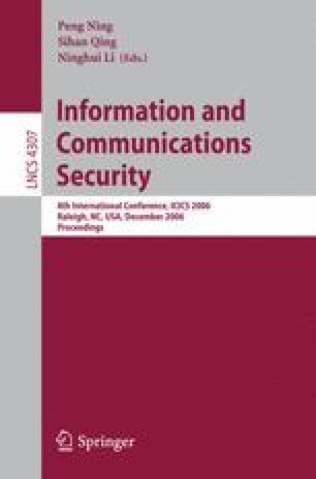
Information and Communications Security ; Vol. 4307 ; 8th International Conference, ICICS 2006, Raleigh, NC, USA, December 4-7, 2006, Proceedings
It is our great pleasure to welcome you to the Eighth International Conference on Information and Communications Security (ICICS 2006), held in Raleigh, North Carolina, USA, December 4–7, 2006. The ICICS conference series is an established forum that brings together researchersand scholars involved in m- tiple disciplines of Information and Communications Security in order to foster exchangeof ideas. The past sevenICICS conferences wereheld in Beijing, China (ICICS 1997); Sydney, Australia (ICICS 1999); Xi’an China (ICICS 2001); S- gapore (ICICS 2002); Hohhot City, China (ICICS 2003); Malaga, Spain (ICICS 2004); and Beijing, China (ICICS 2005). The conference proceedings of the past seven events have been published by Springer in the Lecture Notes in Computer Science series, in LNCS1334,LNCS1726,LNCS2229,LNCS 2513,LNCS 2836, LNCS 3269, and LNCS 3783, respectively. This year we received a total of 119 submissions on various aspects of - hoc and sensor network security. The Program Committee selected 22 regular papers and 17 short papers that cover a variety of topics, including security protocols, applied cryptography and cryptanalysis, access control in distributed systems, privacy, malicious code, network and systems security, and security implementations. Putting together ICICS 2006 was a team e?ort. First of all, we would like to thank the authors of every paper, whether accepted or not, for submitting their papers to ICICS 2006. We would like to express our gratitude to the Program Committee members and the external reviewers, who worked very hard in - viewing the papers and providing suggestions for their improvements.
