



الصفحة 19
الصفحة 19

Fast software encryption ; Vol. 3557 ; 12th International Workshop, FSE 2005, Paris, France, February 21-23, 2005, Revised Selected Papers
The Fast Software Encryption 2005 Workshop was the twelfth in a series of annual workshops on symmetric cryptography, sponsored for the fourth year by the International Association for Cryptologic Research (IACR). The workshop concentratedonallaspectsoffastprimitivesforsymmetriccryptology, including thedesign, cryptanalysisandimplementationofblockandstreamciphersaswell as hash functions and message authentication codes. The ?rst FSE workshop was held in Cambridge in 1993, followed by Leuven in 1994, Cambridge in 1996, Haifain1997, Parisin1998, Romein1999, NewYorkin2000, Yokohamain2001, Leuven in 2002, Lund in 2003, and New Delhi in 2004. This year, a total of 96 submissions were received. After an extensive review by the Program Committee, 30 submissions were accepted.

Fast software encryption ; 15th International Workshop, FSE 2008, Lausanne, Switzerland, February 10-13, 2008, Revised Selected Papers
Constitutes the thoroughly refereed proceedings of the 15th International Workshop on Fast Software Encryption, FSE 2008, held in Lausanne, Switzerland in February 2008.The 26 revised full papers presented together with 4 short papers were carefully reviewed and selected from 72 submissions. The papers address all current aspects of fast and secure primitives for symmetric cryptology and are organized in topical sections on SHA collisions, new hash function designs, block cipher cryptanalysis, implementation aspects, hash function cryptanalysis, stream cipher cryptanalysis, security bounds, and entropy.

Face Biometrics for Personal Identification : Multi-Sensory Multi-Modal Systems
This book provides an ample coverage of theoretical and experimental state-of-the-art work as well as new trends and directions in the biometrics field. It offers students and software engineers a thorough understanding of how some core low-level building blocks of a multi-biometric system are implemented. While this book covers a range of biometric traits including facial geometry, 3D ear form, fingerprints, vein structure, voice, and gait, its main emphasis is placed on multi-sensory and multi-modal face biometrics algorithms and systems. "Multi-sensory" refers to combining data from two or more biometric sensors, such as synchronized reflectance-based and temperature-based face images. "Multi-modal" biometrics means fusing two or more biometric modalities, like face images and voice timber. The first part addresses new and emerging face biometrics. Emphasis is placed on biometric systems where single sensor and single modality are employed in challenging imaging conditions. The second part on multi-sensory face biometrics deals with the personal identification task in challenging variable illuminations and outdoor operating scenarios by employing visible and thermal sensors. The third part of the book focuses on multi-modal face biometrics by integrating voice, ear, and gait modalities with facial data. The last part presents generic chapters on multi-biometrics fusion methodologies and performance prediction techniques.

Expert Clouds and Applications ; Proceedings of ICOECA 2021
Features original papers from International Conference on Expert Clouds and Applications (ICOECA 2021), organized by GITAM School of Technology, Bangalore, India during February 18–19, 2021. It covers new research insights on artificial intelligence, big data, cloud computing, sustainability, and knowledge-based expert systems. The book discusses innovative research from all aspects including theoretical, practical, and experimental domains that pertain to the expert systems, sustainable clouds, and artificial intelligence technologies.
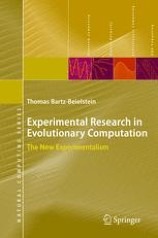
Experimental Research in Evolutionary Computation : The New Experimentalism
This book introduces the new experimentalism in evolutionary computation, providing tools to understand algorithms and programs and their interaction with optimization problems. The book develops and applies statistical techniques to analyze and compare modern search heuristics such as evolutionary algorithms and particle swarm optimization. Treating optimization runs as experiments, the author offers methods for solving complex real-world problems that involve optimization via simulation, and he describes successful applications in engineering and industrial control projects.
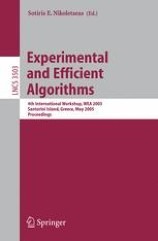
Experimental and Efficient Algorithms ; 4th International Workshop, WEA 2005, Santorini Island, Greece, May 10-13, 2005, Proceedings
This proceedings volume contains the accepted papers and invited talks p- sented at the 4th International Workshop of E?cient and Experimental Al- rithms (WEA 2005), that was held May 10–13, on Santorini Island, Greece. The WEA events are intended to be an international forum for research on the design, analysis and especially the experimental implementation, evaluation and engineering of algorithms, as well as on combinatorial optimization and its applications. The?rstthreeworkshopsinthisserieswereheldinRiga(2001),MonteVerita (2003) and Rio de Janeiro (2004). Thisvolumecontains3invitedpapersrelatedtocorrespondingkeynotetalks.
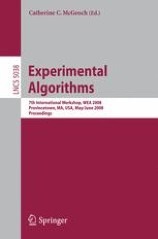
Experimental Algorithms ; 7th International Workshop, WEA 2008 Provincetown, MA, USA, May 30-June 1, 2008 Proceedings
The Workshop on Experimental Algorithms, WEA, is intended to be an international forum for research on the experimental evaluation and engineering of algorithms, as well as in various aspects of computational optimization and its applications. The emphasis of the workshop is the use of experimental me- ods to guide the design, analysis, implementation, and evaluation of algorithms, heuristics, and optimization programs. WEA 2008 was held at the Provincetown Inn, Provincetown, MA, USA, on May 30 – June 1, 2008. This was the seventh workshop of the series.

Experimental Algorithms ; 6th International Workshop, WEA 2007, Rome, Italy, June 6-8, 2007, Proceedings
Fostering and disseminating high quality research results focused on the experimental analysis of algorithms the papers are devoted to the design, analysis, implementation, experimental evaluation, and engineering of efficient algorithms. Among the application areas addressed are most fields applying advanced algorithmic techniques, such as combinatorial optimization, approximation, graph theory, discrete mathematics, data mining, simulation, cryptography and security, scheduling, searching, sorting, string matching, coding, networking, etc.

Experimental Algorithms ; 5th International Workshop, WEA 2006, Cala Galdana, Menorca, Spain, May 24-27, 2006, Proceedings
This book constitutes the refereed proceedings of the 5th International Workshop on Experimental and Efficient Algorithms, WEA 2006, held in Cala Galdana, Menorca, Spain in May 2006. The 26 revised full papers presented together with 3 invited talks were carefully reviewed and selected from 92 submissions. The book is devoted to the design, analysis, implementation, experimental evaluation, and engineering of efficient algorithms. Among the application areas addressed are most fields applying advanced algorithmic techniques.

Evolvable systems : From biology to hardware ; 7th International Conference, ICES 2007, Wuhan, China, September 21-23, 2007, Proceedings
The 41 revised full papers collected in this volume are organized in topical sections on digital hardware evolution, analog hardware evolution, bio-inspired systems, mechanical hardware evolution, evolutionary design, evolutionary algorithms in hardware design, and hardware implementation of evolutionary algorithms.

Evolvable Hardware
The contributions in this book provide the basics of reconfigurable devices so that readers will be fully prepared to understand what EHW is, why it is necessary and how it is designed. The book also discusses the leading research in digital, analog and mechanical EHW. Selections from leading international researchers offer examples of cutting-edge research and applications, placing particular emphasis on their practical usefulness.

Evolutionary Synthesis of Pattern Recognition Systems
Evolutionary Synthesis of Pattern Recognition Systems presents novel effective approaches based on evolutionary computational techniques, such as genetic programming (GP), linear genetic programming (LGP), coevolutionary genetic programming (CGP) and genetic algorithms (GA) to automate the synthesis and analysis of object detection and recognition systems. The book’s concepts, principles, and methodologies will enable readers to automatically build robust and flexible systems—in a systematic manner—that can provide human-competitive performance and reduce the cost of designing and maintaining these systems. Its content covers all key aspects of object recognition: object detection, feature selection, feature discovery, object recognition, domain knowledge. Basic knowledge of programming and data structures, and some calculus, is presupposed.ing the book’s novel ideas

Evolutionary Multiobjective Optimization : Theoretical Advances and Applications
Evolutionary Multiobjective Optimization is a rare collection of the latest state-of-the-art theoretical research, design challenges and applications in the field of multiobjective optimization paradigms using evolutionary algorithms. It includes two introductory chapters giving all the fundamental definitions, several complex test functions and a practical problem involving the multiobjective optimization of space structures under static and seismic loading conditions used to illustrate the various multiobjective optimization concepts.

Evolutionary Multi-Criterion Optimization ; 4th International Conference, EMO 2007, Matsushima, Japan, March 5-8, 2007, Proceedings
Multicriterion optimization refers to problems with two or more objectives (normally in conflict with each other) which must be simultaneously satisfied. Evolutionary algorithms have been used for solving multicriterion optimization problems for over two decades, gaining an increasing attention from industry. This book included four keynote speakers: Hirotaka Nakayama on aspiration level methods, Kay Chen Tan on large and computationally intensive real-world MO optimization problems, Carlos Fonseca on decision making, and Gary B. Lamont on design of large-scale network centric systems.

Evolutionary Multi-Criterion Optimization ; 3rd International Conference, EMO 2005, Guanajuato, Mexico, March 9-11, 2005, Proceedings
Constitutes the refereed proceedings of the Third International Conference on Evolutionary Multi-Criterion Optimization, EMO 2005, held in Guanajuato, Mexico, in March 2005.

Evolutionary Computer Music
The evolutionary computation approach to music is an exciting new development for composers and musicologists alike. For composers, it provides an innovative and natural means for generating musical ideas from a specifiable set of primitive components and processes. For musicologists, these techniques are used to model the cultural transmission and change of a population's body of musical ideas over time. In both cases, musical evolution can be guided by a variety of constraints and tendencies built into the system, such as realistic psychological factors that influence the way music is expressed, experienced, learned, stored, modified, and passed on among individuals. This book discusses not only the applications of evolutionary computation to music, but also the tools needed to create and study such systems. These tools are drawn in part from research into the origins and evolution of biological organisms, ecologies, and cultural systems on the one hand, and from computer simulation methodologies on the other. They can be combined to create surrogate artificial worlds populated by interacting simulated organisms in which complex musical experiments can be performed that would otherwise be impossible.

Evolutionary computation, machine learning and data mining in bioinformatics ; 6th European Conference, EvoBIO 2008, Naples, Italy, March 26-28, 2008. Proceedings
The feld of bioinformatics has two main objectives: the creation and main- nance of biological databases, and the discovery of knowledge from life sciences data in order to unravel the mysteries of biological function, leading to new drugs and therapies for human disease. Life sciences data come in the form of biological sequences, structures, pathways, or literature. One major aspect of discovering biological knowledge is to search, predict, or model specifc infortioninagivendatasetinorderto generate new in teresting knowledge.Computer science methods such as evolutionary computation, machine learning, and data mining all have a great deal to ofer the feld of bioinformatics.

Evolutionary Computation in Data Mining
This carefully edited book reflects and advances the state of the art in the area of Data Mining and Knowledge Discovery with Evolutionary Algorithms. It emphasizes the utility of different evolutionary computing tools to various facets of knowledge discovery from databases, ranging from theoretical analysis to real-life applications. "Evolutionary Computation in Data Mining" provides a balanced mixture of theory, algorithms and applications in a cohesive manner, and demonstrates how the different tools of evolutionary computation can be used for solving real-life problems in data mining and bioinformatics.

Evolutionary computation in combinatorial optimization Vol. 3906 ; 6th European Conference, EvoCOP 2006, Budapest, Hungary, April 10-12, 2006, Proceedings
This book constitutes the refereed proceedings of the 6th European Conference on Evolutionary Computation in Combinatorial Optimization, EvoCOP 2006, held in Budapest, Hungary in April 2006.
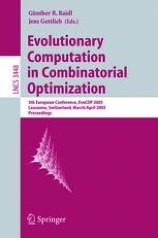
Evolutionary computation in combinatorial optimization ; Vol. 3448 ; 5th European Conference, EvoCOP 2005, Lausanne, Switzerland, March 30 - April 1, 2005, Proceedings
This volume contains the proceedings of EvoCOP 2005, the 5th European Conference on Evolutionary Computation in Combinatorial Optimization. It was held in Lausanne, Switzerland, on 30 March-1 April 2005
