



الصفحة 19
الصفحة 19
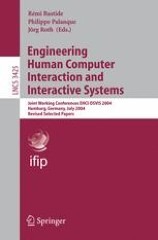
Engineering human computer interaction and interactive systems ; Joint Working Conferences EHCI-DSVIS 2004, Hamburg, Germany, July 11-13, 2004, Revised Selected Papers
As its name suggests, the EHCI-DSVIS conference has been a special event, merging two different, although overlapping, research communities: EHCI (Engineering for Human-Computer Interaction) is a conference organized by the IFIP 2.7/13.4 working group, started in 1974 and held every three years since 1989. The group’s activity is the scientific investigation of the relationships among the human factors in computing and software engineering. DSVIS (Design, Specification and Verification of Interactive Systems) is an annual conference started in 1994, and dedicated to the use of formal methods for the design of interactive systems. Of course these two research domains have a lot in common, and are informed by each other’s results.

Engineering and Managing Software Requirements
This book provides an exploration of key issues in requirements engineering, the book is organized in three parts. Part 1 presents surveys of state-of-the art requirements engineering process research along with critical assessments of existing models, frameworks and techniques. Part 2 addresses key areas in requirements engineering, such as market-driven requirements engineering, goal modeling, requirements ambiguity, and others. Part 3 concludes the book with articles that present empirical evidence and experiences from practices in industrial projects. Its broader perspective gives this book its distinct appeal and makes it of interest to both researchers and practitioners, not only in software engineering but also in other disciplines such as business process engineering and management science.

End-User Development
By now, most people have become familiar with the basic functionality and interfaces of computers. However, developing new or modified applications that effectively support users' goals still requires considerable expertise in programming that cannot be expected from most people. Thus, one fundamental challenge for the coming years is to develop environments that allow users who do not have background in programming to develop or modify their own applications, with the ultimate aim of empowering people to flexibly employ advanced information and communication technologies.
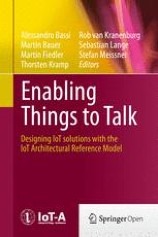
Enabling things to talk : Designing IoT solutions with the IoT architectural reference model
The Internet of Things (IoT) is an emerging network superstructure that will connect physical resources and actual users. It will support an ecosystem of smart applications and services bringing hyper-connectivity to our society by using augmented and rich interfaces. Whereas in the beginning IoT referred to the advent of barcodes and Radio Frequency Identification (RFID), which helped to automate inventory, tracking and basic identification, today IoT is characterized by a dynamic trend toward connecting smart sensors, objects, devices, data and applications. The next step will be “cognitive IoT,” facilitating object and data re-use across application domains and leveraging hyper-connectivity, interoperability solutions and semantically enriched information distribution.

Empirical Software Engineering Issues Critical Assessment and Future Directions : International Workshop, Dagstuhl Castle, Germany, June 26-30, 2006, Revised Papers
Its goal was to discuss the state of the art of empirical software engineering (ESE) by assessing past accomplishments, raising open questions, and proposing a future research agenda. At the same time, the spectrum of methods applied in ESE has broadened.
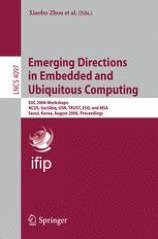
Emerging Directions in Embedded and Ubiquitous Computing ; EUC 2006 Workshops : NCUS, SecUbiq, USN, TRUST, ESO, and MSA, Seoul, Korea, August 1-4, 2006, Proceedings
Constitutes the refereed proceedings of the EUC 2006 workshops, held in conjunction with the IFIP International Conference on Embedded and Ubiquitous Computing in Seoul, Korea, August 2006.

Embedded systems design : The ARTIST roadmap for research and development
Embedded systems now include a very large proportion of the advanced products designed in the world, spanning transport (avionics, space, automotive, trains), electrical and electronic appliances (cameras, toys, televisions, home appliances, audio systems, and cellular phones), process control (energy production and distribution, factory automation and optimization), telecommunications (satellites, mobile phones and telecom networks), and security (e-commerce, smart cards), etc. The extensive and increasing use of embedded systems and their integration in everyday products marks a significant evolution in information science and technology. We expect that within a short timeframe embedded systems will be a part of nearly all equipment designed or manufactured in Europe, the USA, and Asia. There is now a strategic shift in emphasis for embedded systems designers: from simply achieving feasibility, to achieving optimality. Optimal design of embedded systems means targeting a given market segment at the lowest cost and delivery time possible. Optimality implies seamless integration with the physical and electronic environment while respecting real-world constraints such as hard deadlines, reliability, availability, robustness, power consumption, and cost. In our view, optimality can only be achieved through the emergence of embedded systems as a discipline in its own right.

Embedded System Design : Topics, Techniques and Trends; IFIP TC10 Working Conference: International Embedded Systems Symposium (IESS), May 30 - June 1, 2007, Irvine (CA), USA
Embedded systems have gained an enormous amount of processing power and functionality. Many of the formerly external components can now be integrated into a single System-on-Chip. This tendency has resulted in a dramatic reduction in the size and cost of embedded systems. As a unique technology, the design of embedded systems is an essential element of many innovations. This book including design methodology, specification and modeling, embedded software and hardware synthesis, networks-on-chip, distributed and networked systems, and system verification and validation. Particular emphaisis is paid to automotive and medical applications. A set of actual case studies and special aspects in embedded system design are included as well.

Embedded Software and Systems Vol. 3605 ; 1st International Conference, ICESS 2004, Hangzhou, China, December 9-10, 2004, Revised Selected Papers
Welcome to the post proceedings of the First International Conference on Embedded Software and Systems (ICESS 2004), which was held in Hangzhou, P. R. China, 9–10 December 2004. Embedded Software and Systems technology is of increasing importance for a wide range of industrial areas, such as aerospace, automotive, telecommunication, and manufacturing automation. Embedded technology is playing an increasingly dominant role in modern society. This is a natural outcome of amazingly fast developments in the embedded field. The ICESS 2004 conference brought together researchers and developers from academia, industry, and government to advance the science, engineering, and technology in embedded software and systems development, and provided them with a forum to present and exchange their ideas, results, work in progress, and experience in all areas of embedded systems research and development. The ICESS 2004 conference attracted much more interest than expected.
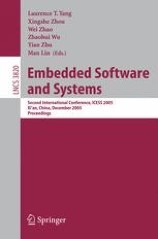
Embedded Software and Systems ; Vol. 3820 ; 2nd International Conference, ICESS 2005, Xi'an, China, December 16-18, 2005, Proceedings
Welcome to the proceedings of the 2005 International Conference on Emb- ded Software and Systems (ICESS 2005) held in Xian, China, December 16-18, 2005. With the advent of VLSI system level integration and system-on-chip, the center of gravity of the computer industry is now moving from personal c- puting into embedded computing. Embedded software and systems are incre- ingly becoming a key technological component of all kinds of complex technical systems, ranging from vehicles, telephones, aircraft, toys, security systems, to medical diagnostics, weapons, pacemakers, climate control systems, etc. The ICESS 2005 conference provided a premier international forum for - searchers, developers and providers from academia and industry to address all resulting profound challenges; to present and discuss their new ideas, - search results, applications and experience; to improve international com- nication and cooperation; and to promote embedded software and system - dustrialization and wide applications on all aspects of embedded software and systems.
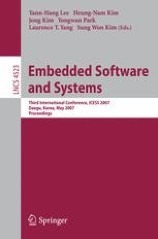
Embedded Software and Systems ; 3rd International Conference, ICESS 2007, Daegu, Korea, May 14-16, 2007, Proceedings
This book introduces sections on embedded architecture, embedded hardware, embedded software, HW-SW co-design and SoC, multimedia and HCI, pervasive/ubiquitous computing and sensor network, power-aware computing, real-time systems, security and dependability, and wireless communication.

Embedded Robotics : Mobile Robot Design and Applications with Embedded Systems
This book presents a unique examination of mobile robots and embedded systems, from introductory to intermediate level. It is structured in three parts, dealing with Embedded Systems (hardware and software design, actuators, sensors, PID control, multitasking), Mobile Robot Design (driving, balancing, walking, and flying robots), and Mobile Robot Applications (mapping, robot soccer, genetic algorithms, neural networks, behavior-based systems, and simulation).

Embedded Robotics : Mobile Robot Design and Applications with Embedded Systems
The EyeBot controller and mobile robots have evolved over more than a decade. This book gives an in-depth introduction to embedded systems and autonomous mobile robots, using the EyeBot controller (EyeCon) and the EyeBot mobile robot family as application examples. This book combines teaching and research material and can be used for courses in Embedded Systems as well as in Robotics and Automation.

Embedded Firmware Solutions : Development Best Practices for the Internet of Things
Embedded Firmware Solutions is the perfect introduction and daily-use field guide--for the thousands of firmware designers, hardware engineers, architects, managers, and developers--to Intel’s new firmware direction (including Quark coverage), showing how to integrate Intel® Architecture designs into their plans. Featuring hands-on examples and exercises using Open Source codebases, like Coreboot and EFI Development Kit (tianocore) and Chromebook, this is the first book that combines a timely and thorough overview of firmware solutions for the rapidly evolving embedded ecosystem with in-depth coverage of requirements and optimization.
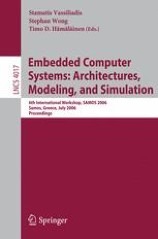
Embedded Computer Systems : Architectures, Modeling, and Simulation ; Vol. 4017 ; 6th International Workshop, SAMOS 2006, Samos, Greece, July 17-20, 2006, Proceedings
This book constitutes the refereed proceedings of the 6th International Workshop on Systems, Architectures, Modeling, and Simulation, SAMOS 2006, held in Samos, Greece on July 2006.The 47 revised full papers presented together with 2 keynote talks were thoroughly reviewed and selected from 130 submissions.
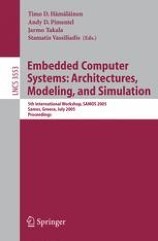
Embedded computer systems : Architectures, modeling, and simulation ; Vol. 3553 ; 5th International Workshop, SAMOS 2005, Samos, Greece, July 18-20, Proceedings
The SAMOS workshop is an international gathering of highly quali?ed researchers from academia and industry, sharing in a 3-day lively discussion on the quiet and - spiring northern mountainside of the Mediterranean island of Samos. As a tradition, the workshop features workshop presentations in the morning, while after lunch all kinds of informal discussions and nut-cracking gatherings take place. The workshop is unique in the sense that not only solved research problems are presented and discussed but also (partly) unsolved problems and in-depth topical reviews can be unleashed in the sci- ti?c arena. Consequently, the workshop provides the participants with an environment where collaboration rather than competition is fostered. The earlier workshops, SAMOS I–IV (2001–2004), were composed only of invited presentations. Due to increasing expressions of interest in the workshop, the Program Committee of SAMOS V decided to open the workshop for all submissions. As a result the SAMOS workshop gained an immediate popularity; a total of 114 submitted papers were received for evaluation. The papers came from 24 countries and regions: Austria (1), Belgium (2), Brazil (5), Canada (4), China (12), Cyprus (2), Czech Republic (1), Finland (15), France (6), Germany (8), Greece (5), Hong Kong (2), India (2), Iran (1), Korea (24), The Netherlands (7), Pakistan (1), Poland (2), Spain (2), Sweden (2), T- wan (1), Turkey (2), UK (2), and USA (5). We are grateful to all of the authors who submitted papers to the workshop.

Embedded Computer Systems : Architectures, Modeling, and Simulation ; 8th International Workshop, SAMOS 2008, Samos, Greece, July 21-24, 2008. Proceedings
This book constitutes the refereed proceedings of the 8th International Workshop on Systems, Architectures, Modeling, and Simulation, SAMOS 2008, held in Samos, Greece, in July 2008.
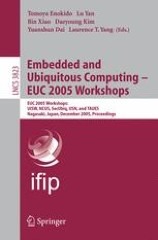
Embedded and Ubiquitous Computing - EUC 2005 Workshops ; EUC 2005 Workshops : UISW, NCUS, SecUbiq, USN, and TAUES, Nagasaki, Japan, December 8-9, 2005
This book constitutes the refereed proceedings of the EUC 2005 workshops held in conjunction with the IFIP International Conference on Embedded and Ubiquitous Computing, EUC 2005, in Nagasaki, Japan in December 2005.The 132 revised full papers presented were carefully reviewed and selected from 352 submissions. Topics covered by the five workshops are ubiquitous intelligence and smart worlds (UISW 2005), network-centric ubiquitous systems (NCUS 2005), security in ubiquitous computing systems (SecUbiq 2005), RFID and ubiquitous sensor networks (USN 2005), and trusted and autonomic ubiquitous and embedded systems (TAUES 2005).

Elementary logic : For software development
This book teaches readers how to better reason about software development, to communicate reasoning, to distinguish between good and bad reasoning, and to read professional literature that presumes knowledge of elementary logic. It explains fundamental concepts and provides reader-friendly instructions for applying logic to software development.

Electronic Postage Systems : Technology, Security, Economics
This book introduces a taxonomy of electronic postage systems and explains their security risks and countermeasures. The underlying cryptographic mechanisms are introduced and explained, and the industrial-scale electronic postage systems existing worldwide, are sorted out with respect to this taxonomy. The author also discusses privacy and anonymous mail, the state of standardization of electronic postage, and the process of security evaluation and testing of electronic postage systems. This volume including electronic postage designers of postal operators and standardization bodies, software and test engineers, software vendors integrating electronic postage solutions into their applications, security engineers and cryptography experts, and accredited test laboratories evaluating electronic postage systems.
