



الصفحة 18
الصفحة 18

Data augmented design : Embracing new data for sustainable urban planning and design
This book offers an essential introduction to a new urban planning and design methodology called Data Augmented Design (DAD) and its evolution and progresses, highlighting data driven methods, urban planning and design applications and related theories. The authors draw on many kinds of data, including big, open, and conventional data, and discuss cutting-edge technologies that illustrate DAD as a future-oriented design framework in terms of its focus on multi-data, multi-method, multi-stage and multi-scale sustainable urban planning. In four sections and ten chapters, the book presents case studies to address the core concepts of DAD, the first type of applications of DAD that emerged in redevelopment-oriented planning and design, the second type committed to the planning and design for urban expansion, and the future-oriented applications of DAD to advance sustainable technologies and the future structural form of the built environment. The book is geared towards a broad readership, ranging from researchers and students of urban planning, urban design, urban geography, urban economics, and urban sociology, to practitioners in the areas of urban planning and design.

Data Algorithms with Spark
Apache Spark's speed, ease of use, sophisticated analytics, and multilanguage support makes practical knowledge of this cluster-computing framework a required skill for data engineers and data scientists. With this hands-on guide, anyone looking for an introduction to Spark will learn practical algorithms and examples using PySpark. you will: Learn how to select Spark transformations for optimized solutions Explore powerful transformations and reductions including reduceByKey(), combineByKey(), and mapPartitions() Understand data partitioning for optimized queries Build and apply a model using PySpark design patterns Apply motif-finding algorithms to graph data Analyze graph data by using the GraphFrames API Apply PySpark algorithms to clinical and genomics data Learn how to use and apply feature engineering in ML algorithms Understand and use practical and pragmatic data design patterns
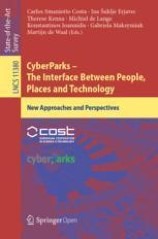
CyberParks – The Interface Between People, Places and Technology: New Approaches and Perspectives
This book is about public open spaces, about people, and about the relationship between them and the role of technology in this relationship. It is about different approaches, methods, empirical studies, and concerns about a phenomenon that is increasingly being in the centre of sciences and strategies – the penetration of digital technologies in the urban space. As the main outcome of the CyberParks Project, this book aims at fostering the understanding about the current and future interactions of the nexus people, public spaces and technology. It addresses a wide range of challenges and multidisciplinary perspectives on emerging phenomena related to the penetration of technology in people’s lifestyles - affecting therefore the whole society, and with this, the production and use of public spaces. Cyberparks coined the term cyberpark to describe the mediated public space, that emerging type of urban spaces where nature and cybertechnologies blend together to generate hybrid experiences and enhance quality of life.

Current trends in database technology - EDBT 2004 Workshops ; EDBT 2004 Workshops PhD, DataX, PIM, P2P&DB, and ClustWeb, Heraklion, Crete, Greece, March 14-18, 2004, Revised Selected Papers
This volume comprises papers from the following ?ve workshops that were part of the complete program for the International Conference on Extending Database Technology (EDBT) held in Heraklion, Greece, March 2004: • ICDE/EDBT Joint Ph. D. Workshop (PhD) • Database Technologies for Handling XML-information on the Web (DataX) • Pervasive Information Management (PIM) • Peer-to-Peer Computing and Databases (P2P&DB) • Clustering Information Over the Web (ClustWeb) Together, the ?ve workshops featured 61 high-quality papers selected from appr- imately 180 submissions.

Creating Mobile Games : Using Java™ ME Platform to Put the Fun into Your Mobile Device and Cell Phone
Creating Mobile Games: shows you how to create a basic game and make it a professional one (by adding a pro look-and-feel by writing your own menus or using the open source J2ME Polish, and enabling marketing/billing from your own web site). Demonstrates Wireless Messaging and other optional APIs (using SMS, PIM, File Connection, Bluetooth, and so forth in a multiplayer game).

COTS-Based software systems ; 4th International Conference, ICCBSS 2005, Bilbao, Spain, February 7-11, 2005, Proceedings
The theme “Build and Conquer” : software development is an engineering discipline, and not an artistic expression. Once we are ready to “build” our software systems using pieces previously builtin (similar to any other technology manufacturer), we will be able to “conquer” the software engineering process. If we take a look at other engineering disciplines such as car manufacturing, house appliances or aeronautics, we see that the final products are built through the integration of multiprovider commercial components. These components are successfully integrated and constitute an important part of the final product. Most software-related organizations still build software from scratch, omitting thousands of ready-built commercially available software components that could be used very effectively during the development phase. This year ICCBSS moves to Europe for the first time since the first conference took place in Orlando, FL, USA in 2002. The conference scope has enlarged over the years to include the Open Source community and Web Services technologies. so many of the characteristics of COTS are also applied to Open Source and Web Services.

Coordination, organizations, institutions, and norms in agent systems II ; AAMAS 2006 and ECAI 2006 International Workshops, COIN 2006 Hakodate, Japan, May 9, 2006 Riva del Garda, Italy, August 28, 2006, Revised Selected Papers
In recent years, social and organizational aspects of agency have become major research topics in MAS. Recent applications of MAS on Web services, grid c- puting and ubiquitous computing highlight the need for using these aspects in order to ensure social order within such environments. Openness, heterogeneity, and scalability of MAS, in turn, pose new demands on traditional MAS int- action models and bring forward the need to look into the environment where agents interact and at di?erent ways of constraining or regulating interactions.it provide theoretically demanding and interdisciplinary research questions at d- ferent levels of abstraction.

Coordination, organizations, institutions, and norms in agent system III ; COIN 2007 International Workshops COIN@AAMAS 2007, Honolulu, HI, USA, May 14, 2007 COIN@MALLOW 2007, Durham, UK, September 3-4, 2007 Revised Selected Papers
This book constitutes the refereed post-workshop proceedings of the International Workshop on Coordination, Organization, Institutions and Norms in Agent Systems, COIN 2007.

Coordination, organizations, institutions, and norms in agent system ; AAMAS 2005 International Workshops on Agents, Norms, and Institutions for Regulated Multiagent Systems, ANIREM 2005 and on organizations in multi-agent systems, OOOP 2005, Utrecht, The Netherlands, July 25-26, 2005, Revised Selected Papers
This book constitutes the refereed post-proceedings of the International Workshop on Agents, Norms and Institutions for Regulated Multiagent Systems, ANIREM 2005, and the International Workshop on Organizations in Multi-Agent Systems, OOOP 2005, held in Utrecht, The Netherlands, July 2005.

Coordination of Large-Scale Multiagent Systems
Challenges arise when the size of a group of cooperating agents is scaled to hundreds or thousands of members. In domains such as space exploration, military and disaster response, groups of this size (or larger) are required to achieve extremely complex, distributed goals. To effectively and efficiently achieve their goals, members of a group need to cohesively follow a joint course of action while remaining flexible to unforeseen developments in the environment. Coordination of Large-Scale Multiagent Systems provides extensive coverage of the latest research and novel solutions being developed in the field.

Coordination models and languages ; Vol.3454 : 7th international conference, COORDINATION 2005, Namur, Belgium, April 20-23, 2005, Proceedings
This book constitutes the refereed proceedings of the 7th International Conference on Coordination Models and Languages, COORDINATION 2005, held in Namur, Belgium in April 2005. The 19 revised full papers presented were carefully reviewed and selected from 88 submissions. Among the topics addressed are Web services, safe ambients, process calculus, abstract verification, role-based software, delegation modeling, distributed information flow, adaptive Web content provision, global computing, mobile agents, mobile computing, multithreaded code generation, shared data space coordination languages, automata specifications, time aware coordination, and service discovery.

Coordination models and languages ; 10th International Conference, COORDINATION 2008, Oslo, Norway, June 4-6, 2008. Proceedings
This book constitutes the refereed proceedings of the 10th International Conference on Coordination Models and Languages, COORDINATION 2008, held in Oslo, Norway, in June 2008, as one of the federated conferences on Distributed Computing Techniques, DisCoTec 2008.

Cooperative Information Agents XII ; 12th International Workshop, CIA 2008, Prague, Czech Republic, September 10-12, 2008. Proceedings
This book constitutes the refereed proceedings of the 12th International Workshop on Cooperative Information Agents, CIA 2008, held in Prague, Czech Republik, in September 2008.

Cooperative Information Agents XI ; Matthias Klusch, Koen V. Hindriks, Mike P. Papazoglou, Leon Sterling
In today’s world of ubiquitously connected heterogeneous information systems and computing devices, the intelligent coordination and provision of relevant added-value information at any time, anywhere is of key importance to a va- ety of applications. This challenge is envisioned to be coped with by means of appropriate intelligent and cooperative information agents. An information agent is a computational software entity that has access to one or multiple heterogeneous and geographically dispersed data and infor- tion sources. It pro-actively searches for and maintains information on behalf of its human users, or other agents preferably just in time. In other words, it is managing and overcoming the di?culties associated with information overload in open, pervasive information and service landscapes. Each component of a modern cooperative information system is represented by an appropriate intelligent information agent capable of resolving system and semantic heterogeneities in a given context on demand. Cooperative infor- tion agents are supposed to accomplish both individual and shared joint goals depending on the actual user preferences in line with given or deduced limits of time, budget and resources available.

Cooperative Information Agents X ; 10th International Workshop, CIA 2006, Edinburgh, UK, September 11-13, 2006, Proceedings
This book constitutes the refereed proceedings of the 10th International Workshop on Cooperative Information Agents, CIA 2006, held in Edinburgh, UK in September 2006. The 29 revised full papers presented together with four invited papers were carefully reviewed and selected from 58 submissions. The papers are organized in topical sections.

Converged communications : Evolution from telephony to 5G mobile internet
The central theme of the book is to build deeper understanding about incremental technological progress by introducing both state of the art and their predecessor technologies. The book explores four main areas, including fixed telephone systems, data communication systems, mobile cellular systems, and IP multimedia systems. It clearly explains architectures, protocols, and functional procedures, and discusses a variety of topics ranging from physical layer processes to system level interactions. Converged Communications offers: In-depth treatments of fixed telephone and transmission systems, including operation of telephone exchanges and signaling systems Comprehensive explorations of data communication systems, including transmission of data over telephone lines and data network technologies, such as Ethernet and TCP/IP Incisive discussions of mobile cellular systems, including GSM, 3G, LTE, VoLTE and 5G Insightful analysis of incremental system evolution to justify various design choices made The book is supported with extensive online appendices, which covers communication system concepts, an overview of standardization, various technologies used in the past, state-of-the art technologies such as WLAN, cable modems, and FTTx, complementing the other systems described in the book which have evolved from the fixed telephone network.

Control Reconfiguration of Dynamical Systems : Linear Approaches and Structural Tests
The book addresses advanced engineering students, developers and researchers that have a specific interest in control reconfiguration. A good understanding of multi-variable dynamic systems is helpful, but the second part is accessible even without this.

Content based image retrieval systems
With an advent of technology, huge collection of digital images is formed as repositories on crime prevention, medical diagnosis, military, face finding, satellites and remote sensing. The task of searching for similar images in the repository is difficult. The data is growing enormously which makes it difficult to store and manage. The traditional image retrieval technique is inefficient in retrieving these images. Content-based image retrieval is an approach from data mining community, which provides the solution of managing this huge quantity of data. In this research, a Content-Based Image Retrieval (CBIR) system has been developed using color and texture as retrieval features from the image repository. The system allows the user to search for an image based on any of the two features alone or in combination by assigning weights to the features. The histogram and color moments approach is used to extract the color feature, texture feature is extracted using statistical moments and co-occurrence matrix method and the shape feature is extracted using the morphological operations. The images and the extracted feature vectors are stored in the Pickle file. The system is robust as it provides search based on the multiple features. The performance of the system was evaluated by analyzing the retrieval results using precision and recall.

Contemporary Cryptology
The aim of this text is to treat selected topics of the subject of contemporary cryptology, structured in five quite independent but related themes: Efficient distributed computation modulo a shared secret / Multiparty computation / Foundations of modern cryptography / Provable security for public key schemes / Efficient and secure public-key cryptosystems.

Constraint solving and language processing
Contains selected and thoroughly revised papers plus contributions from invited speakers presented at the First International Workshop on C- straint Solving and Language Processing, held in Roskilde, Denmark, September 1–3, 2004. Constraint Programming and Constraint Solving, in particular Constraint Logic Programming, appear to be a very promising platform, perhaps the most promising present platform, for bringing forward the state of the art in natural language processing, this due to the naturalness in speci?cation and the direct relation to e?cient implementation. Language, in the present context, may - fer to written and spoken language, formal and semiformal language, and even general input data to multimodal and pervasive systems, which can be handled in very much the same ways using constraint programming. The notion of constraints, with slightly differing meanings, apply in the characterization of linguistic and cognitive phenomena, in formalized linguistic m- els as well as in implementation-oriented frameworks. Programming techniques for constraint solving have been, and still are, in a period with rapid devel- ment of new eficient methods and paradigms from which language processing can prompt. A common metaphor for human language processing is one big c- straint solving process in which the differently specified linguistic and cognitive phases take place in parallel and with mutual cooperation, which ?ts quite well with current constraint programming paradigms.
